Spinus pinus
Pine Siskin
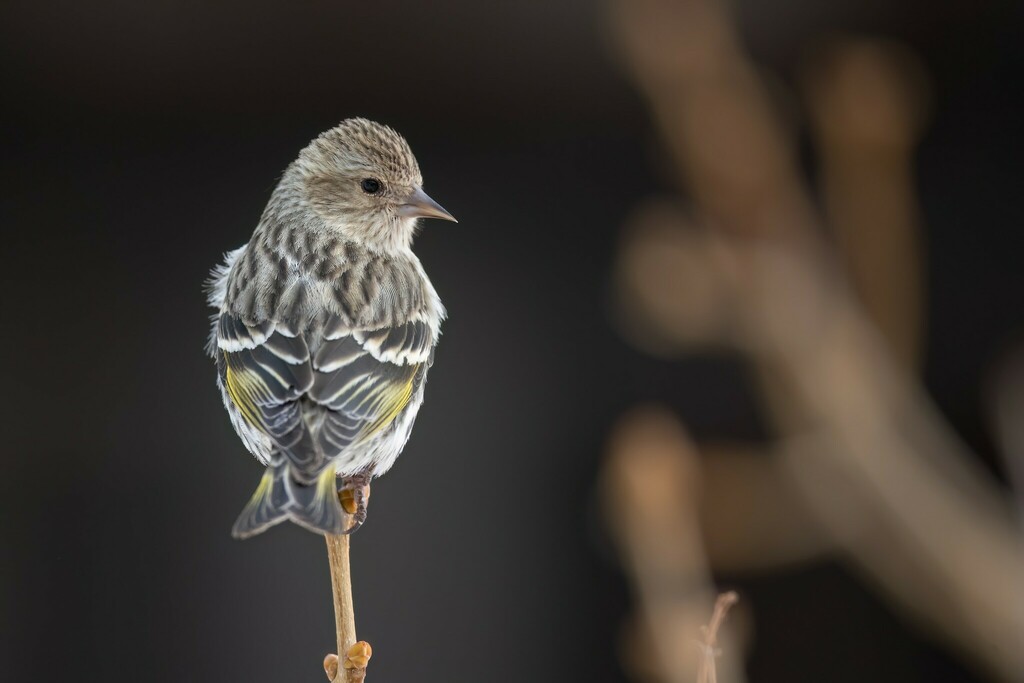
no rights reserved · CC0
Family: Fringillidae · Class: Aves · Order: Passeriformes
Spinus pinus (Pine Siskin) is a California animal in the Fringillidae family.
The Pine Siskin is a small, streaky finch measuring 11 to 14 centimeters (4.3 to 5.5 inches) in length with a wingspan of 18 to 22 centimeters (7.1 to 8.7 inches). Adults weigh 12 to 18 grams (0.4 to 0.6 ounces). The species displays brown and buff streaking throughout its plumage, with males showing bright yellow patches on the wings and tail that are particularly visible during flight. Females exhibit similar but more subdued coloration. The bill is thin and sharply pointed, adapted for extracting seeds from cones. Both sexes possess deeply notched tails and relatively short legs. Pine Siskins breed across the boreal forests of North America, with California populations primarily in the Sierra Nevada, Cascade Range, and coastal mountains. The species occurs at elevations from sea level to 3,050 meters (10,000 feet), though breeding typically occurs above 1,200 meters (4,000 feet). Winter distribution varies dramatically depending on food availability, with birds sometimes appearing in lowland areas throughout the state during irruptive years. The species inhabits coniferous and mixed forests, particularly those dominated by pines, spruces, firs, and hemlocks. Pine Siskins show strong preference for areas with abundant cone-producing trees and are commonly found in Douglas fir, ponderosa pine, and lodgepole pine forests. During winter, they expand into riparian woodlands, parks, and suburban areas with mature trees. The species requires trees for nesting and nearby water sources. Pine Siskins are highly gregarious outside the breeding season, forming flocks that may number in the hundreds. They feed primarily on small seeds from cones of conifers, particularly enjoying spruce, pine, fir, and hemlock seeds. The diet also includes seeds from deciduous trees such as alder and birch, plus insects during breeding season. Breeding occurs from April through August, with females constructing cup-shaped nests on horizontal branches 2 to 15 meters (6 to 50 feet) above ground. Clutch size ranges from 2 to 5 eggs, with incubation lasting 13 days. The species exhibits nomadic behavior, with populations moving unpredictably in response to seed crop failures. Pine Siskins are not federally or state listed as threatened or endangered. According to the North American Breeding Bird Survey, populations have experienced long-term decline of approximately 2.5 percent annually since 1970, though numbers fluctuate dramatically due to the species' irruptive nature. Climate change poses potential threats through altered precipitation patterns affecting cone production cycles. Forest management practices that reduce conifer diversity may impact local populations. The species benefits from maintenance of mature coniferous forests and diverse tree age classes that provide consistent seed sources across years.
Classification
Class: Aves · Order: Passeriformes · Family: Fringillidae
Frequently asked questions
How is Spinus pinus classified?
Spinus pinus belongs to class Aves, order Passeriformes, family Fringillidae.
What family does Spinus pinus belong to?
Spinus pinus is in the Fringillidae family.
What is Spinus pinus?
The Pine Siskin is a small, streaky finch measuring 11 to 14 centimeters (4.3 to 5.5 inches) in length with a wingspan of 18 to 22 centimeters (7.1 to 8.7 inches).
Is Spinus pinus found in California?
Yes. Spinus pinus is recorded in California in The California Species Project's catalogue.
Related species
Other California species in the same genus, family, or bioregion.
Data from The California Species Project — 14,000+ California species with verified data from CNPS, CDFW, USFWS, and more.