Spinus psaltria
Lesser Goldfinch
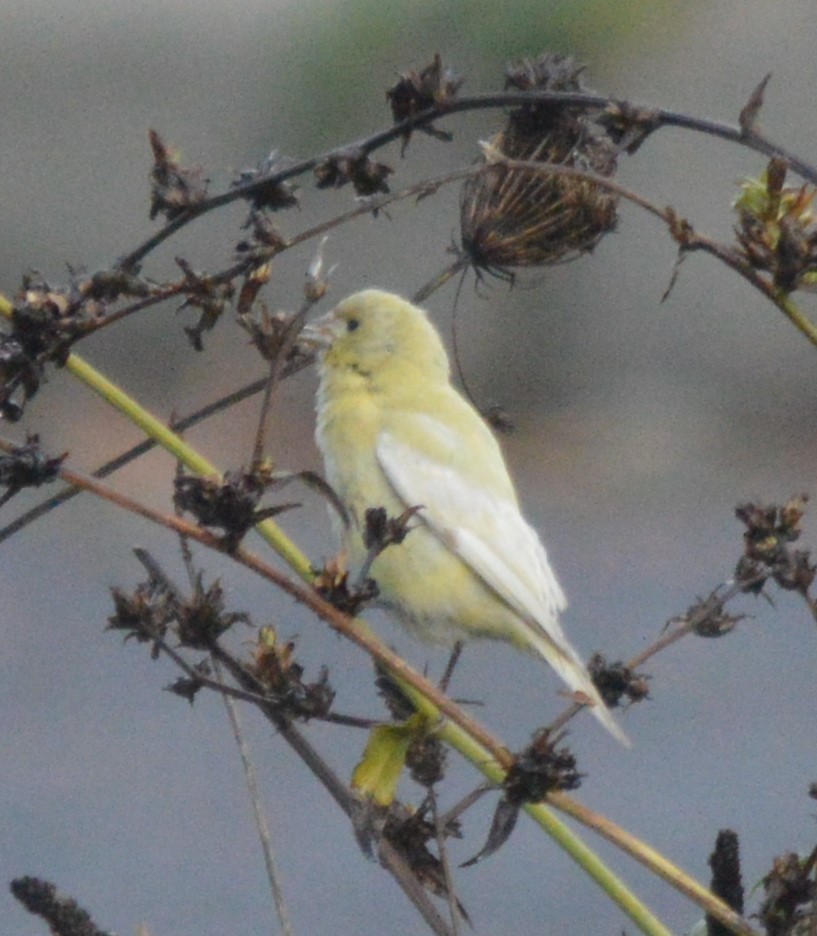
(c) David Anderson, some rights reserved (CC BY) · licence
Family: Fringillidae · Class: Aves · Order: Passeriformes
Spinus psaltria (Lesser Goldfinch) is a California animal in the Fringillidae family.
The Lesser Goldfinch is a small passerine bird measuring 10 to 11 centimeters (3.9 to 4.3 inches) in length with a wingspan of 15 to 20 centimeters (5.9 to 7.9 inches). Adult males display distinctive plumage variation, with eastern populations showing black caps and backs, while western populations exhibit greenish-black backs. Both forms have bright yellow underparts, white wing patches, and yellow wing bars. Females are olive-green above with yellowish underparts and lack the male's contrasting dark cap. The species has a small, pointed bill adapted for seed consumption. The Lesser Goldfinch ranges from the southwestern United States through Central America to northern South America. In California, the species occurs throughout most of the state except for the highest elevations of the Sierra Nevada and the most arid portions of the Mojave Desert. Populations are resident year-round in coastal and Central Valley regions, with some seasonal movement to lower elevations during winter months. The species has expanded its range northward over the past century, now breeding regularly in Oregon and Washington. This goldfinch inhabits diverse environments including riparian woodlands, oak savannas, suburban areas with trees, parks, and agricultural regions with scattered trees or shrubs. The species adapts well to human-modified landscapes and is commonly found in residential areas with bird feeders. Lesser Goldfinches occur from sea level to approximately 2,400 meters (7,900 feet) elevation, showing preference for areas with a mixture of trees for nesting and open spaces for foraging. Lesser Goldfinches are highly social outside the breeding season, forming flocks that may include hundreds of individuals. The species feeds primarily on seeds from composite plants, including sunflowers, thistles, and various weedy species. They also consume tree seeds, particularly those of cottonwoods, willows, and alders. Breeding occurs from April through September, with peak activity in late spring and early summer. Females construct cup-shaped nests in tree forks or shrubs, typically 1 to 10 meters above ground. Clutch size ranges from three to six eggs, with an incubation period of 12 to 13 days. Young fledge after 11 to 15 days, and pairs may produce multiple broods per season. The Lesser Goldfinch is not federally listed and maintains stable populations across most of its range. The species benefits from human activities that create edge habitats and provide supplemental food sources through bird feeding. According to the North American Breeding Bird Survey, populations have remained relatively stable with some regional increases over the past several decades. Climate change may benefit the species by expanding suitable habitat northward, though extreme drought conditions in some southwestern regions could pose localized challenges. The species' adaptability to urban and suburban environments suggests continued population stability in California.
Classification
Class: Aves · Order: Passeriformes · Family: Fringillidae
Frequently asked questions
How is Spinus psaltria classified?
Spinus psaltria belongs to class Aves, order Passeriformes, family Fringillidae.
What family does Spinus psaltria belong to?
Spinus psaltria is in the Fringillidae family.
What is Spinus psaltria?
The Lesser Goldfinch is a small passerine bird measuring 10 to 11 centimeters (3.9 to 4.3 inches) in length with a wingspan of 15 to 20 centimeters (5.9 to 7.9 inches).
Is Spinus psaltria found in California?
Yes. Spinus psaltria is recorded in California in The California Species Project's catalogue.
Related species
Other California species in the same genus, family, or bioregion.
Data from The California Species Project — 14,000+ California species with verified data from CNPS, CDFW, USFWS, and more.