Spinus tristis
American Goldfinch
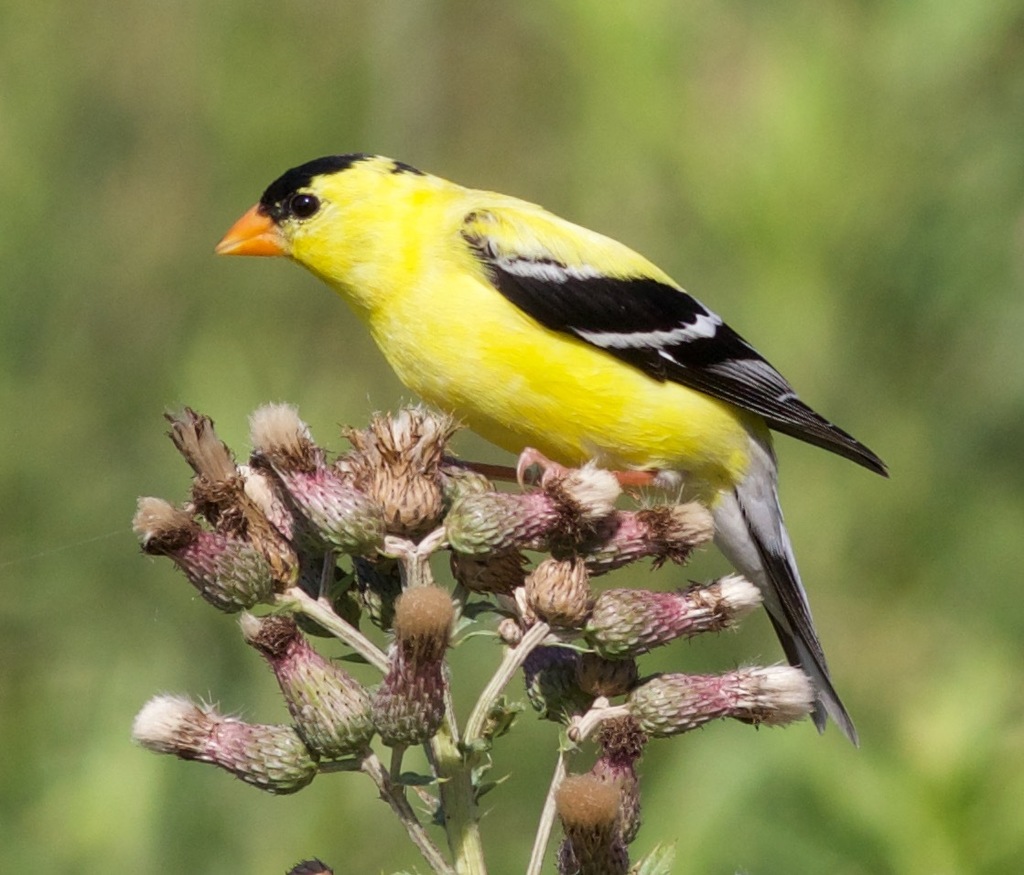
no rights reserved · CC0
Family: Fringillidae · Class: Aves · Order: Passeriformes
Spinus tristis (American Goldfinch) is a California animal in the Fringillidae family.
The American Goldfinch is a small songbird measuring 11 to 14 centimeters (4.3 to 5.5 inches) in length with a wingspan of 19 to 22 centimeters (7.5 to 8.7 inches). Adult males in breeding plumage display bright yellow bodies with black wings, tail, and forehead cap. Females and non-breeding males are olive-brown above with yellowish underparts. Both sexes have white wing bars and a notched tail. The species exhibits distinct seasonal plumage changes, with males molting to duller olive-brown coloration in winter that closely resembles female plumage year-round. The American Goldfinch ranges across most of North America from southern Canada to northern Mexico. In California, the species occurs statewide from sea level to approximately 2,400 meters (8,000 feet) elevation. Populations are resident in most areas but may exhibit seasonal movements from higher elevations during winter months. The species is common in both urban and rural environments throughout the state. American Goldfinches inhabit open woodlands, fields, meadows, gardens, parks, and riparian areas. They prefer edge habitats where trees and shrubs border open grasslands or agricultural areas. The species shows strong associations with areas containing composite flowers and seed-producing plants. Urban populations readily utilize parks, cemeteries, golf courses, and residential areas with appropriate vegetation. This species feeds almost exclusively on seeds, particularly favoring composites such as sunflowers, asters, and thistles. Their specialized diet includes seeds from conifers, deciduous trees, and various herbaceous plants. American Goldfinches have a distinctive undulating flight pattern accompanied by flight calls. They are highly social outside the breeding season, forming flocks that may contain hundreds of individuals during winter months. Breeding occurs later than most songbirds, typically from June through August, coinciding with peak seed availability. This timing allows parents to feed nestlings a diet rich in regurgitated seeds rather than insects. Females construct compact cup nests in shrubs or trees, usually 1 to 10 meters (3 to 33 feet) above ground. Clutch size ranges from 3 to 7 eggs, with incubation lasting 12 to 14 days. Young fledge after 11 to 15 days but continue to receive parental care for several weeks. The American Goldfinch is not federally listed and maintains stable populations across its range. According to the North American Breeding Bird Survey, populations have remained relatively stable over the past several decades, though some regional declines have been documented. The species benefits from human-modified landscapes that increase edge habitats and seed sources. Primary threats include habitat loss in some regions, pesticide use that reduces seed availability, and climate change effects on plant phenology. However, the species' adaptability to urban environments and diverse habitat types suggests continued population stability in California.
Classification
Class: Aves · Order: Passeriformes · Family: Fringillidae
Frequently asked questions
How is Spinus tristis classified?
Spinus tristis belongs to class Aves, order Passeriformes, family Fringillidae.
What family does Spinus tristis belong to?
Spinus tristis is in the Fringillidae family.
What is Spinus tristis?
The American Goldfinch is a small songbird measuring 11 to 14 centimeters (4.3 to 5.5 inches) in length with a wingspan of 19 to 22 centimeters (7.5 to 8.7 inches).
Is Spinus tristis found in California?
Yes. Spinus tristis is recorded in California in The California Species Project's catalogue.
Related species
Other California species in the same genus, family, or bioregion.
Data from The California Species Project — 14,000+ California species with verified data from CNPS, CDFW, USFWS, and more.