Spirinchus thaleichthys
Longfin smelt
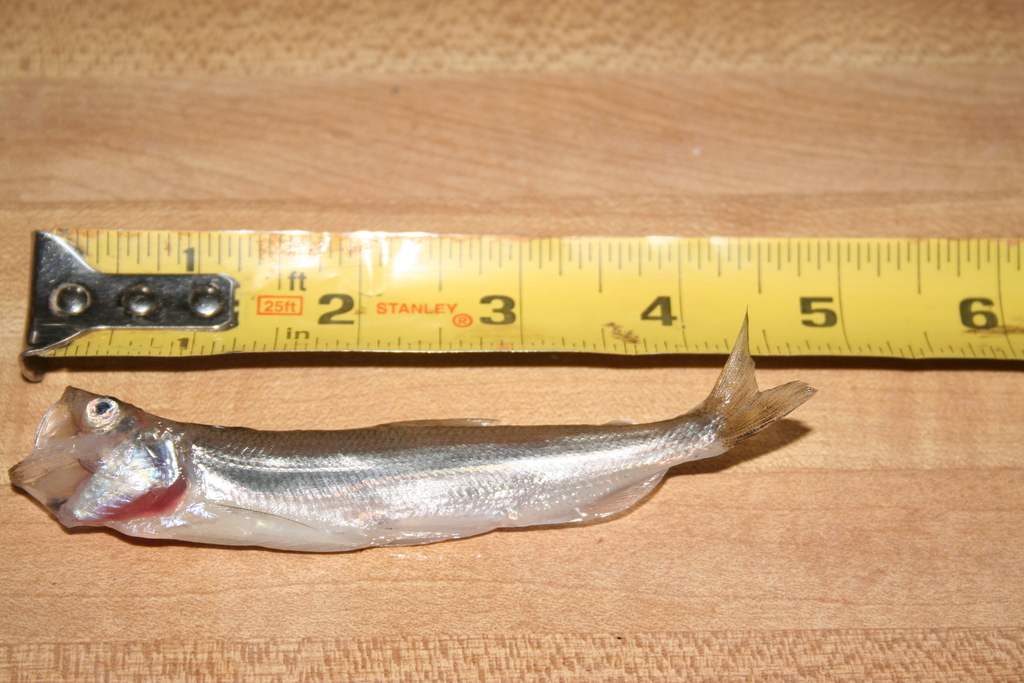
(c) Old Goat, some rights reserved (CC BY-SA) · licence
Family: Osmeridae · Class: Actinopterygii · Order: Osmeriformes
Conservation status: ST · Candidate · G5 S1
Spirinchus thaleichthys (Longfin smelt) is a California animal in the Osmeridae family.
The longfin smelt is a slender, anadromous fish native to the Pacific coast of North America. Adults typically measure 100 to 150 mm (4 to 6 inches) in total length, with a maximum recorded length of approximately 180 mm (7 inches). The body is elongate and somewhat compressed laterally, with a translucent to silvery appearance. The species is distinguished by its relatively long pectoral fins, which extend beyond the base of the pelvic fins when folded back against the body. The dorsal fin is positioned near the middle of the body, and adults possess a small adipose fin characteristic of the smelt family. During spawning season, males develop tubercles on their scales and fins. Longfin smelt historically ranged from southeast Alaska to central California, with populations in major estuarine systems including the Columbia River, San Francisco Bay, and numerous coastal streams. In California, the species occurs primarily in the San Francisco Bay-Delta system, extending from San Pablo Bay through Suisun Bay and into the Sacramento-San Joaquin Delta. The California population represents the southernmost extent of the species' range and has become geographically isolated from northern populations. The species inhabits estuarine and nearshore marine environments, typically in areas where fresh and salt water mix. Adults are found in waters with salinities ranging from 14 to 30 parts per thousand, though they can tolerate a broader salinity range. Longfin smelt prefer cooler water temperatures, generally below 20°C (68°F), and are often associated with areas of moderate to high turbidity. Spawning occurs in freshwater or low-salinity areas of rivers and tributaries. Longfin smelt are primarily planktivorous, feeding on copepods, mysid shrimp, amphipods, and other small crustaceans. The species exhibits an anadromous life cycle, spending most of its adult life in estuarine waters but migrating to freshwater areas to spawn. Spawning typically occurs from December through April, with peak activity during January and February. Females deposit adhesive eggs on vegetation, woody debris, or gravel substrates in shallow water. Most individuals are believed to spawn only once before dying, though some may survive to spawn a second time. The U.S. Fish and Wildlife Service designated longfin smelt as a candidate species under the Endangered Species Act as of December 2025, indicating that listing may be warranted but is precluded by higher priority actions. California lists the species as threatened. The San Francisco Bay-Delta population has experienced severe decline, with abundance indices from fish surveys showing precipitous drops since the 1980s. Primary threats include altered freshwater flows due to water diversions, entrainment in water export facilities, habitat degradation, climate change effects on water temperature and food webs, and predation by introduced species. Water management operations that affect estuarine salinity gradients and food production are considered critical factors in the species' decline.
Classification
Class: Actinopterygii · Order: Osmeriformes · Family: Osmeridae
Conservation status
ST · Candidate · G5 S1
Frequently asked questions
How is Spirinchus thaleichthys classified?
Spirinchus thaleichthys belongs to class Actinopterygii, order Osmeriformes, family Osmeridae.
What family does Spirinchus thaleichthys belong to?
Spirinchus thaleichthys is in the Osmeridae family.
Is Spirinchus thaleichthys protected or of conservation concern?
Spirinchus thaleichthys carries the following status: ST · Candidate · G5 S1.
What is Spirinchus thaleichthys?
The longfin smelt is a slender, anadromous fish native to the Pacific coast of North America.
Is Spirinchus thaleichthys found in California?
Yes. Spirinchus thaleichthys is recorded in California in The California Species Project's catalogue.
Related species
Other California species in the same genus, family, or bioregion.
Data from The California Species Project — 14,000+ California species with verified data from CNPS, CDFW, USFWS, and more.