Spirinchus thaleichthys pop. 2
Longfin smelt - San Francisco Bay-Delta DPS
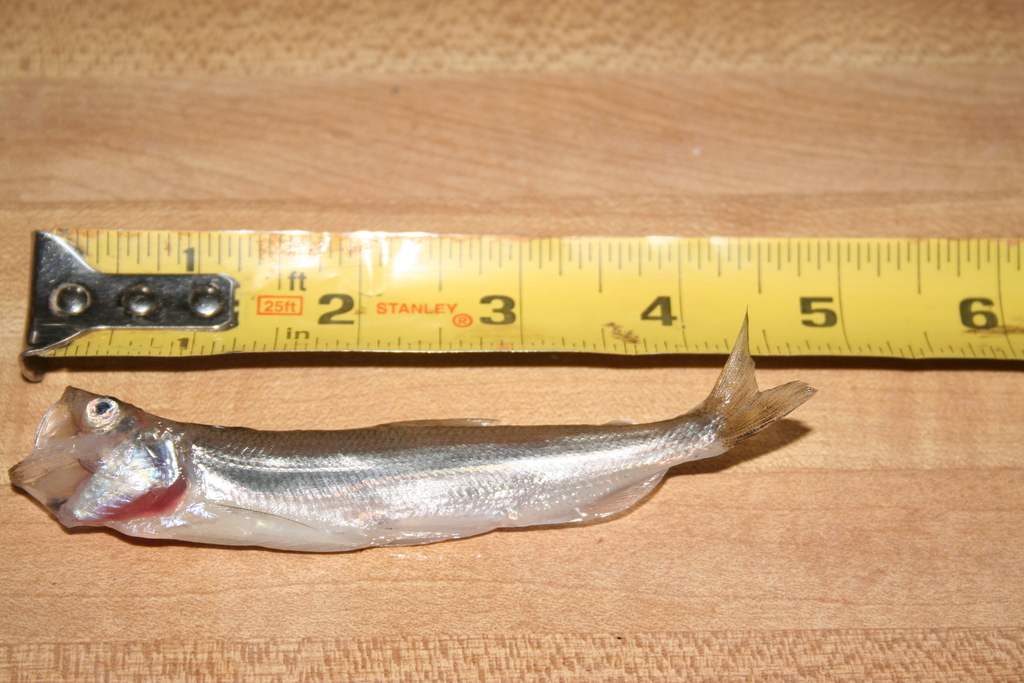
(c) Old Goat, some rights reserved (CC BY-SA) · licence
Family: Osmeridae · Class: Actinopterygii · Order: Osmeriformes
Conservation status: (ST) · Endangered · G5TNRQ S1
Spirinchus thaleichthys pop. 2 (Longfin smelt - San Francisco Bay-Delta DPS) is a California animal in the Osmeridae family.
The longfin smelt is a small anadromous fish belonging to the northern smelt family Osmeridae. Adults typically measure 10 to 20 cm (4 to 8 inches) in length, with characteristically long pectoral fins that extend past the start of the pelvic fins (USFWS 2022). The species displays weak or absent striations on their opercular bones, an incomplete lateral line, and 54 to 65 scales in the lateral series. Adults possess long maxillary bones that extend past the middle of the eye, and the lower jaw projects anterior to the upper jaw. The body is nearly translucent with a steely appearance typical of smelt species. The San Francisco Bay-Delta distinct population segment (DPS) represents the southernmost population of longfin smelt, restricted to the San Francisco Bay estuary and adjacent areas of the Pacific Ocean (USFWS 2024). This population was historically more widespread throughout the Sacramento-San Joaquin Delta system but has experienced severe range contraction. The Bay-Delta DPS is geographically isolated from northern populations, which range from Oregon to Alaska. Longfin smelt are euryhaline, inhabiting open-water channels and bays in salinities ranging from freshwater to seawater. They typically occupy middle or deeper parts of the water column in estuarine environments. The species requires specific salinity gradients for successful reproduction, with adults moving into freshwater or low-salinity areas to spawn. Spawning habitat includes shallow areas with appropriate substrate for egg deposition. The species exhibits a predominantly two-year life cycle and is anadromous, spending portions of their life in both marine and freshwater environments (CDFW 2009). Longfin smelt are opportunistic planktivores, feeding primarily on copepods, mysid shrimp, and other small crustaceans. Spawning typically occurs in winter and early spring months, with females depositing adhesive eggs in shallow water areas. Adults generally die after spawning, though some individuals may survive to spawn a second time. The San Francisco Bay-Delta DPS was listed as federally endangered in July 2024, effective August 29, 2024 (USFWS 2024). The population was previously listed as threatened under the California Endangered Species Act in 2009. Primary threats include altered hydrology from water diversions and dam operations, entrainment in water export facilities, invasive species, climate change effects, and habitat degradation. Population monitoring through fall midwater trawl surveys has documented severe declines, with recent surveys detecting extremely low numbers. The species faces ongoing pressure from reduced freshwater outflows, which alter the estuarine mixing zones critical for their survival. Water temperature increases associated with climate change pose additional challenges, as the species requires specific thermal conditions for successful reproduction and survival. Recovery efforts focus on habitat restoration, improved water management operations, and reduction of entrainment losses at water export facilities.
Classification
Class: Actinopterygii · Order: Osmeriformes · Family: Osmeridae
Conservation status
(ST) · Endangered · G5TNRQ S1
Frequently asked questions
How is Spirinchus thaleichthys pop. 2 classified?
Spirinchus thaleichthys pop. 2 belongs to class Actinopterygii, order Osmeriformes, family Osmeridae.
What family does Spirinchus thaleichthys pop. 2 belong to?
Spirinchus thaleichthys pop. 2 is in the Osmeridae family.
Is Spirinchus thaleichthys pop. 2 protected or of conservation concern?
Spirinchus thaleichthys pop. 2 carries the following status: (ST) · Endangered · G5TNRQ S1.
What is Spirinchus thaleichthys pop. 2?
The longfin smelt is a small anadromous fish belonging to the northern smelt family Osmeridae.
Is Spirinchus thaleichthys pop. 2 found in California?
Yes. Spirinchus thaleichthys pop. 2 is recorded in California in The California Species Project's catalogue.
Related species
Other California species in the same genus, family, or bioregion.
Data from The California Species Project — 14,000+ California species with verified data from CNPS, CDFW, USFWS, and more.