Spiza americana
Dickcissel
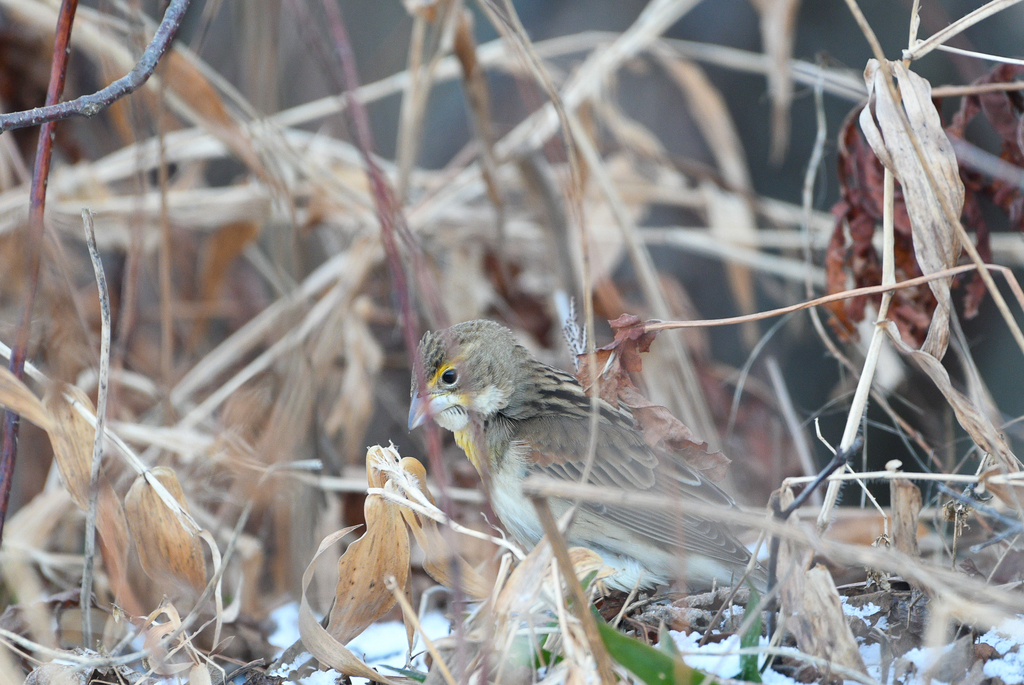
(c) Richard Littauer, some rights reserved (CC BY) · licence
Family: Cardinalidae · Class: Aves · Order: Passeriformes
Spiza americana (Dickcissel) is a California animal in the Cardinalidae family.
The Dickcissel is a medium-sized songbird measuring 14 to 16 centimeters (5.5 to 6.3 inches) in length with a wingspan of 24 to 26 centimeters (9.4 to 10.2 inches). Adult males in breeding plumage display a distinctive yellow breast with a prominent black V-shaped bib extending from the throat to the upper breast. The head shows a gray crown with a bright yellow supercilium above the eye, while the back appears streaked brown and buff. Females and non-breeding males lack the black bib and show more subdued coloration with streaked brown upperparts, pale underparts with some yellow wash on the breast, and a less pronounced facial pattern. Both sexes have a thick, seed-cracking bill typical of their cardinal family membership. Historically, Dickcissels bred across the Great Plains from southern Canada to Texas and east to the Atlantic Coast. Their range has contracted significantly since the 19th century, with populations now concentrated in the central Great Plains from Nebraska and Iowa south through Kansas, Oklahoma, and eastern Texas. In California, Dickcissels occur primarily as vagrant visitors, with most records from fall migration periods along the coast and in desert regions. The species has been documented in scattered locations throughout the state, though occurrences remain irregular and unpredictable. Dickcissels inhabit open grasslands, prairies, agricultural areas, and weedy fields during the breeding season. They show preference for areas with scattered shrubs or fence posts that serve as singing perches for males. The species utilizes both native grasslands and cultivated areas including alfalfa fields, wheat fields, and other grain crops. During winter, they congregate in vast flocks in agricultural regions of northern South America, particularly Venezuela's llanos. This species exhibits polygynous breeding behavior, with males establishing territories and attracting multiple females through persistent singing from elevated perches. Females construct cup-shaped nests on or near the ground in dense vegetation, typically laying 3 to 5 pale blue eggs with dark spotting. The breeding season extends from May through August, with some pairs producing multiple broods. Dickcissels feed primarily on seeds during most of the year but consume insects extensively during breeding season to meet protein demands for reproduction and feeding young. Their diet includes grasshoppers, beetles, caterpillars, and other arthropods. The Dickcissel is not federally listed but has experienced significant population declines and range contractions over the past century. North American Breeding Bird Survey data indicates population decreases of approximately 64 percent between 1966 and 2019. Primary threats include habitat loss from conversion of grasslands to intensive agriculture, pesticide use in both breeding and wintering areas, and collision mortality during migration. Conservation efforts focus on grassland preservation through programs like the Conservation Reserve Program and sustainable agricultural practices that maintain habitat connectivity across the species' range.
Classification
Class: Aves · Order: Passeriformes · Family: Cardinalidae
Frequently asked questions
How is Spiza americana classified?
Spiza americana belongs to class Aves, order Passeriformes, family Cardinalidae.
What family does Spiza americana belong to?
Spiza americana is in the Cardinalidae family.
What is Spiza americana?
The Dickcissel is a medium-sized songbird measuring 14 to 16 centimeters (5.5 to 6.3 inches) in length with a wingspan of 24 to 26 centimeters (9.4 to 10.2 inches).
Is Spiza americana found in California?
Yes. Spiza americana is recorded in California in The California Species Project's catalogue.
Related species
Other California species in the same genus, family, or bioregion.
Data from The California Species Project — 14,000+ California species with verified data from CNPS, CDFW, USFWS, and more.