Spizella breweri
Brewer's Sparrow
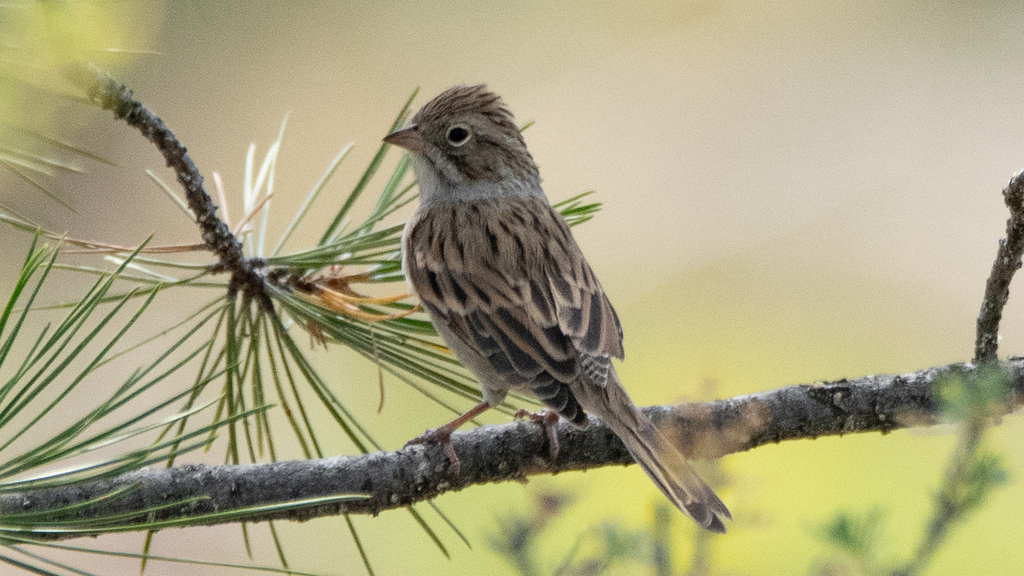
(c) Casey H. Richart, some rights reserved (CC BY) · licence
Family: Passerellidae · Class: Aves · Order: Passeriformes
Conservation status: G5 S4
Spizella breweri (Brewer's Sparrow) is a California animal in the Passerellidae family.
Brewer's Sparrow is a small, pale gray-brown passerine measuring 11.5 to 14 cm (4.5 to 5.5 inches) in length with a wingspan of 18 to 20 cm (7.1 to 7.9 inches). Adults weigh 8 to 13 grams. The species exhibits subtle plumage with a finely streaked brown crown, pale supercilium, and grayish-brown upperparts with darker streaking. The underparts are pale grayish-white with minimal streaking on the breast. The bill is small and conical, pale pink to horn-colored. The tail is relatively long and notched. Breeding adults show slightly more contrasted plumage than non-breeding birds. Juveniles display more pronounced streaking on the breast and flanks. Brewer's Sparrow breeds across the western United States and southwestern Canada, with its range extending from British Columbia and Alberta south through the Great Basin and intermountain regions to northern Arizona and New Mexico. In California, the species breeds primarily in the northeastern counties, including Modoc, Lassen, Siskiyou, and portions of Shasta and Plumas counties. During migration and winter, populations move south to southwestern United States and northwestern Mexico, with some individuals remaining in southern California deserts. The species inhabits shrubsteppe environments dominated by sagebrush, particularly big sagebrush (Artemisia tridentata) communities. Breeding habitat typically occurs at elevations between 1,200 and 3,000 meters (3,900 to 9,800 feet) in areas with 10 to 40 percent shrub cover interspersed with open spaces. The species prefers mature shrub stands with adequate spacing for foraging and nesting. During winter, Brewer's Sparrows occupy desert scrub habitats, grasslands with scattered shrubs, and agricultural areas. Brewer's Sparrows are primarily insectivorous during the breeding season, consuming beetles, caterpillars, ants, and other arthropods. Diet shifts to include more seeds during fall and winter months, particularly from grasses and forbs. The species forages both on the ground and in shrub canopies, often gleaning insects from foliage. Breeding occurs from April through July, with females constructing cup-shaped nests of grasses and twigs placed 0.3 to 1.5 meters above ground in shrub branches. Clutch size ranges from 3 to 5 eggs, with incubation lasting 11 to 13 days. Young fledge after 8 to 9 days. The species typically produces one to two broods per season. Brewer's Sparrow maintains a stable global population with a G5 ranking, indicating the species is secure overall. In California, the species receives an S4 ranking, suggesting it is apparently secure at the state level but may have some cause for long-term concern. The primary conservation threat is habitat loss and degradation through conversion of sagebrush ecosystems to agriculture, urban development, and altered fire regimes. Grazing practices that reduce shrub cover and invasive plant species, particularly cheatgrass (Bromus tectorum), also impact habitat quality. Climate change may affect the species through shifts in precipitation patterns and temperature regimes that influence sagebrush ecosystem dynamics.
Classification
Class: Aves · Order: Passeriformes · Family: Passerellidae
Conservation status
G5 S4
Frequently asked questions
How is Spizella breweri classified?
Spizella breweri belongs to class Aves, order Passeriformes, family Passerellidae.
What family does Spizella breweri belong to?
Spizella breweri is in the Passerellidae family.
Is Spizella breweri protected or of conservation concern?
Spizella breweri carries the following status: G5 S4.
What is Spizella breweri?
Brewer's Sparrow is a small, pale gray-brown passerine measuring 11.5 to 14 cm (4.5 to 5.5 inches) in length with a wingspan of 18 to 20 cm (7.1 to 7.9 inches).
Is Spizella breweri found in California?
Yes. Spizella breweri is recorded in California in The California Species Project's catalogue.
Related species
Other California species in the same genus, family, or bioregion.
Data from The California Species Project — 14,000+ California species with verified data from CNPS, CDFW, USFWS, and more.