Spizella pallida
Clay-colored Sparrow
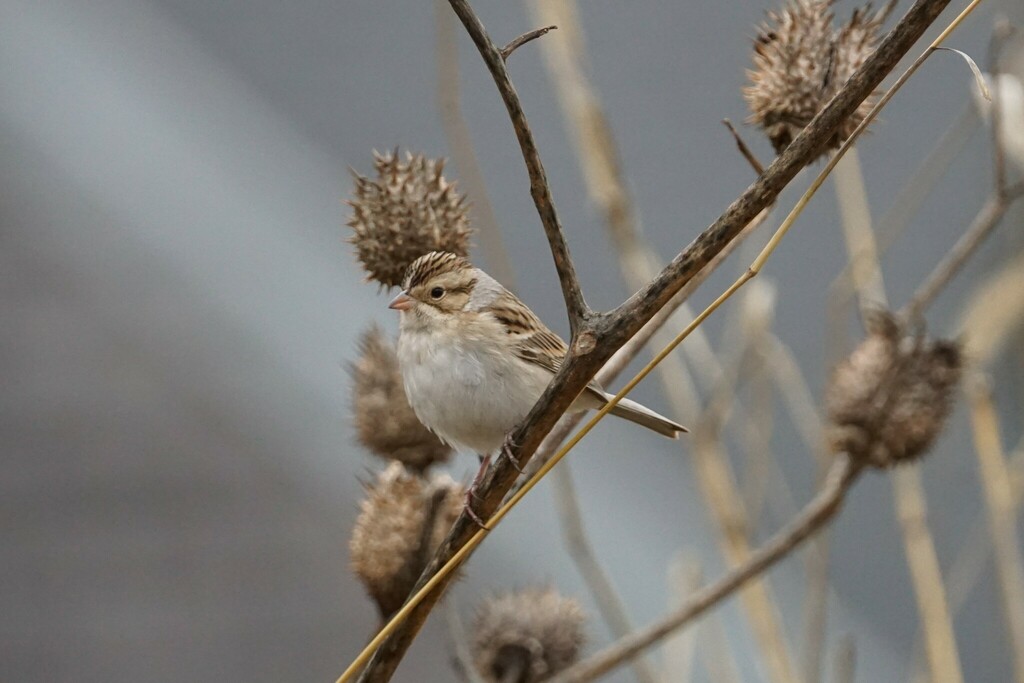
(c) Matt Pelikan, some rights reserved (CC BY) · licence
Family: Passerellidae · Class: Aves · Order: Passeriformes
Spizella pallida (Clay-colored Sparrow) is a California animal in the Passerellidae family.
The Clay-colored Sparrow is a small passerine bird measuring 12-14 cm (4.7-5.5 inches) in length with a wingspan of 18-20 cm (7-8 inches). Adults weigh 10-12 grams. The species exhibits subtle but distinctive plumage features, with brown and buff striped upperparts and a pale gray-buff breast and belly. The head pattern is particularly diagnostic, featuring a prominent pale central crown stripe bordered by dark lateral crown stripes, a pale supercilium, and a dark eye line. The nape displays a distinctive gray patch, contrasting with the brown back. The bill is pale pink to yellowish, and the legs are flesh-colored to pale brown. Historically, Clay-colored Sparrows bred primarily in the Great Plains and prairie provinces of North America, with their range extending from southern Canada through the central United States. In California, the species occurs as an uncommon migrant and winter visitor, primarily in the southeastern desert regions and occasionally along the coast. Sightings are most frequent in the Mojave and Sonoran desert areas, including Imperial, Riverside, and San Bernardino counties. The species typically appears in California from late August through April, with peak migration occurring in September and October. During migration and winter in California, Clay-colored Sparrows inhabit open grasslands, agricultural fields, desert scrub, and brushy areas with scattered trees or shrubs. They show preference for areas with mixed vegetation structure, including weedy fields, fallow agricultural land, and desert washes with dense undergrowth. The species often associates with other sparrow species in mixed foraging flocks, particularly Brewer's Sparrows and Chipping Sparrows. Clay-colored Sparrows are primarily granivorous, feeding on small seeds from grasses and forbs. Their diet includes seeds from various plant families, supplemented by small insects during the breeding season. Foraging behavior involves gleaning seeds from the ground and low vegetation, often scratching through leaf litter and using a distinctive double-scratch technique. The species exhibits typical sparrow social behavior, forming loose flocks during migration and winter. Breeding occurs outside California in their northern range, where females construct cup nests in low shrubs and lay 3-5 pale blue-green eggs with brown markings. The Clay-colored Sparrow is not federally or state-listed in California and maintains stable populations across its continental range. According to the North American Breeding Bird Survey, populations have remained relatively stable over the past several decades, though with some regional variations. In California, the species faces typical threats associated with habitat loss from agricultural intensification and urban development in wintering areas. Climate change may affect migration timing and wintering distribution patterns. The species benefits from conservation programs that maintain grassland and shrubland habitats, including the Conservation Reserve Program in agricultural regions.
Classification
Class: Aves · Order: Passeriformes · Family: Passerellidae
Frequently asked questions
How is Spizella pallida classified?
Spizella pallida belongs to class Aves, order Passeriformes, family Passerellidae.
What family does Spizella pallida belong to?
Spizella pallida is in the Passerellidae family.
What is Spizella pallida?
The Clay-colored Sparrow is a small passerine bird measuring 12-14 cm (4.7-5.5 inches) in length with a wingspan of 18-20 cm (7-8 inches).
Is Spizella pallida found in California?
Yes. Spizella pallida is recorded in California in The California Species Project's catalogue.
Related species
Other California species in the same genus, family, or bioregion.
Data from The California Species Project — 14,000+ California species with verified data from CNPS, CDFW, USFWS, and more.