Spizella passerina
Chipping Sparrow
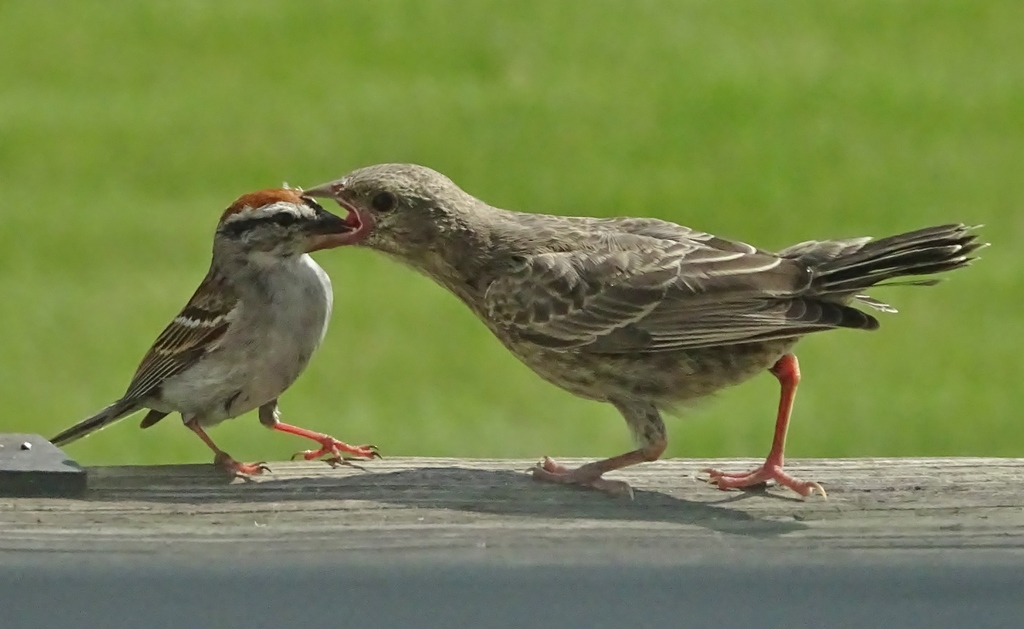
(c) Shirley Zundell, some rights reserved (CC BY) · licence
Family: Passerellidae · Class: Aves · Order: Passeriformes
Spizella passerina (Chipping Sparrow) is a California animal in the Passerellidae family.
The Chipping Sparrow is a small, slender songbird measuring 12 to 14 centimeters (4.7 to 5.5 inches) in length with a wingspan of 18 to 23 centimeters (7.1 to 9.1 inches). Adults weigh 11 to 16 grams (0.4 to 0.6 ounces). Breeding adults display a distinctive rufous crown, white eyebrow stripe, and black eye line extending from the bill through the eye. The back is brown with darker streaks, while the underparts are pale gray to white. Non-breeding adults and juveniles show a browner crown with fine streaking and less distinct facial markings. The bill is dark during breeding season and pale yellow-orange in winter. Chipping Sparrows breed across much of North America from southern Canada to Nicaragua. In California, they occur as year-round residents in suitable habitat throughout most of the state, with breeding populations found from sea level to approximately 3,200 meters (10,500 feet) elevation. The species is absent from the Central Valley floor and southeastern desert regions during breeding season. Northern populations migrate south for winter, with California hosting both resident and migrant populations from October through March. The species inhabits open woodlands, forest edges, parks, and suburban areas with scattered trees. Preferred breeding habitat includes coniferous and mixed forests, particularly areas with Douglas fir, pine, and oak woodlands. They favor locations with short grass or bare ground for foraging beneath a canopy of mature trees. In urban environments, they utilize parks, golf courses, and residential areas with ornamental conifers. During winter, flocks may be found in weedy fields, brush, and areas with seed-producing plants. Chipping Sparrows are primarily granivorous, feeding on grass seeds, forb seeds, and occasionally insects during breeding season. They forage on the ground using a characteristic double-scratch technique, jumping forward and raking backward with both feet. Breeding occurs from April through August, with peak nesting in May and June. Females construct cup-shaped nests 1 to 4 meters (3 to 13 feet) above ground in dense foliage of conifers or shrubs. Clutches typically contain 3 to 4 pale blue eggs with dark markings. Incubation lasts 11 to 14 days, and nestlings fledge after 9 to 12 days. Pairs commonly produce two broods per season in favorable conditions. The Chipping Sparrow is not federally or state listed and maintains stable populations across most of its range. According to the North American Breeding Bird Survey, populations have remained relatively stable since 1966, with some regional variations. The species benefits from edge habitats created by forest management practices but may be negatively affected by intensive urbanization and loss of open understory in forests. Climate change could potentially shift suitable habitat ranges northward and to higher elevations, though current populations appear resilient to environmental changes.
Classification
Class: Aves · Order: Passeriformes · Family: Passerellidae
Frequently asked questions
How is Spizella passerina classified?
Spizella passerina belongs to class Aves, order Passeriformes, family Passerellidae.
What family does Spizella passerina belong to?
Spizella passerina is in the Passerellidae family.
What is Spizella passerina?
The Chipping Sparrow is a small, slender songbird measuring 12 to 14 centimeters (4.7 to 5.5 inches) in length with a wingspan of 18 to 23 centimeters (7.1 to 9.1 inches).
Is Spizella passerina found in California?
Yes. Spizella passerina is recorded in California in The California Species Project's catalogue.
Related species
Other California species in the same genus, family, or bioregion.
Data from The California Species Project — 14,000+ California species with verified data from CNPS, CDFW, USFWS, and more.