Spizelloides arborea
American Tree Sparrow
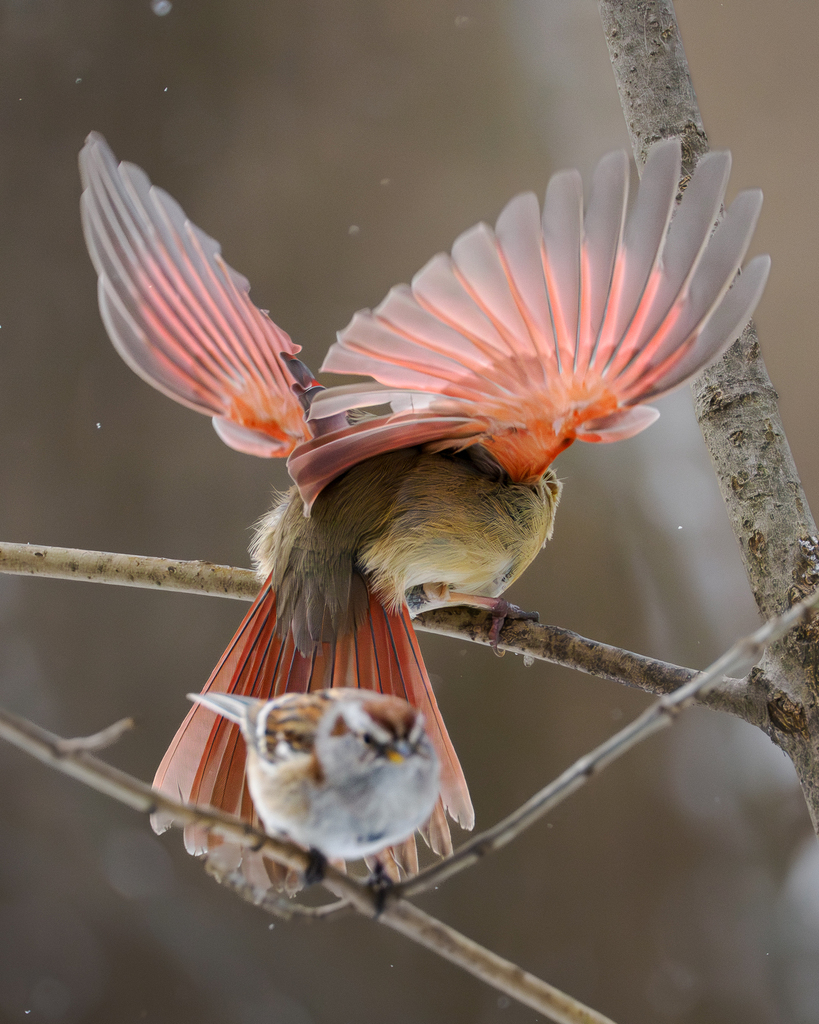
(c) Michael, some rights reserved (CC BY) · licence
Family: Passerellidae · Class: Aves · Order: Passeriformes
Spizelloides arborea (American Tree Sparrow) is a California animal in the Passerellidae family.
The American Tree Sparrow is a medium-sized sparrow measuring 13 to 16 cm (5.1 to 6.3 inches) in length with a wingspan of 19 to 23 cm (7.5 to 9.1 inches). Adults weigh 13 to 20 grams. The species displays a distinctive rufous crown and ear patch, contrasting with a gray face and nape. The upperparts are streaked brown and black, while the underparts are pale gray with a prominent dark spot on the breast. The bill is dark above and yellow below, and the legs are yellowish-brown. Males and females appear similar, though males may show slightly brighter coloration during breeding season. The American Tree Sparrow breeds across the arctic and subarctic regions of Alaska and northern Canada, from treeline north to the edge of the tundra. During winter, the species migrates south across much of the northern and central United States. In California, American Tree Sparrows are irregular winter visitors, primarily occurring in the northeastern counties including Modoc, Lassen, and Siskiyou. They are typically found from October through March, with peak abundance in December and January. Winter habitat in California consists of open areas with scattered trees and shrubs, including agricultural fields, weedy lots, brushy areas, and woodland edges. The species shows preference for areas with seed-producing plants and nearby cover for roosting and protection. During breeding season, they inhabit the transition zone between boreal forest and tundra, nesting in low shrubs such as willow and birch. American Tree Sparrows are primarily granivorous, feeding on seeds of grasses, sedges, and forbs. During winter, they form loose flocks of 10 to 50 individuals, often mixing with other sparrow species. The birds forage on the ground using a distinctive double-scratch technique, hopping forward and then scratching backward with both feet simultaneously. Breeding occurs from May through July in arctic regions, with females constructing cup-shaped nests in low shrubs or on the ground. Clutch size ranges from 3 to 6 eggs, with an incubation period of 11 to 13 days. The American Tree Sparrow is not federally or state-listed in California, reflecting its stable continental population. According to the North American Breeding Bird Survey, populations have remained relatively stable over the past several decades, with some regional variation. Climate change poses potential long-term threats through shifts in arctic breeding habitat and altered migration timing. The species benefits from agricultural practices that maintain weedy field edges and from conservation programs that preserve grassland and shrubland habitats. Winter populations in California may fluctuate based on food availability and weather patterns in northern breeding and staging areas.
Classification
Class: Aves · Order: Passeriformes · Family: Passerellidae
Frequently asked questions
How is Spizelloides arborea classified?
Spizelloides arborea belongs to class Aves, order Passeriformes, family Passerellidae.
What family does Spizelloides arborea belong to?
Spizelloides arborea is in the Passerellidae family.
What is Spizelloides arborea?
The American Tree Sparrow is a medium-sized sparrow measuring 13 to 16 cm (5.1 to 6.3 inches) in length with a wingspan of 19 to 23 cm (7.5 to 9.1 inches).
Is Spizelloides arborea found in California?
Yes. Spizelloides arborea is recorded in California in The California Species Project's catalogue.
Related species
Other California species in the same genus, family, or bioregion.
Data from The California Species Project — 14,000+ California species with verified data from CNPS, CDFW, USFWS, and more.