Spodoptera frugiperda
Fall Armyworm Moth
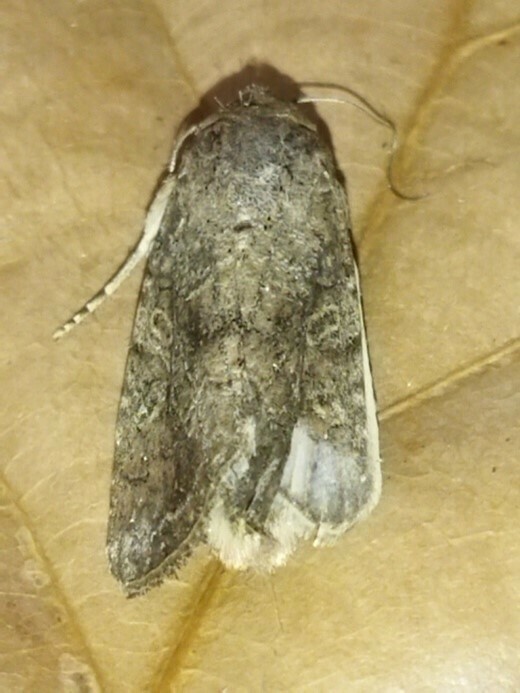
(c) SteveM4560, some rights reserved (CC BY) · licence
Family: Noctuidae · Class: Insecta · Order: Lepidoptera
Spodoptera frugiperda (Fall Armyworm Moth) is a California animal in the Noctuidae family.
The fall armyworm moth (Spodoptera frugiperda) is a medium-sized noctuid moth with forewings measuring 14-17 mm in length and a wingspan of 32-40 mm. Adults display sexual dimorphism in wing coloration. Males have forewings with a mottled brown and gray pattern featuring distinct pale and dark markings, including characteristic white spots near the wing tips. Females typically show more uniform grayish-brown forewings with less prominent markings. The hindwings of both sexes are pale white to light gray with darker marginal bands. At rest, the moth holds its wings in a triangular tent-like position over the body. Native to tropical and subtropical regions of the Americas, the fall armyworm moth ranges from Argentina northward through Central America, the Caribbean, and into the southern United States. The species is a strong migrant that cannot survive freezing temperatures, but populations expand northward each spring and summer. In North America, permanent breeding populations exist from southern Texas through Florida, with seasonal migrations extending into Canada. The species has become a significant invasive pest in Africa, Asia, and Australia since 2016. Fall armyworm moths inhabit agricultural areas, grasslands, and disturbed habitats from sea level to elevations of approximately 1,000 meters. Adults are most active during warm, humid evenings and are attracted to artificial lights. The species thrives in areas with abundant host plants and can complete multiple generations per year in favorable climates. Larvae develop in a wide range of grasses and crops, with over 350 recorded host plants. Adult moths are primarily nocturnal, feeding on nectar from various flowering plants. Mating occurs during evening hours, with females releasing pheromones to attract males. After mating, females deposit eggs in masses of 100-300 on host plant leaves, covering them with scales and hair from their abdomen. Eggs hatch in 2-3 days under optimal conditions. The larval stage consists of six instars over 14-22 days, during which caterpillars feed voraciously on host plants. Pupation occurs in soil chambers 2-8 cm deep. The complete life cycle from egg to adult requires 24-35 days at temperatures of 25-30°C. The fall armyworm is considered one of the most destructive agricultural pests globally, causing billions of dollars in crop damage annually. Primary host plants include corn, rice, sorghum, sugarcane, cotton, and various pasture grasses. Larvae are particularly damaging during their later instars, when they can consume entire leaves and growing points of plants. The species' high reproductive rate, mobility, and broad host range make it extremely difficult to control. Management strategies include integrated pest management approaches combining biological control agents, pheromone traps, resistant crop varieties, and selective pesticide applications. Climate change may expand the species' range and increase generation numbers in temperate regions.
Classification
Class: Insecta · Order: Lepidoptera · Family: Noctuidae
Frequently asked questions
How is Spodoptera frugiperda classified?
Spodoptera frugiperda belongs to class Insecta, order Lepidoptera, family Noctuidae.
What family does Spodoptera frugiperda belong to?
Spodoptera frugiperda is in the Noctuidae family.
What is Spodoptera frugiperda?
The fall armyworm moth (Spodoptera frugiperda) is a medium-sized noctuid moth with forewings measuring 14-17 mm in length and a wingspan of 32-40 mm.
Is Spodoptera frugiperda found in California?
Yes. Spodoptera frugiperda is recorded in California in The California Species Project's catalogue.
Related species
Other California species in the same genus, family, or bioregion.
Data from The California Species Project — 14,000+ California species with verified data from CNPS, CDFW, USFWS, and more.