Spodoptera praefica
Western Yellowstriped Armyworm
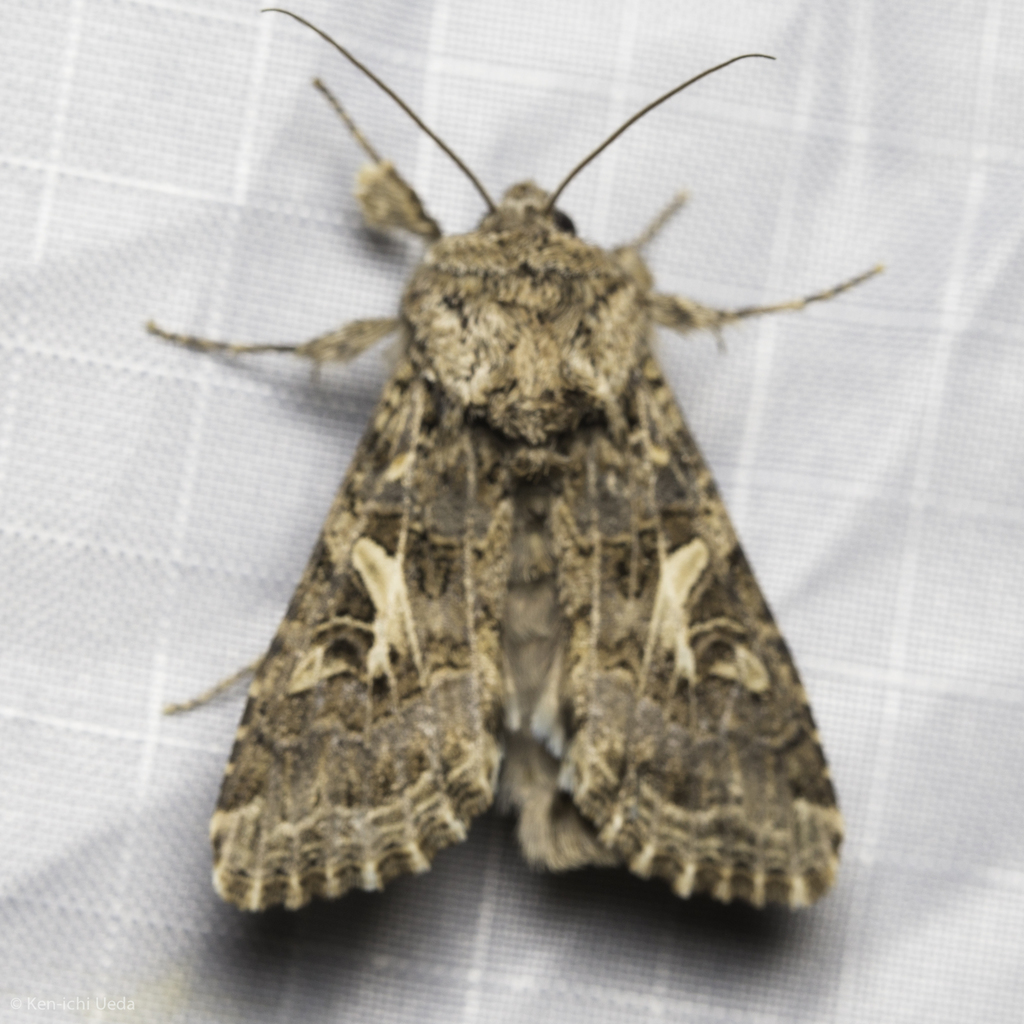
(c) Ken-ichi Ueda, some rights reserved (CC BY) · licence
Family: Noctuidae · Class: Insecta · Order: Lepidoptera
Spodoptera praefica (Western Yellowstriped Armyworm) is a California animal in the Noctuidae family.
The Western Yellowstriped Armyworm (Spodoptera praefica) is a noctuid moth species whose larvae are significant agricultural pests across western North America. Adult moths have a wingspan of 32 to 40 mm (1.3 to 1.6 inches), with forewings displaying brown to grayish-brown coloration marked by darker lines and spots. The hindwings are pale gray to white with darker marginal bands. Adult females are typically larger than males and can be distinguished by their broader, less feathery antennae. The species ranges from British Columbia south to California, extending eastward to Utah and northward to Alberta. This distribution encompasses much of the western United States and southwestern Canada, with populations occurring from sea level to elevations of approximately 1,500 meters (4,920 feet). The species is particularly common in agricultural regions of the Central Valley of California, the Columbia River Basin, and irrigated areas throughout its range. Western Yellowstriped Armyworm larvae feed on leaves of numerous crop plants including alfalfa, potato, rice, sugarbeet, and sweet potato, as well as various herbaceous plants. Adults are attracted to irrigated agricultural areas and disturbed habitats where host plants are abundant. The species thrives in areas with mild temperatures and adequate moisture, making irrigated farmland ideal habitat. Larvae prefer young, tender plant growth and can cause significant defoliation when populations are high. The species exhibits multivoltine behavior, producing two to four generations annually depending on climate conditions. Adults are nocturnal and most active during warm evenings from spring through fall. Mating typically occurs shortly after emergence, with females depositing eggs in masses of 100 to 300 on host plant foliage. Eggs are pale yellow initially, darkening before hatching in 3 to 5 days. Larvae undergo six instars over 3 to 4 weeks, reaching lengths of 35 to 40 mm (1.4 to 1.6 inches) when mature. The characteristic yellow stripe along each side of the larval body gives the species its common name. Pupation occurs in soil chambers 2 to 5 cm below the surface. Larvae are polyphagous feeders that can cause extensive crop damage through defoliation. Young larvae feed gregariously on leaf undersides, while older instars become more solitary and consume entire leaves. Economic damage is most severe on leafy crops like alfalfa and vegetables, where larvae can reduce yields substantially during outbreak years. The Western Yellowstriped Armyworm is not listed under state or federal conservation legislation and is not considered threatened or endangered. As an agricultural pest species, management focuses on population control rather than conservation. The species benefits from agricultural practices that provide abundant host plants and disturbed habitats. Climate change may potentially expand its range northward and increase the number of annual generations in some areas, though specific population trends have not been systematically monitored for conservation purposes.
Classification
Class: Insecta · Order: Lepidoptera · Family: Noctuidae
Frequently asked questions
How is Spodoptera praefica classified?
Spodoptera praefica belongs to class Insecta, order Lepidoptera, family Noctuidae.
What family does Spodoptera praefica belong to?
Spodoptera praefica is in the Noctuidae family.
What is Spodoptera praefica?
The Western Yellowstriped Armyworm (Spodoptera praefica) is a noctuid moth species whose larvae are significant agricultural pests across western North America.
Is Spodoptera praefica found in California?
Yes. Spodoptera praefica is recorded in California in The California Species Project's catalogue.
Related species
Other California species in the same genus, family, or bioregion.
Data from The California Species Project — 14,000+ California species with verified data from CNPS, CDFW, USFWS, and more.