Spoladea recurvalis
Hawaiian Beet Webworm
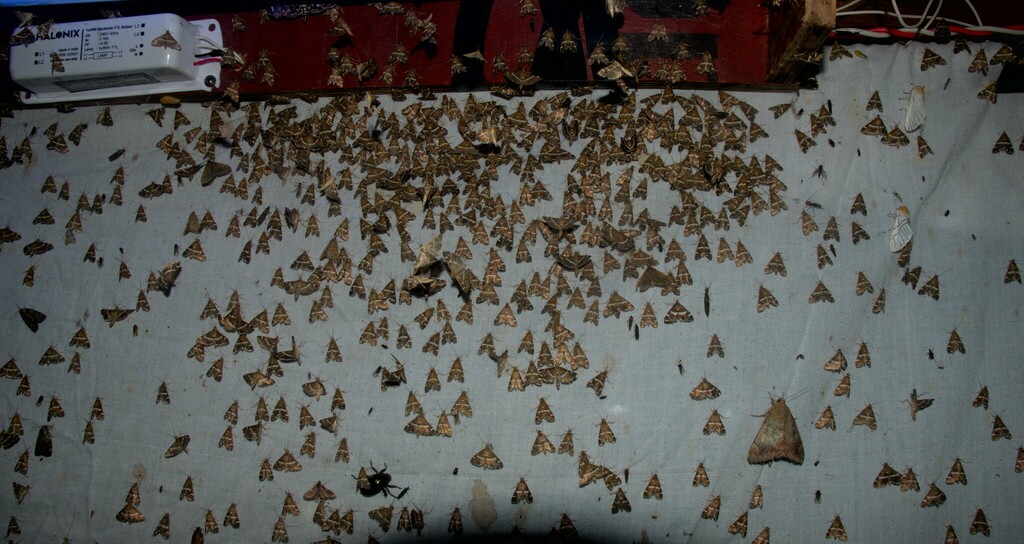
(c) Ramnarayan K, some rights reserved (CC BY) · licence
Family: Crambidae · Class: Insecta · Order: Lepidoptera
Spoladea recurvalis (Hawaiian Beet Webworm) is a California animal in the Crambidae family.
The Hawaiian Beet Webworm (Spoladea recurvalis) is a small moth in the family Crambidae with a wingspan typically ranging from 18 to 25 mm. The forewings are pale brown to grayish-brown with distinctive wavy dark lines and pale yellow or whitish markings. The hindwings are lighter, often whitish or pale gray with darker marginal areas. At rest, the wings are held in a triangular position over the body, characteristic of many crambid moths. The larvae are pale green to yellowish-green caterpillars measuring 15 to 20 mm when fully grown, with a dark head capsule and faint longitudinal stripes along the body. Spoladea recurvalis has an extensive distribution across North America, occurring from Ontario and New York south to Florida, and west through Texas to California, extending north to Illinois. The species also inhabits Hawaii and has a pantropical distribution, found throughout the Neotropics and many warmer regions worldwide including Australia, Africa, and southeast Asia. In temperate regions, populations migrate northward during late summer, expanding their range seasonally. The species inhabits agricultural areas, gardens, disturbed sites, and weedy habitats where host plants are present. Hawaiian Beet Webworms are found from sea level to moderate elevations and thrive in both cultivated and wild plant communities. The larvae prefer areas with dense vegetation that provides shelter and abundant food resources. Larvae feed on a variety of plants in the Amaranthaceae and Chenopodiaceae families, including cultivated beets, Swiss chard, and spinach, as well as various weedy species such as Amaranthus and Chenopodium. The caterpillars create silken webs or shelters by folding leaves or tying them together, feeding within these protective structures. Development from egg to adult typically takes 4 to 6 weeks under favorable conditions. Multiple generations occur annually in warm climates, with continuous breeding in tropical regions. Adults are primarily nocturnal and are attracted to artificial lights. Females lay eggs singly or in small clusters on host plant leaves. The Hawaiian Beet Webworm is not listed under the Endangered Species Act and is not considered a species of conservation concern. As an agricultural pest species with a cosmopolitan distribution, populations appear stable or increasing in many regions. The species' ability to utilize both wild and cultivated host plants, combined with its high reproductive potential and dispersal capabilities, contributes to its successful establishment across diverse geographic regions. In some areas, the species is managed as a crop pest through integrated pest management strategies including biological control agents, monitoring, and selective pesticide applications when economically warranted. Climate change may potentially expand the northern limits of the species' permanent range as winter temperatures moderate in temperate regions.
Classification
Class: Insecta · Order: Lepidoptera · Family: Crambidae
Frequently asked questions
How is Spoladea recurvalis classified?
Spoladea recurvalis belongs to class Insecta, order Lepidoptera, family Crambidae.
What family does Spoladea recurvalis belong to?
Spoladea recurvalis is in the Crambidae family.
What is Spoladea recurvalis?
The Hawaiian Beet Webworm (Spoladea recurvalis) is a small moth in the family Crambidae with a wingspan typically ranging from 18 to 25 mm.
Is Spoladea recurvalis found in California?
Yes. Spoladea recurvalis is recorded in California in The California Species Project's catalogue.
Related species
Other California species in the same genus, family, or bioregion.
Data from The California Species Project — 14,000+ California species with verified data from CNPS, CDFW, USFWS, and more.