Spongilla lacustris
Lake Sponge
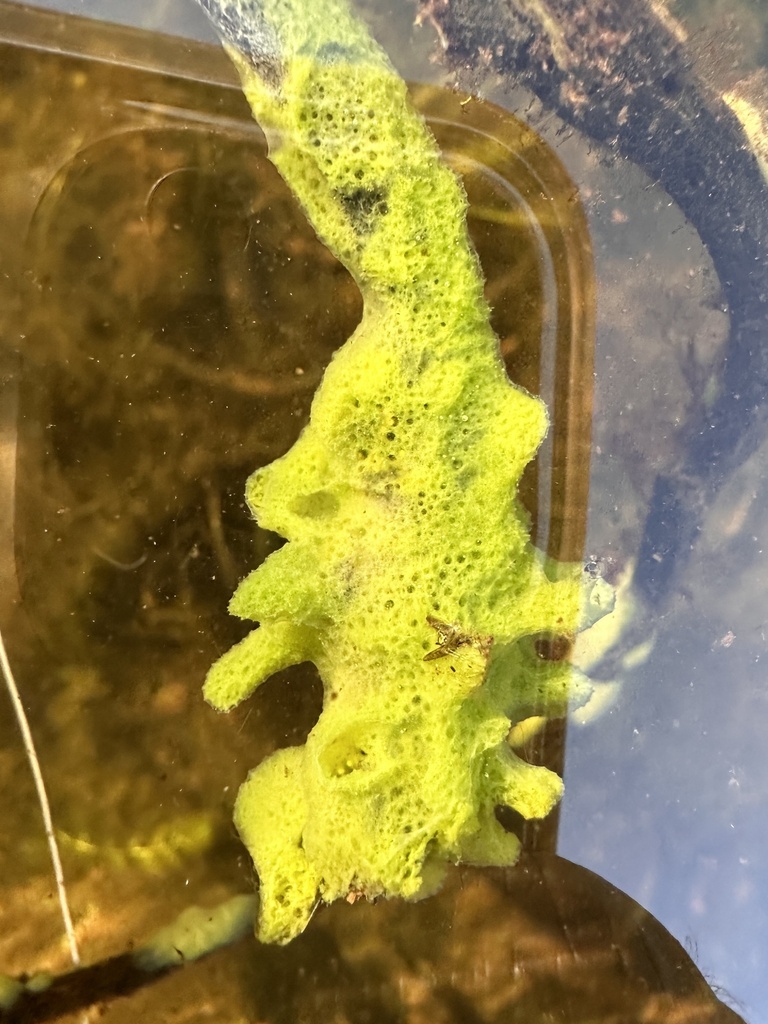
(c) Matt Berger, some rights reserved (CC BY) · licence
Family: Spongillidae · Class: Demospongiae · Order: Haplosclerida
Spongilla lacustris (Lake Sponge) is a California animal in the Spongillidae family.
Spongilla lacustris is a freshwater sponge belonging to the phylum Porifera and family Spongillidae. This sessile invertebrate forms encrusting colonies that can vary considerably in shape and size depending on environmental conditions. The sponge typically appears as irregular masses or thin crusts adhering to submerged surfaces, ranging in color from pale yellow to green or brown. The green coloration often results from symbiotic algae living within the sponge tissue. The surface texture is characteristically porous with numerous small openings called ostia for water intake and larger openings called oscula for water expulsion. Spongilla lacustris has a cosmopolitan distribution, occurring across North America, Europe, and Asia. In North America, this species is found throughout the continental United States and southern Canada. The sponge inhabits various freshwater environments including lakes, ponds, slow-moving rivers, and streams. It requires permanent water bodies that do not completely dry during seasonal drought periods. This species typically colonizes hard substrates in freshwater habitats, attaching to rocks, submerged logs, plant stems, and artificial structures such as dock pilings and concrete surfaces. Spongilla lacustris thrives in both shallow and deep waters, generally preferring areas with moderate water flow and adequate dissolved oxygen levels. The sponge can tolerate a range of water temperatures but grows most actively in warmer conditions during spring and summer months. As a filter feeder, Spongilla lacustris obtains nutrients by drawing water through its porous body structure and capturing microscopic organisms and organic particles. The sponge feeds primarily on bacteria, algae, protozoa, and small organic detritus suspended in the water column. Water circulation through the sponge body is maintained by specialized cells called choanocytes, which create current through coordinated flagellar movement. Reproduction occurs both asexually through budding and fragmentation, and sexually through the production of sperm and eggs. During unfavorable conditions such as winter freezing or drought, the sponge produces resistant structures called gemmules that can survive harsh environmental conditions and regenerate new colonies when conditions improve. Spongilla lacustris is not listed under any federal or state conservation programs and is considered globally secure with a NatureServe ranking of G5 (NatureServe Explorer). The species demonstrates considerable ecological resilience and adaptability to various freshwater environments. However, like other freshwater organisms, populations may be affected by water pollution, habitat modification, and invasive species. The sponge plays an important ecological role in freshwater ecosystems by filtering water and providing substrate for other aquatic organisms. Recent molecular studies have revealed relatively low bacterial diversity associated with this freshwater sponge compared to marine sponge species, with associated bacteria primarily from Actinobacteria, Chloroflexi, and Alpha- and Betaproteobacteria groups, many of which appear to be environmental rather than true symbionts (Gaikwad et al. 2016).
Classification
Class: Demospongiae · Order: Haplosclerida · Family: Spongillidae
Frequently asked questions
How is Spongilla lacustris classified?
Spongilla lacustris belongs to class Demospongiae, order Haplosclerida, family Spongillidae.
What family does Spongilla lacustris belong to?
Spongilla lacustris is in the Spongillidae family.
What is Spongilla lacustris?
Spongilla lacustris is a freshwater sponge belonging to the phylum Porifera and family Spongillidae.
Is Spongilla lacustris found in California?
Yes. Spongilla lacustris is recorded in California in The California Species Project's catalogue.
More California species
This species has no close relatives in our California data — here are other species to explore.
Data from The California Species Project — 14,000+ California species with verified data from CNPS, CDFW, USFWS, and more.