Stagmomantis californica
California Mantis
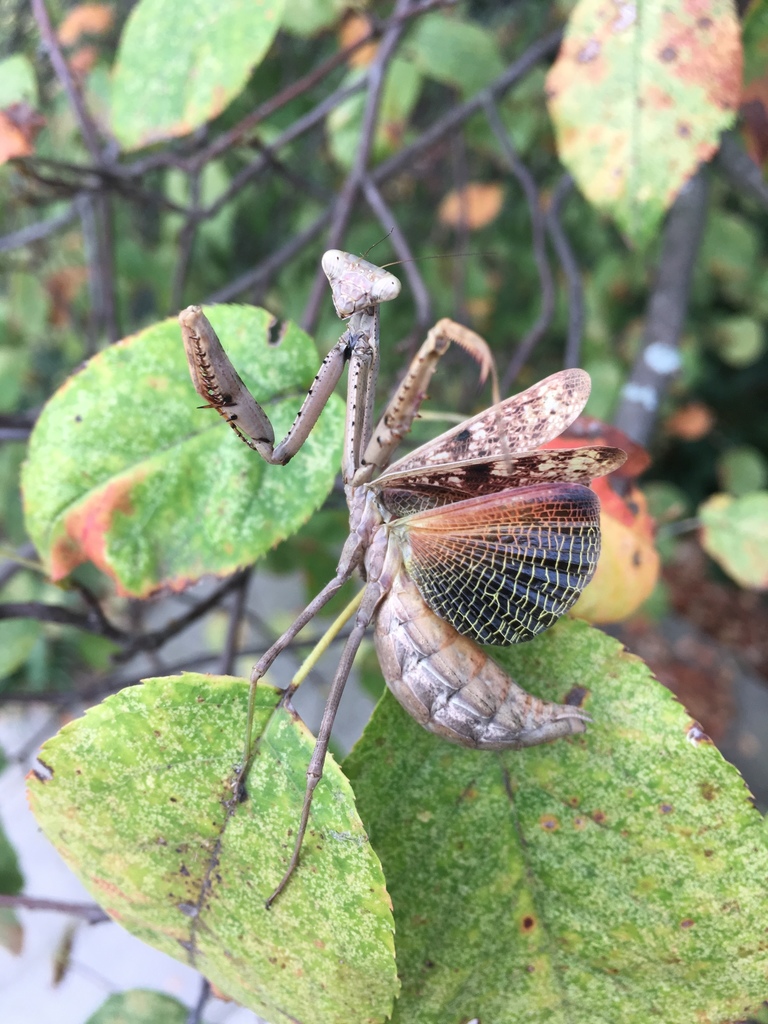
no rights reserved · CC0
Family: Mantidae · Class: Insecta · Order: Mantodea
Stagmomantis californica (California Mantis) is a California animal in the Mantidae family.
The California mantis is a medium-sized praying mantis native to the western United States. Adults typically measure 50 to 75 mm (2.0 to 3.0 inches) in length, making them slightly smaller and more slender than the closely related bordered mantis (Stagmomantis limbata). The species exhibits cryptic coloration ranging from tan to green, often matching their surrounding vegetation. The forewings are mottled with dark bands on the upper surface, while the hind wings are distinctively mottled to nearly completely suffused with dark brown to near black coloration, with a purplish base (BugGuide.net). Males can be distinguished from females by their more slender build and longer antennae. The California mantis ranges from Texas and Colorado west to southern California, primarily inhabiting arid regions including California's Central Valley. Within California, the species occurs throughout the southern portion of the state and extends north into the Central Valley, where it reaches the northern limits of its range. This distribution overlaps with S. limbata in many areas, requiring careful examination of wing patterns or male abdominal characteristics for definitive identification. This species inhabits chaparral and desert environments, showing a strong preference for drier conditions compared to related mantis species that may occur in the same regions. The California mantis is largely arboreal or semi-arboreal, typically found climbing on shrubs and bushes rather than remaining at ground level (BugGuide.net). It generally favors more xeric habitats than sympatric mantis species, helping to reduce interspecific competition. As an ambush predator, the California mantis employs a sit-and-wait hunting strategy, remaining motionless on vegetation until prey approaches within striking distance. The species feeds on a wide variety of flying and crawling insects, including flies, moths, beetles, and other arthropods. Their powerful raptorial forelegs are equipped with sharp spines that secure prey during consumption. The California mantis overwinters in the egg stage, with females depositing foam-like ootheca (egg cases) on vegetation or other surfaces during autumn. Eggs hatch in spring and summer, with nymphs undergoing several molts before reaching adulthood. Adults are most commonly observed during summer and autumn months, with females potentially surviving into winter in favorable conditions. The California mantis is not federally or state listed and appears to maintain stable populations throughout its range as of December 2025. As a native predator, it plays an important role in controlling insect populations in chaparral and desert ecosystems. The species faces typical threats associated with habitat modification and urbanization in some portions of its range, particularly in rapidly developing areas of California. However, its ability to utilize a variety of shrubland habitats and adapt to somewhat disturbed environments has helped maintain viable populations. The California mantis serves as both predator and prey within its ecosystem, contributing to the complex food webs of western North American arid lands.
Classification
Class: Insecta · Order: Mantodea · Family: Mantidae
Frequently asked questions
How is Stagmomantis californica classified?
Stagmomantis californica belongs to class Insecta, order Mantodea, family Mantidae.
What family does Stagmomantis californica belong to?
Stagmomantis californica is in the Mantidae family.
What is Stagmomantis californica?
The California mantis is a medium-sized praying mantis native to the western United States.
Is Stagmomantis californica found in California?
Yes. Stagmomantis californica is recorded in California in The California Species Project's catalogue.
Related species
Other California species in the same genus, family, or bioregion.
Data from The California Species Project — 14,000+ California species with verified data from CNPS, CDFW, USFWS, and more.