Staphylus ceos
Golden-headed Scallopwing
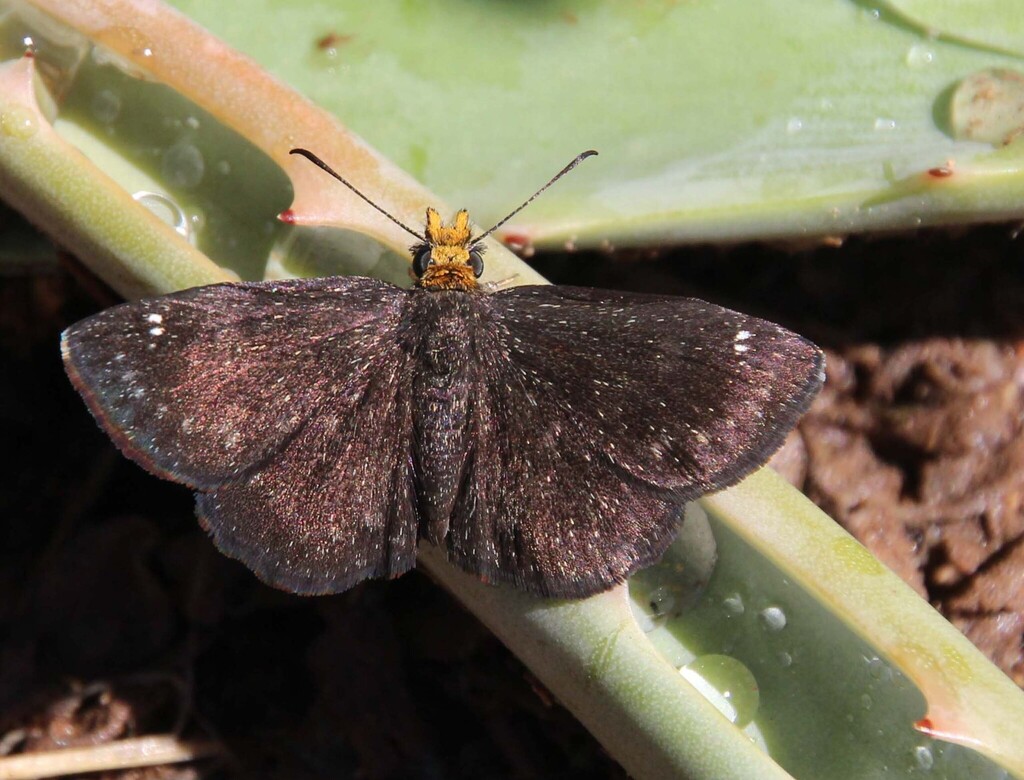
(c) Lon Brehmer, some rights reserved (CC BY) · licence
Family: Hesperiidae · Class: Insecta · Order: Lepidoptera
Staphylus ceos (Golden-headed Scallopwing) is a California animal in the Hesperiidae family.
The Golden-headed Scallopwing (Staphylus ceos) is a small butterfly in the skipper family Hesperiidae. Adults have a wingspan of approximately 25 to 32 mm (1.0 to 1.3 inches). The forewings are dark brown to blackish with small white or pale yellow spots arranged in irregular bands. The hindwings are similarly colored with a scalloped outer margin that gives the species its common name. Males typically display a more pronounced golden-yellow patch on the head, which is the source of the "golden-headed" designation, though this coloration can vary in intensity. The antennae are relatively short with a distinctive hooked club typical of skippers. The Golden-headed Scallopwing occurs in southern Arizona, southern New Mexico, and west and South Texas, extending south through Mexico to Durango. In the United States, the species reaches its northernmost distribution limits in these southwestern border regions. The butterfly is considered a resident species throughout most of its range, though populations in the extreme northern areas may experience seasonal fluctuations. This species inhabits arid and semi-arid environments, particularly desert scrub communities and dry washes where its host plant occurs. Golden-headed Scallopwings are typically found at elevations ranging from sea level to approximately 1,500 meters (4,900 feet). The species shows a strong association with areas containing Fremont's goosefoot (Chenopodium fremontii), which serves as the primary larval host plant. Adults are often observed in rocky canyon bottoms, desert flats, and disturbed areas where the host plant establishes. Adult Golden-headed Scallopwings exhibit rapid, erratic flight patterns characteristic of skipper butterflies. Males engage in territorial behavior, perching on prominent rocks or vegetation to watch for females and chase away intruders. The species is multivoltine in warmer regions, producing multiple generations per year, with flight periods extending from spring through fall when conditions are favorable. Females deposit eggs singly on leaves of Fremont's goosefoot. Larvae feed within shelters constructed by folding or tying host plant leaves together with silk. The caterpillars are pale green to yellowish-green with darker striping and feed primarily on young, tender foliage. The Golden-headed Scallopwing does not currently hold federal or state conservation status in the United States. However, like many desert-adapted species, populations may face pressure from habitat modification, urbanization, and climate change effects on precipitation patterns. The species' dependence on Fremont's goosefoot makes it vulnerable to changes in plant community composition. In areas where the host plant remains abundant and undisturbed, Golden-headed Scallopwing populations appear stable. The butterfly's ability to utilize disturbed habitats where the host plant colonizes may provide some resilience against moderate habitat alterations, though severe ecosystem modifications could impact local populations.
Classification
Class: Insecta · Order: Lepidoptera · Family: Hesperiidae
Frequently asked questions
How is Staphylus ceos classified?
Staphylus ceos belongs to class Insecta, order Lepidoptera, family Hesperiidae.
What family does Staphylus ceos belong to?
Staphylus ceos is in the Hesperiidae family.
What is Staphylus ceos?
The Golden-headed Scallopwing (Staphylus ceos) is a small butterfly in the skipper family Hesperiidae.
Is Staphylus ceos found in California?
Yes. Staphylus ceos is recorded in California in The California Species Project's catalogue.
Related species
Other California species in the same genus, family, or bioregion.
Data from The California Species Project — 14,000+ California species with verified data from CNPS, CDFW, USFWS, and more.