Steatoda grossa
False Black Widow
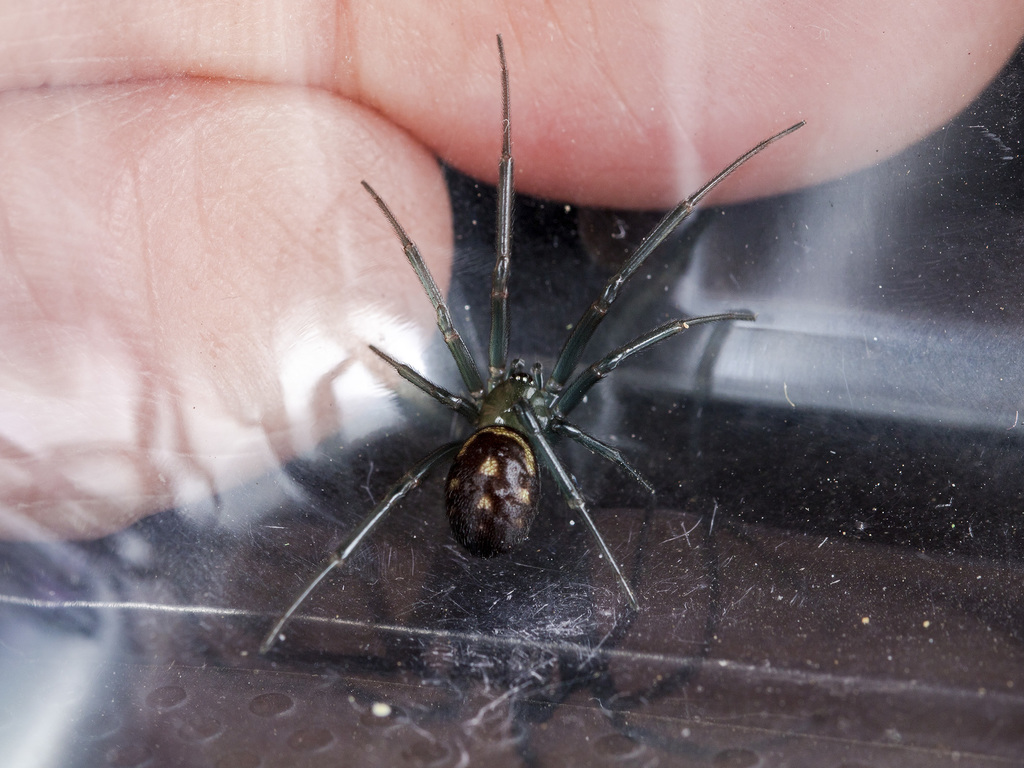
(c) Анатолий Озерной /Anatoly Ozernoy, some rights reserved (CC BY-SA) · licence
Family: Theridiidae · Class: Arachnida · Order: Araneae
Steatoda grossa (False Black Widow) is a California animal in the Theridiidae family.
The false black widow is a medium-sized spider in the family Theridiidae, native to Europe but now established as a cosmopolitan species. Adult females measure 8 to 15 millimeters (0.31 to 0.59 inches) in body length, while males are smaller at 6 to 10 millimeters. The body is typically dark brown to purplish-black with a globular abdomen. Females often display pale markings on the dorsal surface of the abdomen, which may form bands or geometric patterns. The legs are relatively robust and darker than the body. Unlike true black widow spiders (Latrodectus species), false black widows lack the distinctive red hourglass marking on the ventral abdomen. Steatoda grossa was imported from Europe and has established populations throughout North America. In the United States, it occurs along the east and west coasts, in states bordering the Great Lakes, and has been documented in Colorado (BugGuide). The species is now considered cosmopolitan, found on multiple continents. In California, it has become well-established in urban and suburban areas throughout the state. The species primarily inhabits human-modified environments, particularly in and around homes and buildings (BugGuide). False black widows construct irregular cobwebs in protected spaces such as garages, sheds, basements, window frames, and under eaves. They prefer areas with minimal disturbance and adequate prey availability. The webs are three-dimensional tangles of sticky silk threads, typical of theridiid spiders, positioned to intercept flying and crawling arthropods. False black widows are generalist predators that capture any arthropods entangled in their cobwebs (BugGuide). Their diet includes flies, beetles, moths, ants, and other small invertebrates. The spiders use their silk to wrap and immobilize prey before feeding. Males mature during summer and autumn, while adult females can be found year-round (BugGuide). Mating involves complex courtship behaviors where males approach females cautiously to avoid being mistaken for prey. Females produce multiple egg sacs containing 40 to 100 eggs each, which they guard within their webs. Spiderlings undergo several molts before reaching maturity. Steatoda grossa is not listed under any conservation legislation and requires no special protection. As an introduced species, it is not considered native to California's ecosystems. The false black widow has successfully colonized urban environments across its introduced range, demonstrating high adaptability to human-modified habitats. While sometimes confused with potentially dangerous black widow spiders, false black widows pose minimal risk to humans, with bites typically causing only minor local reactions similar to bee stings. The species may actually provide beneficial pest control services by reducing populations of nuisance insects around human dwellings. Population trends suggest continued range expansion in suitable urban and suburban habitats throughout California and North America.
Classification
Class: Arachnida · Order: Araneae · Family: Theridiidae
Frequently asked questions
How is Steatoda grossa classified?
Steatoda grossa belongs to class Arachnida, order Araneae, family Theridiidae.
What family does Steatoda grossa belong to?
Steatoda grossa is in the Theridiidae family.
What is Steatoda grossa?
The false black widow is a medium-sized spider in the family Theridiidae, native to Europe but now established as a cosmopolitan species.
Is Steatoda grossa found in California?
Yes. Steatoda grossa is recorded in California in The California Species Project's catalogue.
Related species
Other California species in the same genus, family, or bioregion.
Data from The California Species Project — 14,000+ California species with verified data from CNPS, CDFW, USFWS, and more.