Steatoda nobilis
Noble False Widow
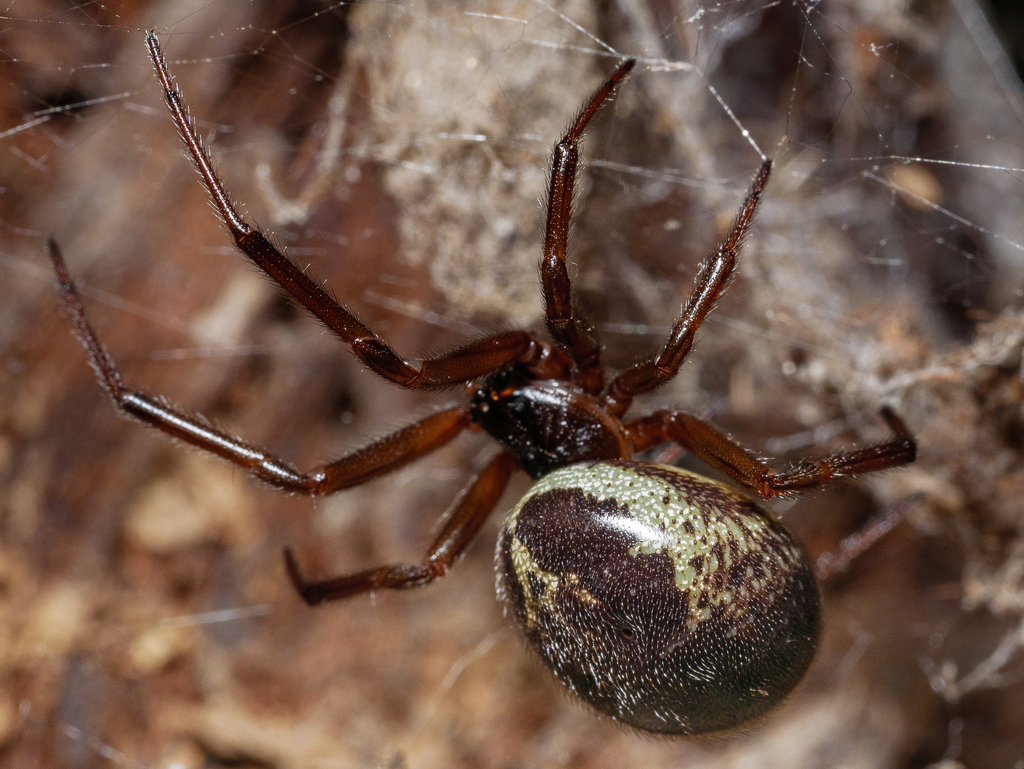
(c) Dustin Edmundson, some rights reserved (CC BY) · licence
Family: Theridiidae · Class: Arachnida · Order: Araneae
Steatoda nobilis (Noble False Widow) is a California animal in the Theridiidae family.
The noble false widow (Steatoda nobilis) is a medium-sized spider in the cobweb weaver family Theridiidae. Adult females measure 9.5 to 14 millimeters (0.37 to 0.55 inches) in body length, while males are smaller at 4 to 7 millimeters (0.16 to 0.28 inches). The species exhibits sexual dimorphism in coloration: females typically display a dark brown to purplish-brown cephalothorax and abdomen with cream or pale yellow markings, including a distinctive skull-like pattern on the dorsal abdomen. Males are generally lighter in coloration with more pronounced pale markings. The legs are relatively long and robust, with females having a leg span reaching 15 millimeters (0.59 inches). Steatoda nobilis is native to the Canary Islands and Madeira but has become established as an introduced species in several regions, including parts of California (Bauer et al. 2014). The species was first documented in California around 2011, with established populations reported in the San Francisco Bay Area (iNaturalist 2025). Current California populations are primarily concentrated in coastal counties, particularly in urban and suburban environments, though the full extent of its distribution in the state remains incompletely documented. This species demonstrates broad habitat adaptability, thriving in both natural and anthropogenic environments. Noble false widows construct three-dimensional cobwebs in sheltered locations, including under building eaves, in wall crevices, garden sheds, and among vegetation. They show a preference for sites that provide protection from direct sunlight and precipitation while offering access to flying insects. The species tolerates a wide range of temperatures and has been found from sea level to elevations exceeding 200 meters (656 feet) in its introduced range. Noble false widows are nocturnal predators that feed primarily on flying insects trapped in their irregular webs. Their diet includes flies, mosquitoes, moths, and other small arthropods (BugGuide 2025). Females produce spherical egg sacs containing 50 to 200 eggs, which they guard within their webs. The species exhibits an extended breeding season in favorable climates, with females capable of producing multiple egg sacs annually. Juveniles undergo several molts before reaching maturity, with development time influenced by temperature and prey availability. Adults can live for several years under optimal conditions. Steatoda nobilis is not listed under federal or California endangered species legislation, as it is considered an introduced species rather than a conservation priority. However, its establishment in California raises potential ecological concerns regarding impacts on native spider communities, as documented in European studies of similar introductions (Kulczycki et al. 2012). The species' ability to colonize urban environments and its relatively large size compared to many native cobweb weavers may provide competitive advantages. Limited research exists on the long-term ecological effects of this introduction in California, with current documentation primarily through citizen science platforms focusing on range expansion and population establishment patterns throughout coastal regions.
Classification
Class: Arachnida · Order: Araneae · Family: Theridiidae
Frequently asked questions
How is Steatoda nobilis classified?
Steatoda nobilis belongs to class Arachnida, order Araneae, family Theridiidae.
What family does Steatoda nobilis belong to?
Steatoda nobilis is in the Theridiidae family.
What is Steatoda nobilis?
The noble false widow (Steatoda nobilis) is a medium-sized spider in the cobweb weaver family Theridiidae.
Is Steatoda nobilis found in California?
Yes. Steatoda nobilis is recorded in California in The California Species Project's catalogue.
Related species
Other California species in the same genus, family, or bioregion.
Data from The California Species Project — 14,000+ California species with verified data from CNPS, CDFW, USFWS, and more.