Stegea salutalis
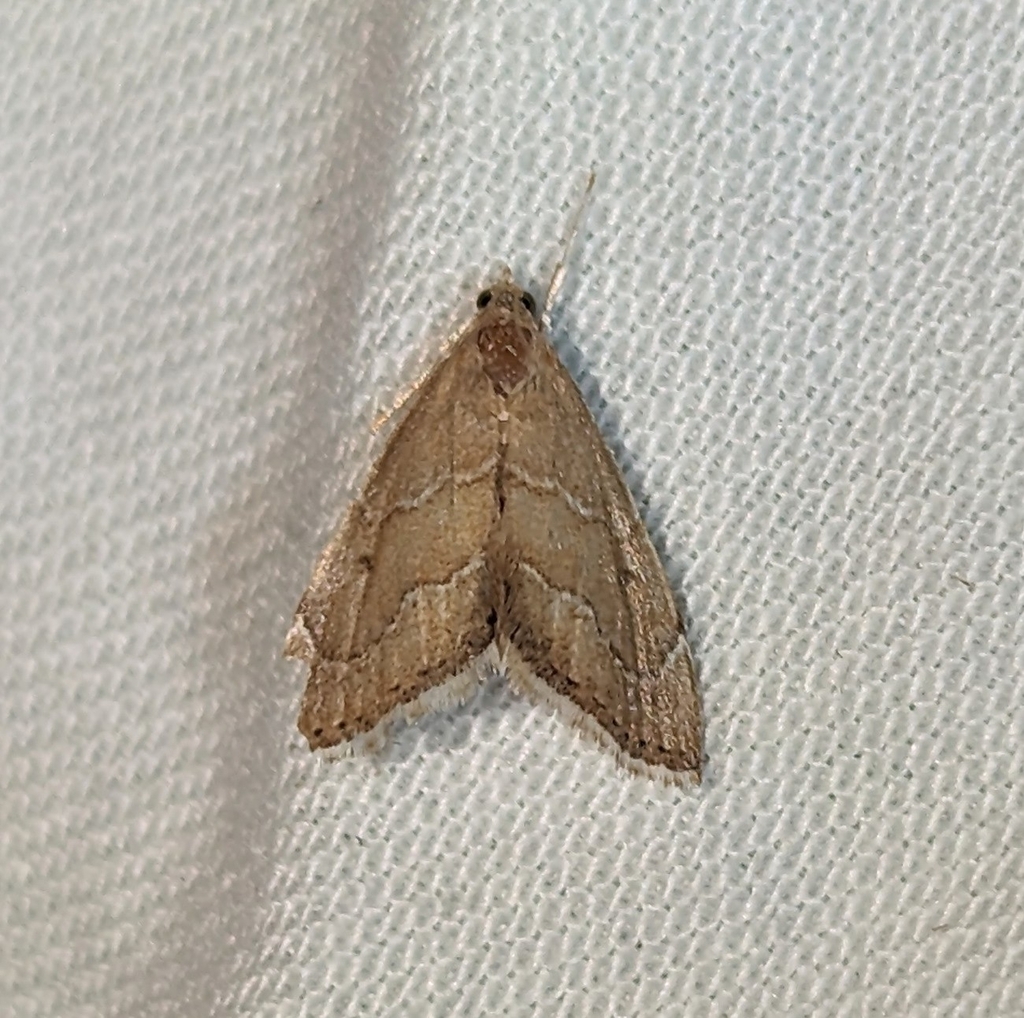
no rights reserved · CC0
Family: Crambidae · Class: Insecta · Order: Lepidoptera
Stegea salutalis is a California animal in the Crambidae family.
Stegea salutalis is a small moth in the family Crambidae, commonly known as the grass moths or snout moths. This species belongs to a group of pyraloid moths characterized by elongated labial palps that project forward from the head, giving many species a distinctive snout-like appearance. Adults typically measure 15 to 20 mm (0.6 to 0.8 inches) in wingspan, with forewings that are generally pale brown to grayish-brown with darker markings and crosslines. The hindwings are lighter in coloration, often whitish or pale yellow. Sexual dimorphism is present, with males possessing more feathered or pectinate antennae compared to the thread-like antennae of females. Stegea salutalis occurs across a broad geographic range extending from British Columbia southward through western North America to Colorado and Texas, continuing into northwestern Mexico. This extensive distribution spans multiple biogeographic regions, from temperate coniferous forests in the north to arid and semi-arid environments in the southwestern United States and Mexico. The species is recorded from elevations ranging from near sea level to montane zones, though specific elevational limits vary across its range. The species inhabits diverse habitats across its range, including grasslands, shrublands, oak woodlands, and forest edges. Adults are typically associated with areas containing native grasses and herbaceous plants. In California, the species likely occurs in chaparral, coastal sage scrub, and grassland communities. Habitat preferences appear to correlate with the presence of suitable host plants for larval development. Adult moths are nocturnal and are attracted to artificial lights during their flight period. Flight times vary geographically but generally occur from late spring through early fall, with peak activity during summer months. Larvae are believed to be grass feeders, developing in stems, crowns, or roots of various grass species, though specific host plant associations for this species require further documentation. Like other members of the Crambidae, larvae likely undergo multiple instars before pupation. The species may produce one or two generations per year depending on local climate conditions and elevation. Stegea salutalis does not currently hold any federal or state conservation status in California or other parts of its range. The species appears to maintain stable populations across much of its distribution, likely due to its broad habitat tolerance and widespread occurrence. However, like many native moths, local populations may face pressures from habitat conversion, urbanization, and changes in fire regimes that affect grassland and shrubland communities. The introduction of non-native grasses may also impact larval host plant availability in some regions. Climate change could potentially affect the species' distribution, particularly at the margins of its range where temperature and precipitation patterns are shifting.
Classification
Class: Insecta · Order: Lepidoptera · Family: Crambidae
Frequently asked questions
How is Stegea salutalis classified?
Stegea salutalis belongs to class Insecta, order Lepidoptera, family Crambidae.
What family does Stegea salutalis belong to?
Stegea salutalis is in the Crambidae family.
What is Stegea salutalis?
Stegea salutalis is a small moth in the family Crambidae, commonly known as the grass moths or snout moths.
Is Stegea salutalis found in California?
Yes. Stegea salutalis is recorded in California in The California Species Project's catalogue.
Related species
Other California species in the same genus, family, or bioregion.
Data from The California Species Project — 14,000+ California species with verified data from CNPS, CDFW, USFWS, and more.