Stelis laticincta
Wide-striped Painted-Dark bee
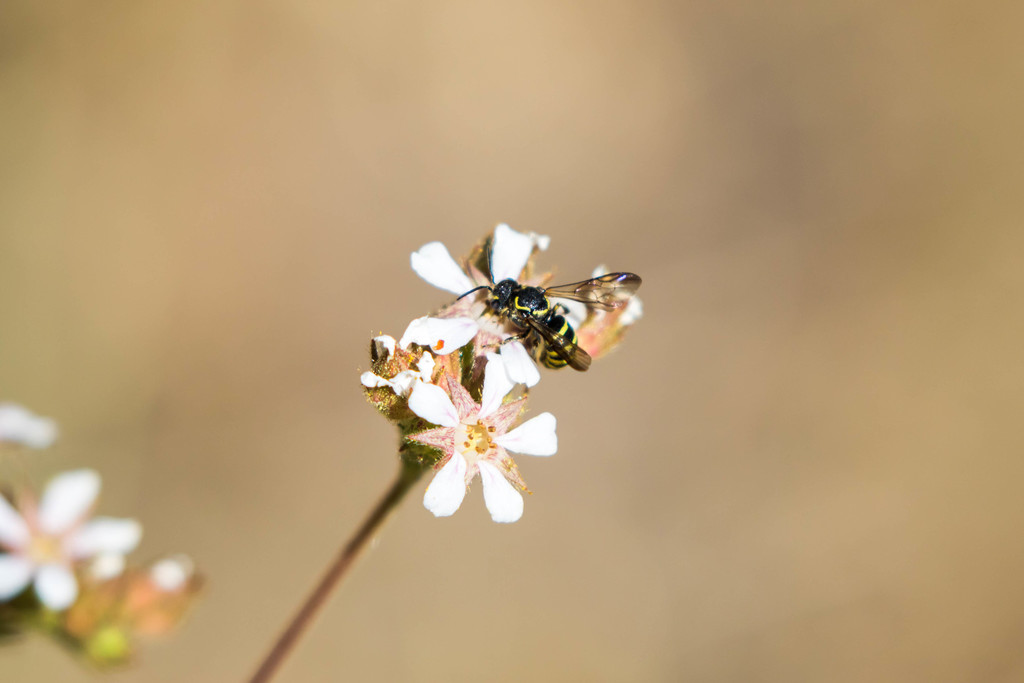
(c) Melissa McMasters, some rights reserved (CC BY) · licence
Family: Megachilidae · Class: Insecta · Order: Hymenoptera
Stelis laticincta (Wide-striped Painted-Dark bee) is a California animal in the Megachilidae family.
Stelis laticincta, commonly known as the wide-striped painted-dark bee, is a member of the leafcutter bee family (Megachilidae) within the order Hymenoptera. This species belongs to the genus Stelis, which comprises cuckoo bees that exhibit kleptoparasitic behavior rather than collecting pollen themselves. As a member of the Stelis genus, S. laticincta likely displays the characteristic morphology of these bees, including a relatively robust body with distinctive striping patterns that give rise to its common name. Stelis bees typically range from small to medium size, generally measuring 6-12 mm in length, though specific measurements for S. laticincta have not been well documented. The species likely exhibits the dark coloration with pale stripes typical of many Stelis species, though detailed morphological descriptions remain limited in the scientific literature. The current distribution of Stelis laticincta in California has not been comprehensively documented in available sources. Like many native bee species, its range may be more restricted than historically, though specific population data and geographic extent remain unclear. California supports approximately 1,600 native bee species, representing exceptional diversity, but detailed range maps for many specialist species like S. laticincta are lacking. Habitat requirements for S. laticincta are not well characterized in the literature. As a member of the Stelis genus, this species likely depends on the presence of suitable host bee species, as all Stelis bees are kleptoparasitic. The species probably occurs in habitats that support diverse native bee communities, potentially including chaparral, oak woodlands, or other vegetation types that sustain robust populations of megachilid hosts. Stelis laticincta exhibits the kleptoparasitic lifestyle characteristic of its genus. Adult females locate the nests of host bee species, typically other megachilids, and lay their eggs within the host's brood cells. The developing Stelis larvae consume the pollen provisions intended for the host's offspring, effectively usurping the nest. This reproductive strategy makes Stelis species entirely dependent on their hosts for successful reproduction. Specific host relationships for S. laticincta have not been documented, though related Stelis species typically parasitize various leafcutter bees (Megachile) and mason bees (Osmia). Flight periods and seasonal activity patterns for this species remain undocumented. The conservation status of Stelis laticincta has not been formally assessed at federal or state levels. Like many native bee species, it likely faces threats from habitat loss, pesticide use, and the decline of host bee populations. The kleptoparasitic lifestyle of Stelis species makes them particularly vulnerable to conservation challenges, as they depend not only on suitable habitat but also on stable populations of their host species. Climate change may further impact this species through effects on both habitat availability and host bee phenology. Scientific documentation for this species remains extremely limited. The information presented here synthesizes available taxonomic and ecological knowledge of the Stelis genus. Detailed studies of S. laticincta's biology, distribution, host relationships, and ecology are needed to support effective conservation planning.
Classification
Class: Insecta · Order: Hymenoptera · Family: Megachilidae
Frequently asked questions
How is Stelis laticincta classified?
Stelis laticincta belongs to class Insecta, order Hymenoptera, family Megachilidae.
What family does Stelis laticincta belong to?
Stelis laticincta is in the Megachilidae family.
What is Stelis laticincta?
Stelis laticincta, commonly known as the wide-striped painted-dark bee, is a member of the leafcutter bee family (Megachilidae) within the order Hymenoptera.
Is Stelis laticincta found in California?
Yes. Stelis laticincta is recorded in California in The California Species Project's catalogue.
Related species
Other California species in the same genus, family, or bioregion.
Data from The California Species Project — 14,000+ California species with verified data from CNPS, CDFW, USFWS, and more.