Stercorarius longicaudus
Long-tailed Jaeger
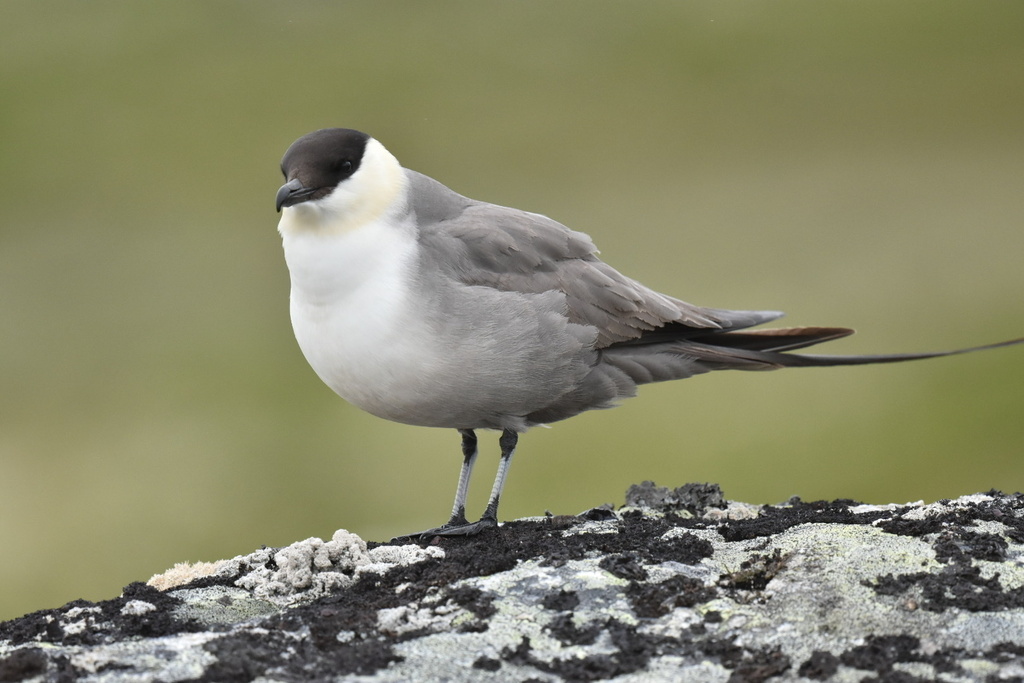
no rights reserved · CC0
Family: Stercorariidae · Class: Aves · Order: Charadriiformes
Stercorarius longicaudus (Long-tailed Jaeger) is a California animal in the Stercorariidae family.
The Long-tailed Jaeger is a medium-sized seabird distinguished by its exceptionally long central tail feathers and sleek build. Adults measure 50 to 58 cm (20 to 23 inches) in length, including the elongated tail streamers that can extend up to 25 cm (10 inches) beyond the main tail feathers. The wingspan ranges from 105 to 117 cm (41 to 46 inches). Adults weigh 230 to 444 grams (8.1 to 15.7 ounces). The species exhibits two color morphs: light morph birds display pale gray upperparts, white underparts, and a distinctive black cap extending below the eye, while dark morph individuals show uniform dark brown plumage. Both morphs feature dark flight feathers and a characteristic white wing flash visible during flight. Long-tailed Jaegers breed in Arctic tundra across Alaska, northern Canada, Scandinavia, and Siberia. In North America, the breeding range extends from northern Alaska south to the Alaska Peninsula and east across northern Canada to Hudson Bay. During migration and winter, the species occurs along both Pacific and Atlantic coasts, with regular observations off California's coast from August through November. California waters provide important foraging habitat during southbound migration, with birds documented from Humboldt County to San Diego County. The species inhabits open ocean waters during migration and winter, typically remaining well offshore in pelagic environments. During breeding season, Long-tailed Jaegers occupy Arctic and subarctic tundra, preferring areas with scattered ponds, wet meadows, and low vegetation. They nest on dry ground, often on slight elevations or ridges within the tundra landscape. Migration routes follow continental shelf waters and oceanic currents where prey concentrations are highest. Long-tailed Jaegers are highly migratory, traveling up to 64,000 km (40,000 miles) annually between Arctic breeding grounds and Antarctic wintering areas. During breeding season, they feed primarily on small mammals, particularly lemmings, and also consume insects, eggs, and chicks of other birds. At sea, they practice kleptoparasitism, harassing other seabirds to force them to regurgitate prey, and also capture fish, squid, and crustaceans directly from the surface. Breeding occurs from June through August, with pairs establishing territories on tundra. Females lay 1 to 3 eggs in a shallow scrape lined with vegetation. Incubation lasts 23 to 25 days, and chicks fledge after 22 to 27 days. The Long-tailed Jaeger is not federally listed in the United States and maintains a global conservation status of Least Concern according to the International Union for Conservation of Nature. However, climate change poses significant threats to Arctic breeding habitats, potentially altering tundra ecosystems and prey availability. Warming temperatures affect lemming population cycles, which directly impact jaeger reproductive success. Marine pollution, including plastic debris and chemical contaminants, presents additional challenges in oceanic habitats. Population trends remain stable globally, though regional variations occur based on local environmental conditions and prey abundance cycles.
Classification
Class: Aves · Order: Charadriiformes · Family: Stercorariidae
Frequently asked questions
How is Stercorarius longicaudus classified?
Stercorarius longicaudus belongs to class Aves, order Charadriiformes, family Stercorariidae.
What family does Stercorarius longicaudus belong to?
Stercorarius longicaudus is in the Stercorariidae family.
What is Stercorarius longicaudus?
The Long-tailed Jaeger is a medium-sized seabird distinguished by its exceptionally long central tail feathers and sleek build.
Is Stercorarius longicaudus found in California?
Yes. Stercorarius longicaudus is recorded in California in The California Species Project's catalogue.
Related species
Other California species in the same genus, family, or bioregion.
Data from The California Species Project — 14,000+ California species with verified data from CNPS, CDFW, USFWS, and more.