Stercorarius maccormicki
South Polar Skua
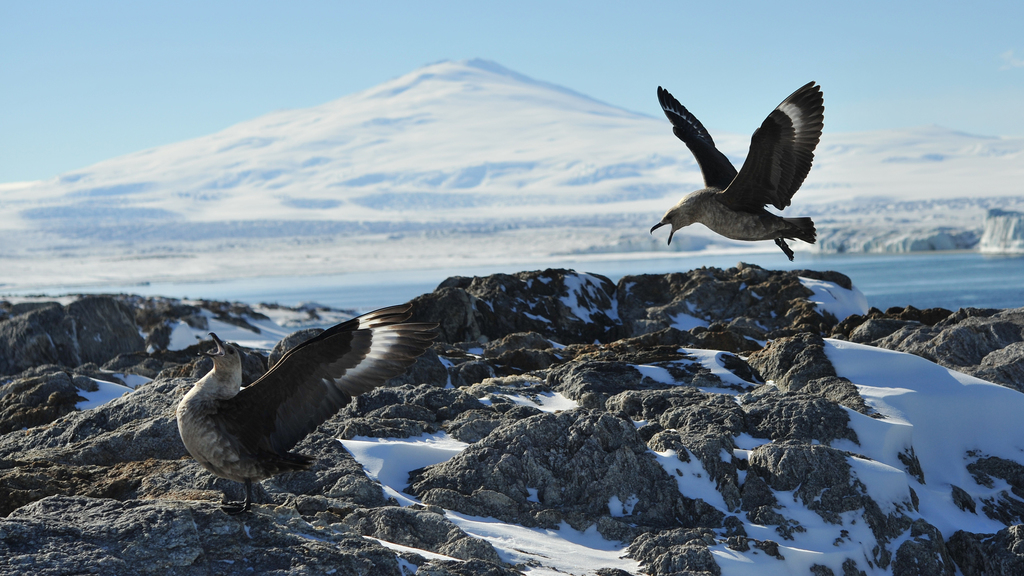
(c) Kim, Hyun-tae, some rights reserved (CC BY) · licence
Family: Stercorariidae · Class: Aves · Order: Charadriiformes
Stercorarius maccormicki (South Polar Skua) is a California animal in the Stercorariidae family.
The South Polar Skua is a large, robust seabird measuring 50 to 55 cm (20 to 22 inches) in length with a wingspan of 130 to 140 cm (51 to 55 inches). Adults weigh between 1.2 and 1.8 kg (2.6 to 4.0 pounds). The species exhibits two distinct color morphs: a pale morph with light brown to buff-colored head and underparts contrasting with darker brown wings and back, and a dark morph that is uniformly dark chocolate brown throughout. Both morphs display prominent white patches at the base of the primary flight feathers, creating distinctive white wing flashes visible during flight. The bill is heavy and hooked, dark gray to black in color, while the legs and webbed feet are dark gray. The South Polar Skua breeds exclusively in Antarctica and surrounding sub-Antarctic islands. During the non-breeding season, these seabirds undertake extensive migrations northward, with individuals regularly reaching the waters off California's coast. In the eastern Pacific, the species occurs from Alaska to Chile, typically remaining in pelagic waters beyond the continental shelf. Off California, South Polar Skuas are most commonly observed from May through October, with peak numbers during late summer and early fall. This species inhabits open ocean environments, rarely approaching shore except during severe weather events. South Polar Skuas prefer areas with high biological productivity, often associated with upwelling zones and continental shelf edges where prey concentrations are elevated. During migration and winter, they remain almost entirely pelagic, typically found in waters deeper than 200 meters. South Polar Skuas are opportunistic predators and scavengers with a varied diet. They feed on fish, squid, krill, and other marine invertebrates, often obtained through surface diving or by piracy from other seabirds. The species is known for its aggressive kleptoparasitic behavior, pursuing and harassing other seabirds to force them to regurgitate their catch. On breeding grounds, they also prey on penguin eggs and chicks. South Polar Skuas typically nest in loose colonies on ice-free areas of Antarctica, laying one to two olive-brown eggs with dark markings between November and January. Both parents incubate eggs for 28 to 32 days and care for young until fledging at approximately 50 to 60 days. The South Polar Skua is not federally or state-listed in California, as it occurs only as a regular migrant and winter visitor in offshore waters. The species has a stable global population estimated at 15,000 to 20,000 breeding pairs, primarily distributed across the Antarctic Peninsula and surrounding islands. Climate change poses potential long-term threats through alterations to Antarctic ice dynamics and marine food webs, which could affect breeding habitat availability and prey distribution patterns.
Classification
Class: Aves · Order: Charadriiformes · Family: Stercorariidae
Frequently asked questions
How is Stercorarius maccormicki classified?
Stercorarius maccormicki belongs to class Aves, order Charadriiformes, family Stercorariidae.
What family does Stercorarius maccormicki belong to?
Stercorarius maccormicki is in the Stercorariidae family.
What is Stercorarius maccormicki?
The South Polar Skua is a large, robust seabird measuring 50 to 55 cm (20 to 22 inches) in length with a wingspan of 130 to 140 cm (51 to 55 inches).
Is Stercorarius maccormicki found in California?
Yes. Stercorarius maccormicki is recorded in California in The California Species Project's catalogue.
Related species
Other California species in the same genus, family, or bioregion.
Data from The California Species Project — 14,000+ California species with verified data from CNPS, CDFW, USFWS, and more.