Stercorarius parasiticus
Parasitic Jaeger
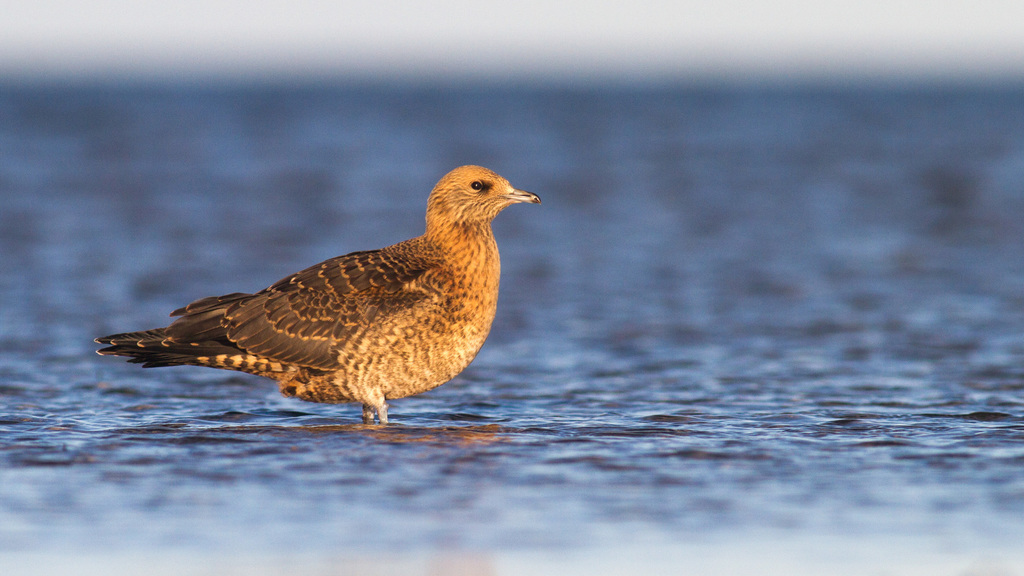
(c) Fyn Kynd, some rights reserved (CC BY-SA) · licence
Family: Stercorariidae · Class: Aves · Order: Charadriiformes
Stercorarius parasiticus (Parasitic Jaeger) is a California animal in the Stercorariidae family.
The Parasitic Jaeger is a medium-sized seabird measuring 41 to 46 cm (16 to 18 inches) in length with a wingspan of 107 to 125 cm (42 to 49 inches). Adults weigh between 300 to 650 grams (0.66 to 1.43 pounds). The species exhibits considerable plumage variation, with light, intermediate, and dark morphs. Light morph adults display dark brown upperparts, white underparts, and a distinctive dark cap extending below the eye. Dark morph individuals are uniformly dark brown except for white wing patches visible in flight. All adults possess elongated central tail feathers that extend 5 to 9 cm beyond the other rectrices, though these are often broken or worn. Juveniles lack the extended tail feathers and show heavy barring throughout their plumage. Parasitic Jaegers breed across the Arctic tundra of North America, Europe, and Asia. In North America, breeding populations occur from northern Alaska across northern Canada to Labrador and Newfoundland. The species migrates along both Pacific and Atlantic coasts, with California waters serving as important wintering and passage habitat. Along the California coast, Parasitic Jaegers are observed from August through May, with peak abundance during fall migration from September through November. During the breeding season, Parasitic Jaegers inhabit Arctic and subarctic tundra, preferring areas near water bodies such as lakes, ponds, and coastal lagoons. Nesting occurs on elevated, well-drained sites including hummocks, ridges, and slopes. In marine environments, the species frequents nearshore waters, bays, and estuaries, typically within 50 km of shore though occasionally observed further offshore during migration. Parasitic Jaegers are primarily kleptoparasitic, obtaining much of their food by pursuing other seabirds and forcing them to regurgitate recently caught prey. Common targets include terns, gulls, and small alcids. The species also hunts independently, capturing fish by surface dipping and shallow diving. During the breeding season, diet expands to include small mammals, particularly lemmings and voles, as well as eggs and chicks of other birds. Breeding pairs establish territories on the tundra, with females laying 1 to 3 olive-brown eggs in a shallow scrape lined with vegetation. The incubation period lasts 24 to 28 days, and chicks fledge after 25 to 35 days. The Parasitic Jaeger is not federally listed under the Endangered Species Act and maintains a global conservation status of Least Concern according to the International Union for Conservation of Nature. However, Arctic breeding populations face potential threats from climate change, which may alter tundra habitats and prey availability. Coastal wintering areas are subject to human disturbance, pollution, and habitat modification. The species' dependence on healthy seabird populations for kleptoparasitic feeding makes it vulnerable to declines in prey species caused by overfishing, ocean warming, and other marine ecosystem changes.
Classification
Class: Aves · Order: Charadriiformes · Family: Stercorariidae
Frequently asked questions
How is Stercorarius parasiticus classified?
Stercorarius parasiticus belongs to class Aves, order Charadriiformes, family Stercorariidae.
What family does Stercorarius parasiticus belong to?
Stercorarius parasiticus is in the Stercorariidae family.
What is Stercorarius parasiticus?
The Parasitic Jaeger is a medium-sized seabird measuring 41 to 46 cm (16 to 18 inches) in length with a wingspan of 107 to 125 cm (42 to 49 inches).
Is Stercorarius parasiticus found in California?
Yes. Stercorarius parasiticus is recorded in California in The California Species Project's catalogue.
Related species
Other California species in the same genus, family, or bioregion.
Data from The California Species Project — 14,000+ California species with verified data from CNPS, CDFW, USFWS, and more.