Stercorarius pomarinus
Pomarine Jaeger
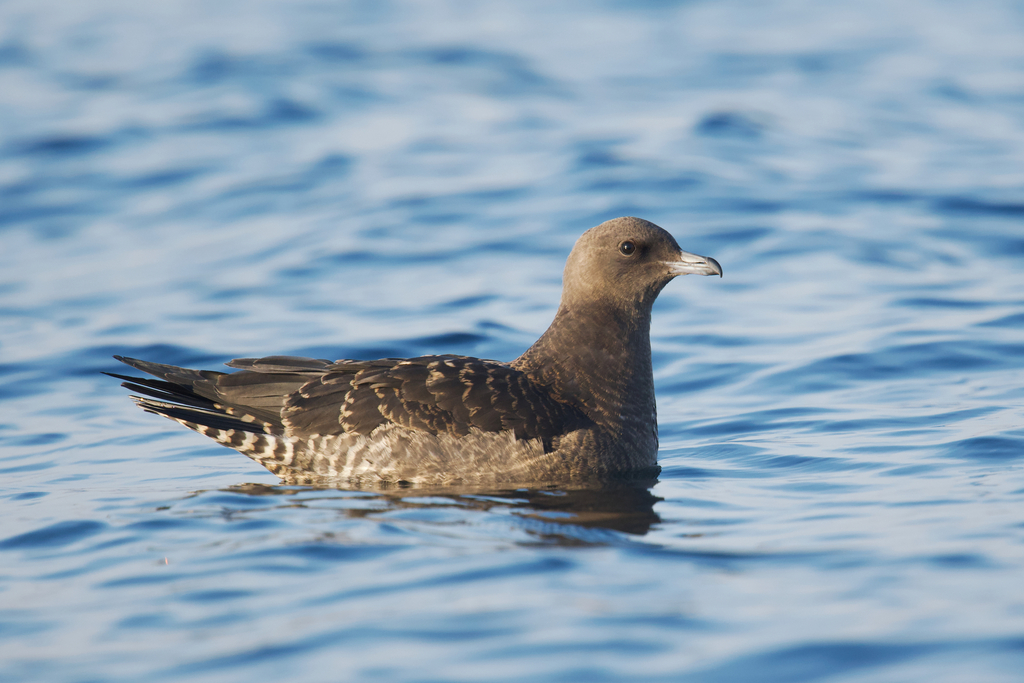
(c) Owen Strickland, some rights reserved (CC BY) · licence
Family: Stercorariidae · Class: Aves · Order: Charadriiformes
Stercorarius pomarinus (Pomarine Jaeger) is a California animal in the Stercorariidae family.
The Pomarine Jaeger is a medium-sized seabird measuring 46 to 67 cm (18 to 26 inches) in length with a wingspan of 125 to 138 cm (49 to 54 inches). Adults weigh 540 to 920 grams (1.2 to 2.0 pounds), making it the largest of the three jaeger species. During breeding season, adults display a distinctive dark brown cap extending below the eye, white cheeks and throat, and a prominent breast band. The central tail feathers are elongated and twisted, extending 5 to 10 cm beyond the other rectrices in adults. Non-breeding plumage is more uniform brown above with lighter underparts. Light and dark morphs exist, with intermediate forms also occurring. Juveniles lack the elongated central tail feathers and show heavy barring throughout. Pomarine Jaegers breed in Arctic tundra regions of Alaska, northern Canada, and northern Eurasia. In California, they occur as migrants and winter visitors along the entire coast from March through November, with peak abundance during spring and fall migration periods. The species is regularly observed from shore-based locations including Point Reyes, Monterey Bay, and the Channel Islands. During migration, concentrations can be observed several kilometers offshore, particularly along upwelling zones. This pelagic species inhabits open ocean waters, typically remaining beyond the continental shelf except during migration when individuals may approach nearshore areas. Pomarine Jaegers prefer areas of high marine productivity, often associated with upwelling zones, convergence areas, and regions where cold and warm water masses meet. During the breeding season, they occupy Arctic tundra near lakes and coastal areas, selecting elevated sites for nesting. Pomarine Jaegers are primarily kleptoparasitic, obtaining much of their food by harassing other seabirds until they regurgitate or drop their catch. Target species include gulls, terns, and alcids. They also hunt directly for fish, particularly during the breeding season when feeding young, and consume small mammals, bird eggs, and carrion on Arctic breeding grounds. The species exhibits strong site fidelity to both breeding and wintering areas. Breeding occurs from June to August, with pairs constructing shallow scrapes lined with vegetation. Females typically lay two olive-brown eggs with dark markings. Both parents incubate eggs for 25 to 27 days and care for the semi-precocial young. The Pomarine Jaeger is not currently listed under the Endangered Species Act or by the state of California. The global population is estimated at 150,000 to 290,000 breeding pairs according to BirdLife International. Climate change represents the primary long-term threat, as Arctic warming affects breeding habitat and prey availability. Shifting marine ecosystems due to changing ocean temperatures may alter food webs that support this species during migration and winter periods. Oil spills and marine pollution pose additional risks to marine-dependent populations. The species' dependence on other seabirds for kleptoparasitism makes it vulnerable to declines in host species populations.
Classification
Class: Aves · Order: Charadriiformes · Family: Stercorariidae
Frequently asked questions
How is Stercorarius pomarinus classified?
Stercorarius pomarinus belongs to class Aves, order Charadriiformes, family Stercorariidae.
What family does Stercorarius pomarinus belong to?
Stercorarius pomarinus is in the Stercorariidae family.
What is Stercorarius pomarinus?
The Pomarine Jaeger is a medium-sized seabird measuring 46 to 67 cm (18 to 26 inches) in length with a wingspan of 125 to 138 cm (49 to 54 inches).
Is Stercorarius pomarinus found in California?
Yes. Stercorarius pomarinus is recorded in California in The California Species Project's catalogue.
Related species
Other California species in the same genus, family, or bioregion.
Data from The California Species Project — 14,000+ California species with verified data from CNPS, CDFW, USFWS, and more.