Stereolepis gigas
Giant sea bass
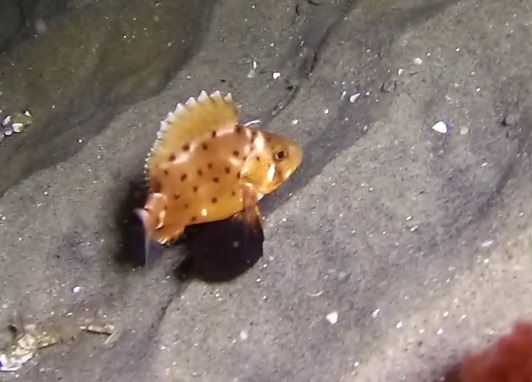
(c) Michael Bear, some rights reserved (CC BY) · licence
Family: Polyprionidae · Class: Actinopterygii · Order: Perciformes
Conservation status: G3 S1S2
Stereolepis gigas (Giant sea bass) is a California animal in the Polyprionidae family.
The giant sea bass is the largest bony fish native to California's coastal waters, capable of reaching lengths exceeding 2.5 meters (8.2 feet) and weights of 255 kilograms (563 pounds). Adults display a distinctive dark brown to black coloration with a robust, elongated body and large mouth. Juveniles are notably different, exhibiting bright orange to reddish coloration with distinctive dark spots that fade as they mature. The species possesses a single dorsal fin with 11 spines and 10 soft rays, and a rounded caudal fin. Large adults develop a pronounced hump behind the head, giving them a distinctive profile. Historically, giant sea bass ranged from Humboldt Bay, California, south to the tip of Baja California, Mexico, and in the northern Gulf of California. The species was once abundant throughout Southern California waters, particularly around the Channel Islands. Current distribution is severely contracted, with the population centered primarily around the Channel Islands and mainland Southern California from Point Conception to the Mexican border. Occasional sightings occur north of Point Conception, but these are increasingly rare. Giant sea bass inhabit rocky reefs, kelp forests, and sandy bottoms in nearshore and offshore waters from the surface to depths of 275 meters (900 feet). Adults are typically found in deeper waters around rocky outcrops and seamounts, while juveniles often shelter in kelp forests and eelgrass beds in shallower waters. The species shows strong site fidelity, with individuals often remaining in specific territories for extended periods. This species is a slow-growing, long-lived predator that feeds primarily on a variety of fish, squid, crustaceans, and stingrays. Giant sea bass are protogynous hermaphrodites, beginning life as females and transitioning to males as they age and grow larger. Sexual maturity occurs between 11 to 13 years of age at approximately 1.2 to 1.5 meters (4 to 5 feet) in length. Spawning occurs during summer months in aggregations, typically in deeper offshore waters. The species can live over 70 years, with some estimates suggesting maximum ages approaching 100 years. The giant sea bass holds a Global rank of G3 (vulnerable) and California State rank of S1S2 (critically imperiled to imperiled), reflecting its severely depleted population status. Once supporting a substantial commercial and recreational fishery, the species experienced dramatic population decline due to overfishing in the early to mid-20th century. California implemented complete protection for the species in 1982, prohibiting all take. Despite decades of protection, recovery has been slow due to the species' life history characteristics including slow growth, late maturity, and low reproductive output. Current population estimates suggest fewer than 500 adult individuals remain in California waters, though monitoring challenges make precise counts difficult. Primary ongoing threats include habitat degradation, climate change effects on kelp forest ecosystems, and incidental take in commercial fishing operations.
Classification
Class: Actinopterygii · Order: Perciformes · Family: Polyprionidae
Conservation status
G3 S1S2
Frequently asked questions
How is Stereolepis gigas classified?
Stereolepis gigas belongs to class Actinopterygii, order Perciformes, family Polyprionidae.
What family does Stereolepis gigas belong to?
Stereolepis gigas is in the Polyprionidae family.
Is Stereolepis gigas protected or of conservation concern?
Stereolepis gigas carries the following status: G3 S1S2.
What is Stereolepis gigas?
The giant sea bass is the largest bony fish native to California's coastal waters, capable of reaching lengths exceeding 2.5 meters (8.2 feet) and weights of 255 kilograms (563 pounds).
Is Stereolepis gigas found in California?
Yes. Stereolepis gigas is recorded in California in The California Species Project's catalogue.
More California species
This species has no close relatives in our California data — here are other species to explore.
Data from The California Species Project — 14,000+ California species with verified data from CNPS, CDFW, USFWS, and more.