Sterna forsteri
Forster's Tern
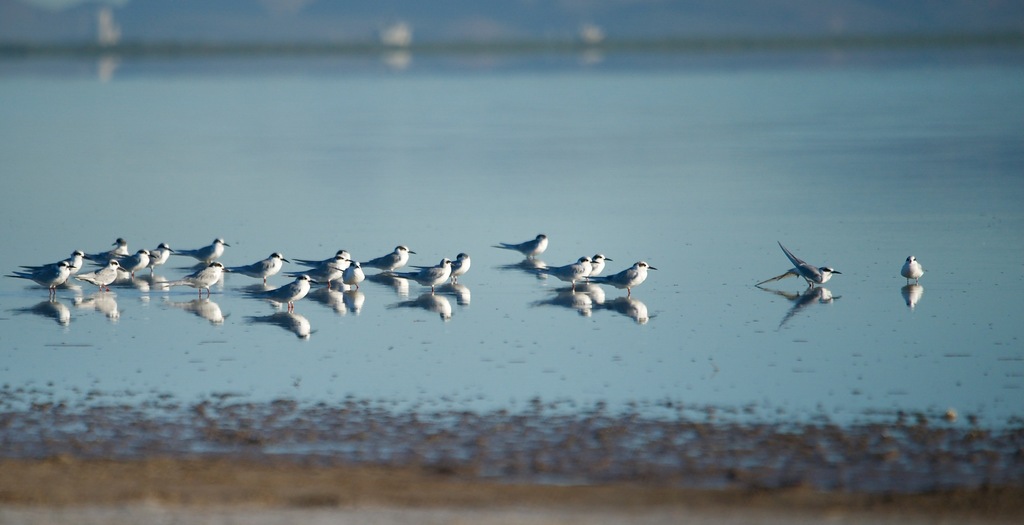
(c) Bill Levine, some rights reserved (CC BY) · licence
Family: Laridae · Class: Aves · Order: Charadriiformes
Sterna forsteri (Forster's Tern) is a California animal in the Laridae family.
Forster's Tern is a medium-sized waterbird measuring 33 to 36 centimeters (13 to 14 inches) in length with a wingspan of 79 to 84 centimeters (31 to 33 inches). Adults weigh 130 to 200 grams. During breeding season, adults display a black cap extending from the forehead to the nape, a bright orange bill with a black tip, and orange legs. The upperparts are pale gray, while the underparts are white. In winter plumage, the black cap is replaced by a distinctive black eye patch and dark auricular streak. The tail is deeply forked, and the wings appear translucent when viewed from below in flight. Juveniles show brown mottling on the back and wings. Forster's Tern breeds across much of western and central North America, from southern Canada to northern Mexico. In California, the species nests primarily in the Central Valley, the San Francisco Bay Area, coastal lagoons, and the Salton Sea. Important breeding colonies occur at San Francisco Bay salt ponds, Mono Lake, Clear Lake, and various Central Valley wetlands. During winter, many California birds remain year-round in coastal areas, while others migrate to coastal regions from central California to Panama. The species inhabits shallow freshwater and saltwater environments including marshes, lakes, reservoirs, coastal bays, and lagoons. Forster's Terns prefer areas with emergent vegetation such as cattails and bulrushes for nesting. They utilize water depths typically less than one meter for foraging. Nesting colonies are established on floating mats of vegetation, artificial platforms, or low islands with sparse vegetation. The species shows tolerance for varying salinity levels, allowing occupation of both freshwater wetlands and hypersaline environments. Forster's Terns are piscivorous, feeding primarily on small fish measuring 5 to 10 centimeters in length. They employ hover-and-plunge feeding techniques, diving from heights of 3 to 8 meters above the water surface. The diet includes killifish, anchovies, silversides, and various minnow species, supplemented by aquatic invertebrates and occasionally insects. Breeding occurs from April through August, with peak activity in May and June. Females construct nests using available vegetation and lay 2 to 4 eggs, typically 3. The incubation period lasts 23 to 25 days, with both parents sharing duties. Chicks fledge after 28 to 35 days but remain dependent on parents for several additional weeks. Forster's Tern is not federally or state listed in California and maintains stable populations across much of its range. However, the species faces localized threats including habitat loss through wetland drainage, water diversions affecting prey availability, and human disturbance at nesting colonies. Climate change impacts include altered precipitation patterns affecting wetland hydrology and potential shifts in prey distribution. Conservation efforts focus on protecting and restoring wetland habitats, managing water levels during breeding season, and establishing buffer zones around nesting colonies to minimize disturbance.
Classification
Class: Aves · Order: Charadriiformes · Family: Laridae
Frequently asked questions
How is Sterna forsteri classified?
Sterna forsteri belongs to class Aves, order Charadriiformes, family Laridae.
What family does Sterna forsteri belong to?
Sterna forsteri is in the Laridae family.
What is Sterna forsteri?
Forster's Tern is a medium-sized waterbird measuring 33 to 36 centimeters (13 to 14 inches) in length with a wingspan of 79 to 84 centimeters (31 to 33 inches).
Is Sterna forsteri found in California?
Yes. Sterna forsteri is recorded in California in The California Species Project's catalogue.
Related species
Other California species in the same genus, family, or bioregion.
Data from The California Species Project — 14,000+ California species with verified data from CNPS, CDFW, USFWS, and more.