Sterna paradisaea
Arctic Tern
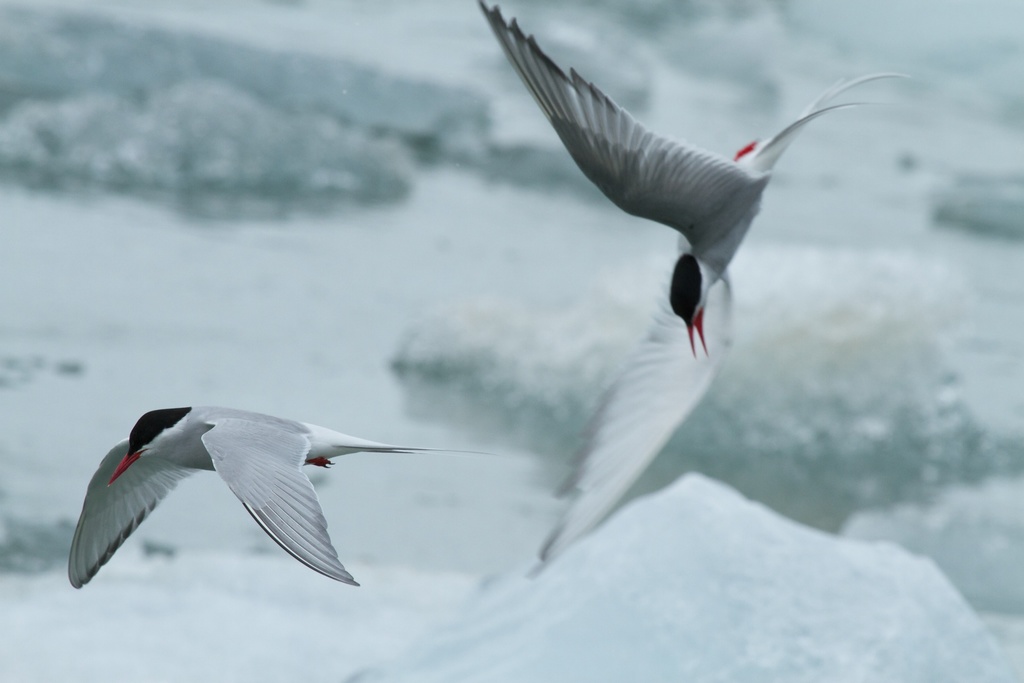
(c) Brian Gratwicke, some rights reserved (CC BY) · licence
Family: Laridae · Class: Aves · Order: Charadriiformes
Sterna paradisaea (Arctic Tern) is a California animal in the Laridae family.
The Arctic tern is a medium-sized seabird measuring 33 to 36 centimeters (13 to 14 inches) in length with a wingspan of 76 to 85 centimeters (30 to 33 inches). Adults weigh 86 to 127 grams (3.0 to 4.5 ounces). During breeding season, the species displays a black cap extending from the forehead to the nape, bright orange-red bill and legs, and pale gray upperparts contrasting with white underparts. The wings are narrow and pointed with dark gray flight feathers. Non-breeding adults show a white forehead with black restricted to the nape and crown, while the bill and legs fade to dark orange or black. Arctic terns breed in the high Arctic and subarctic regions of North America, Europe, and Asia. In North America, breeding populations occur from Alaska and northern Canada south to British Columbia, the Great Lakes region, and New England. The species is a vagrant to California, with irregular sightings primarily along the coast during migration periods. Most California records occur from April through June and August through October, coinciding with the species' epic migrations between Arctic breeding grounds and Antarctic wintering areas. The species inhabits coastal environments including beaches, mudflats, estuaries, and nearshore waters during migration and winter. Breeding habitat consists of tundra, islands, beaches, and rocky shores near water. Arctic terns require open areas for nesting with minimal vegetation and access to productive fishing waters. During migration, they utilize marine environments and occasionally inland water bodies. Arctic terns are highly aerial, spending most of their lives in flight. The species undertakes the longest migration of any bird, traveling roughly 70,000 kilometers (44,000 miles) annually from Arctic breeding grounds to Antarctic waters and back. They feed primarily by plunge-diving for small fish, particularly herring, sardines, anchovies, and smelt, though they also consume marine invertebrates and occasionally insects. Breeding occurs in colonies from May through August, with pairs typically laying 1 to 3 eggs in ground scrapes lined with vegetation, shells, or pebbles. Incubation lasts 21 to 24 days, and chicks fledge after 21 to 24 days. Both parents participate in incubation and chick-rearing. Globally, Arctic tern populations are considered stable, though some regional declines have been documented. The species faces threats from climate change affecting both Arctic breeding habitats and marine food webs, coastal development, human disturbance at breeding colonies, and pollution including plastic ingestion. Oil spills pose particular risks given the species' extensive marine habitat use. In California, Arctic terns receive protection under the Migratory Bird Treaty Act, and their rarity makes each sighting noteworthy for monitoring migration patterns and population trends.
Classification
Class: Aves · Order: Charadriiformes · Family: Laridae
Frequently asked questions
How is Sterna paradisaea classified?
Sterna paradisaea belongs to class Aves, order Charadriiformes, family Laridae.
What family does Sterna paradisaea belong to?
Sterna paradisaea is in the Laridae family.
What is Sterna paradisaea?
The Arctic tern is a medium-sized seabird measuring 33 to 36 centimeters (13 to 14 inches) in length with a wingspan of 76 to 85 centimeters (30 to 33 inches).
Is Sterna paradisaea found in California?
Yes. Sterna paradisaea is recorded in California in The California Species Project's catalogue.
Related species
Other California species in the same genus, family, or bioregion.
Data from The California Species Project — 14,000+ California species with verified data from CNPS, CDFW, USFWS, and more.