Sternula antillarum
Least Tern
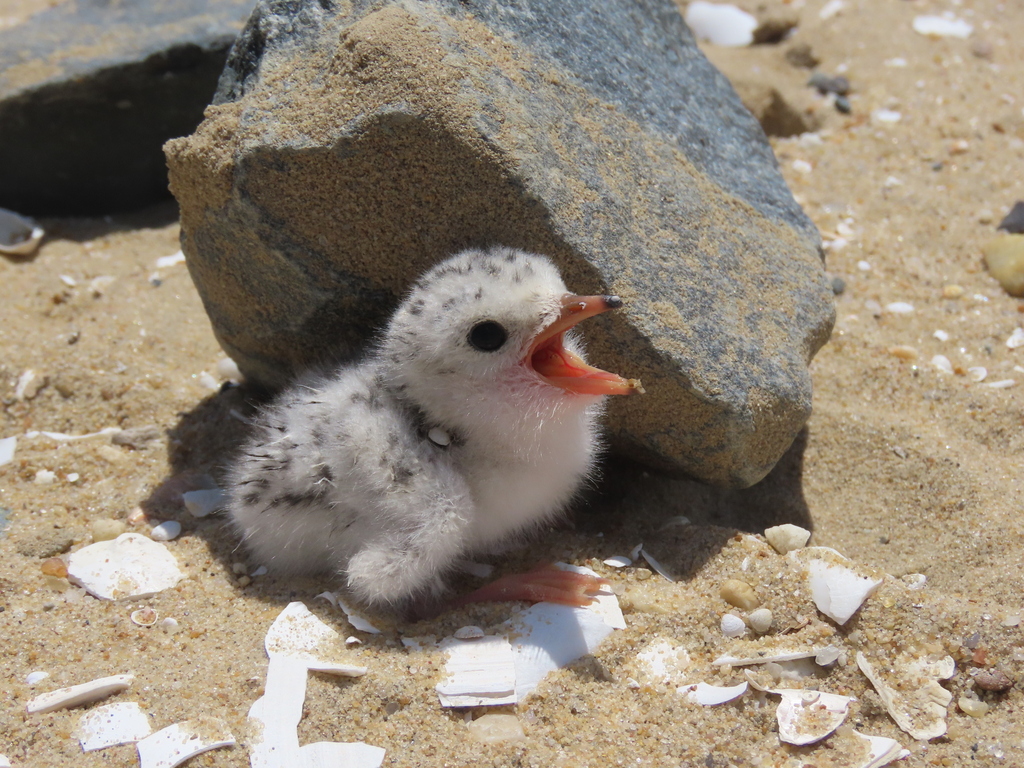
(c) Alina Martin, some rights reserved (CC BY) · licence
Family: Laridae · Class: Aves · Order: Charadriiformes
Sternula antillarum (Least Tern) is a California animal in the Laridae family.
The Least Tern is the smallest member of the gull and tern family in North America, measuring approximately 23 cm (9 inches) in length with a wingspan of 50 cm (20 inches). Adults display distinctive black caps during breeding season, pale gray wings with black-tipped primaries, and deeply forked tails. The bill is bright yellow with a black tip, and legs are orange-yellow. Non-breeding adults lose the black cap, retaining only a black eye stripe and nape patch. Long, narrow wings and graceful flight patterns distinguish this species from other small seabirds. Least Terns breed along the Pacific, Atlantic, and Gulf coasts of North America, with an interior population along major river systems. The species includes three recognized subspecies: the California Least Tern (Sternula antillarum browni), the Interior Least Tern (S. a. athalassos), and the eastern subspecies (S. a. antillarum). In California, the subspecies browni nests at approximately 29 sites along the coast from San Francisco Bay south to Mexico, encompassing roughly 487 hectares of nesting habitat. Major nesting areas include beaches near river mouths, bays, and estuaries from Alameda County through San Diego County. Least Terns nest colonially on bare or sparsely vegetated sand, dried mudflats, sandy islands, and gravel areas close to productive fishing waters. Nesting sites are typically within 2 km of foraging areas and feature minimal vegetation cover. The species requires open, flat terrain for nesting and nearby shallow waters with abundant small fish. Both natural beaches and constructed sites such as dredge spoil islands serve as nesting habitat. These aerial insectivores feed primarily on small fish obtained through plunge-diving from heights of 3-6 meters. Their diet consists mainly of fish species less than 9 cm long, including northern anchovy, topsmelt, surf perch, killifish, and mosquitofish (NatureServe Explorer). Breeding occurs from April through August, with females typically laying 1-3 eggs in shallow scrapes lined with shells or debris. Incubation lasts 19-25 days, and young fledge after 19-20 days but remain dependent on parents for several weeks. The California Least Tern subspecies is federally listed as endangered, while the Interior Least Tern is listed as endangered throughout its range. According to USFWS, California least tern populations have recovered from fewer than 600 pairs in the 1970s to approximately 7,000 pairs by recent counts. Primary threats include habitat loss from coastal development, human disturbance at nesting colonies, predation by introduced species, and climate change impacts on prey availability. Conservation efforts focus on habitat protection, predator control, and colony management through partnerships with military installations, ports, and local agencies. The species' dependence on dynamic coastal environments makes it particularly vulnerable to sea level rise and altered sediment transport patterns.
Classification
Class: Aves · Order: Charadriiformes · Family: Laridae
Frequently asked questions
How is Sternula antillarum classified?
Sternula antillarum belongs to class Aves, order Charadriiformes, family Laridae.
What family does Sternula antillarum belong to?
Sternula antillarum is in the Laridae family.
What is Sternula antillarum?
The Least Tern is the smallest member of the gull and tern family in North America, measuring approximately 23 cm (9 inches) in length with a wingspan of 50 cm (20 inches).
Is Sternula antillarum found in California?
Yes. Sternula antillarum is recorded in California in The California Species Project's catalogue.
Related species
Other California species in the same genus, family, or bioregion.
Data from The California Species Project — 14,000+ California species with verified data from CNPS, CDFW, USFWS, and more.