Sternula antillarum browni
California least tern
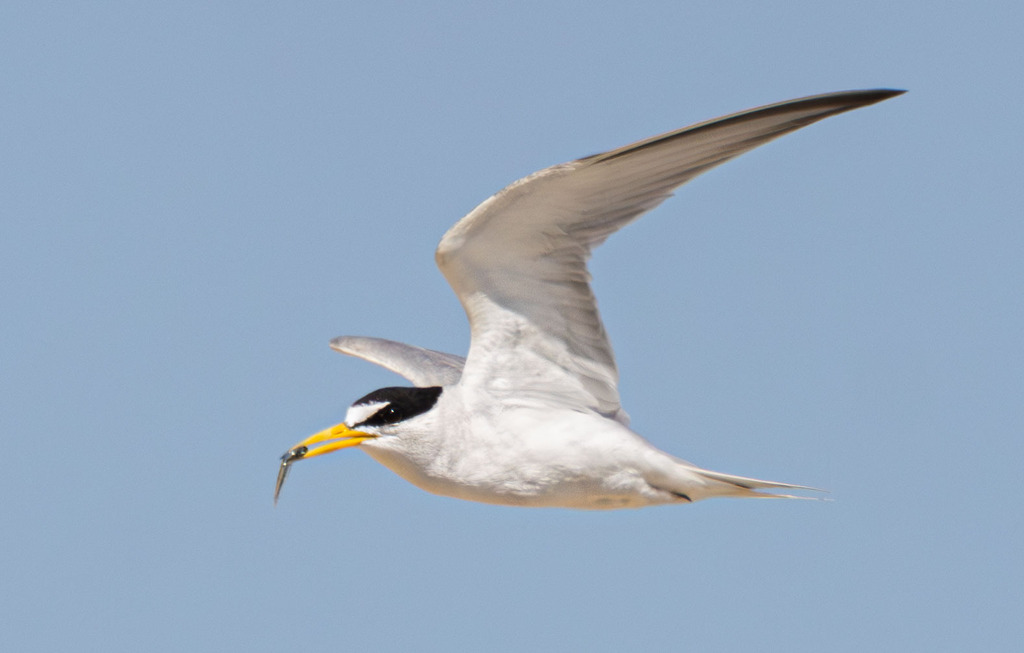
(c) Brooke J., some rights reserved (CC BY) · licence
Family: Laridae · Class: Aves · Order: Charadriiformes
Conservation status: FP · Endangered · G4T2T3Q S2
Sternula antillarum browni (California least tern) is a California animal in the Laridae family.
The California least tern is the smallest North American tern species, measuring fewer than 10 inches (25 cm) in length with a wingspan of approximately 20 inches (51 cm) and weighing between 45 and 55 grams (USFWS). Adults display a distinctive black cap during breeding season, gray wings with black wingtips, white underparts, and bright orange legs. The bill is yellow with a black tip, slightly decurved and tapered. Both sexes share similar plumage characteristics, though males may be slightly larger. The species has a short, deeply forked tail and long, narrow wings adapted for precise flight maneuvers over water. Historically distributed along the Pacific Coast from San Francisco Bay to Baja California, Mexico, the California least tern now occupies a severely fragmented range. Current breeding populations are concentrated at fewer than 50 sites, primarily in Southern California from Ventura County south to San Diego County, with isolated colonies along the central coast. The subspecies also breeds in Baja California, Mexico. Breeding sites are now largely restricted to protected areas, military installations, and managed beaches due to extensive coastal development. California least terns require open, flat areas with minimal vegetation for nesting, typically on sandy beaches, mudflats, or artificial substrates near marine waters. Colonies are established on elevated portions of beaches, dredge spoil islands, and occasionally rooftops. Nesting sites must be close to productive foraging areas, usually within 2-3 miles of shallow marine waters, bays, estuaries, or lagoons where small fish concentrate. The species shows adaptability to human-modified environments, readily using constructed islands and managed beach areas. Breeding occurs from April through September, with peak activity in May and June. California least terns are highly social during nesting, forming dense colonies ranging from a few pairs to over 600 pairs at major sites like Naval Base Coronado. Females typically lay 1-3 eggs in shallow scrapes lined with shell fragments or debris. Incubation lasts 19-25 days, with both parents sharing duties. Diet consists primarily of small fish including anchovies, sardines, and smelt, captured through precise diving from heights of 3-30 feet. Adults may travel several miles from colonies to forage in productive waters. Listed as federally endangered in 1970, the California least tern experienced severe population decline from historical numbers in the thousands to approximately 600 birds by 1973. Through intensive management including habitat protection, predator control, and human disturbance reduction, populations have recovered to over 7,000 individuals as of recent surveys (USFWS). Primary threats include coastal development, human disturbance, introduced predators, and climate change impacts on prey availability. Sea level rise poses long-term challenges to remaining beach nesting sites. Active management at most breeding locations includes seasonal closures, predator exclusion fencing, and docent programs to minimize human disturbance during the critical nesting period.
Classification
Class: Aves · Order: Charadriiformes · Family: Laridae
Conservation status
FP · Endangered · G4T2T3Q S2
Frequently asked questions
How is Sternula antillarum browni classified?
Sternula antillarum browni belongs to class Aves, order Charadriiformes, family Laridae.
What family does Sternula antillarum browni belong to?
Sternula antillarum browni is in the Laridae family.
Is Sternula antillarum browni protected or of conservation concern?
Sternula antillarum browni carries the following status: FP · Endangered · G4T2T3Q S2.
What is Sternula antillarum browni?
The California least tern is the smallest North American tern species, measuring fewer than 10 inches (25 cm) in length with a wingspan of approximately 20 inches (51 cm) and weighing between 45 and 55 grams (USFWS).
Is Sternula antillarum browni found in California?
Yes. Sternula antillarum browni is recorded in California in The California Species Project's catalogue.
Related species
Other California species in the same genus, family, or bioregion.
Data from The California Species Project — 14,000+ California species with verified data from CNPS, CDFW, USFWS, and more.