Streptopelia orientalis
Oriental Turtle-Dove
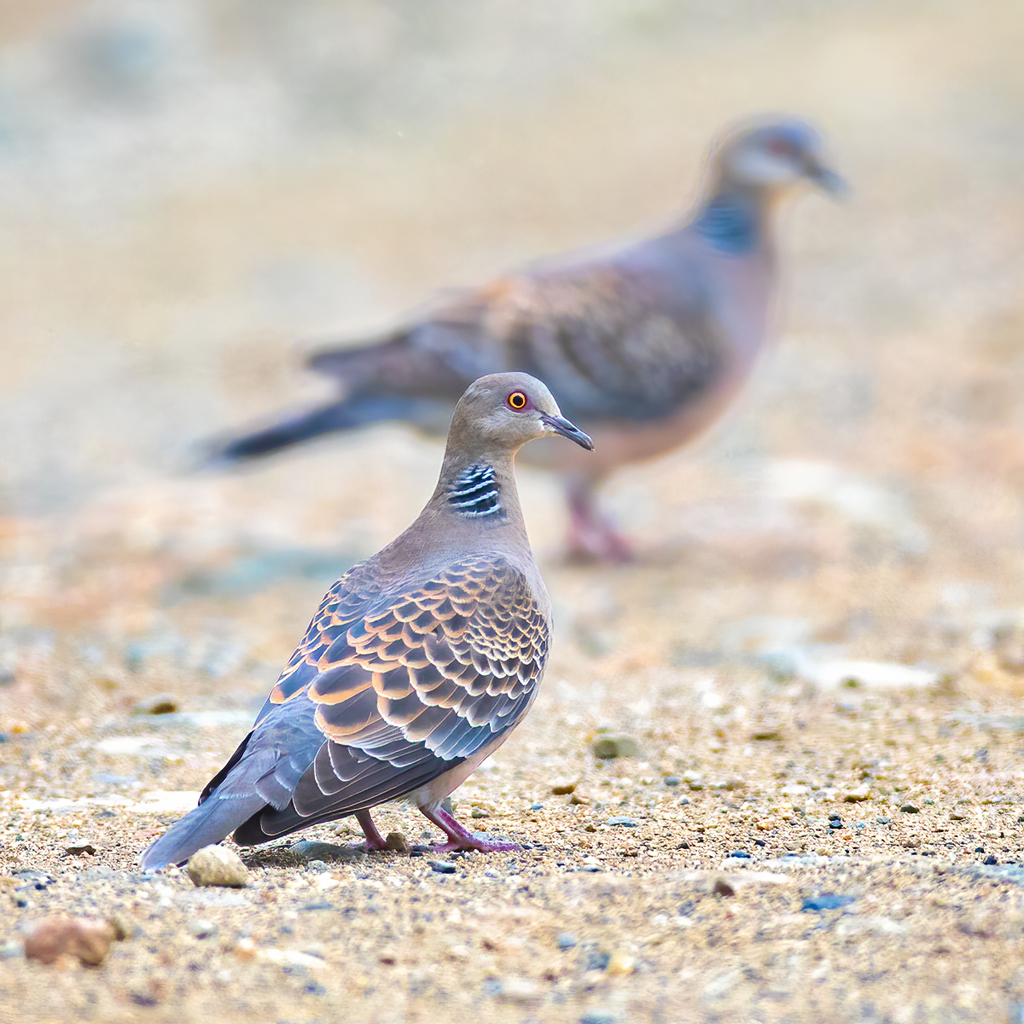
(c) egorbirder, some rights reserved (CC BY) · licence
Family: Columbidae · Class: Aves · Order: Columbiformes
Streptopelia orientalis (Oriental Turtle-Dove) is a California animal in the Columbidae family.
The Oriental Turtle-Dove is a medium-sized dove measuring 33-35 cm (13-14 inches) in length with a wingspan of approximately 58-68 cm (23-27 inches). Adults display brownish-gray upperparts with distinctive black and white striped patches on the sides of the neck. The breast and underparts are pale pinkish-buff, while the wings show rufous and black scaling. The tail is dark with prominent white tips on the outer feathers. Males and females appear similar, though males may be slightly larger with more pronounced neck markings. The Oriental Turtle-Dove is native to temperate Asia, with its natural range extending from the Russian Far East through Mongolia, China, Korea, and Japan. In North America, this species occurs only as an introduced population. Small numbers have been documented in California, particularly in urban and suburban areas of Los Angeles County, where the species was first reported in the 1990s. The California population appears to be derived from escaped cage birds rather than natural migration. In its native range, Oriental Turtle-Doves inhabit mixed forests, woodland edges, parks, and agricultural areas from sea level to elevations of 4,000 meters (13,100 feet). The California population shows similar habitat preferences, utilizing urban parks, residential areas with mature trees, and ornamental landscapes. The species favors areas with a combination of trees for nesting and open ground for foraging. Oriental Turtle-Doves are primarily granivorous, feeding on seeds of grasses, herbs, and cultivated crops. They also consume small fruits and occasionally take insects, particularly during the breeding season. The species typically forages on the ground, often in small flocks outside the breeding season. In their native range, breeding occurs from April through August, with pairs constructing loose platform nests of twigs in trees or shrubs. Females typically lay two white eggs, with incubation lasting 14-16 days. The species produces multiple broods per season under favorable conditions. The Oriental Turtle-Dove is not federally listed or protected under California state law. The species maintains stable populations throughout most of its native Asian range and is classified as Least Concern by the International Union for Conservation of Nature. The small California population represents an introduced occurrence rather than a conservation concern. In Asia, the species faces localized pressures from habitat conversion and hunting in some regions, but overall populations remain robust. The California population appears to be limited and possibly declining, though comprehensive surveys are lacking. Climate change may affect the species' elevational distribution in its native mountain habitats, potentially forcing populations to higher elevations as temperatures increase.
Classification
Class: Aves · Order: Columbiformes · Family: Columbidae
Frequently asked questions
How is Streptopelia orientalis classified?
Streptopelia orientalis belongs to class Aves, order Columbiformes, family Columbidae.
What family does Streptopelia orientalis belong to?
Streptopelia orientalis is in the Columbidae family.
What is Streptopelia orientalis?
The Oriental Turtle-Dove is a medium-sized dove measuring 33-35 cm (13-14 inches) in length with a wingspan of approximately 58-68 cm (23-27 inches).
Is Streptopelia orientalis found in California?
Yes. Streptopelia orientalis is recorded in California in The California Species Project's catalogue.
Related species
Other California species in the same genus, family, or bioregion.
Data from The California Species Project — 14,000+ California species with verified data from CNPS, CDFW, USFWS, and more.