Streptoprocne zonaris
White-collared Swift
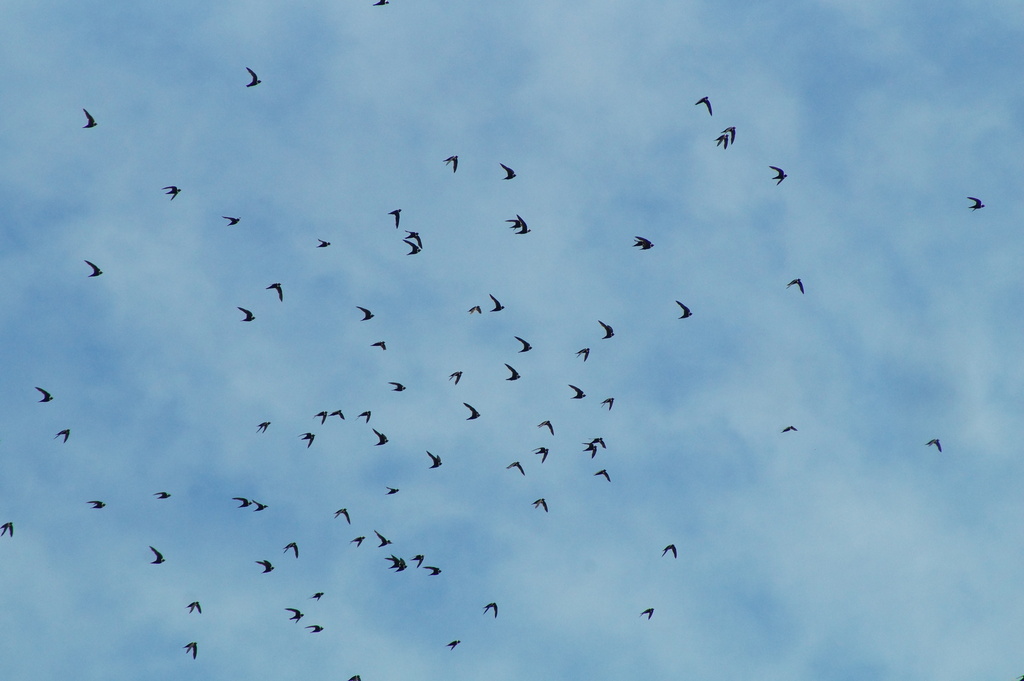
(c) Carlos Domínguez-Rodríguez, some rights reserved (CC BY) · licence
Family: Apodidae · Class: Aves · Order: Apodiformes
Streptoprocne zonaris (White-collared Swift) is a California animal in the Apodidae family.
The White-collared Swift is a large, powerful aerial insectivore belonging to the family Apodidae. Adults measure 20 to 22 centimeters (7.9 to 8.7 inches) in length with a wingspan reaching 43 to 46 centimeters (17 to 18 inches), making it one of the largest swift species in the Americas. The species displays predominantly blackish-brown plumage with a distinctive white collar around the neck that may appear incomplete or broken in some individuals. The tail is slightly notched rather than deeply forked, distinguishing it from smaller swift species. Wings are long, narrow, and curved, adapted for sustained flight and rapid aerial maneuvers. The White-collared Swift has an extensive range from Mexico through Central America to South America, reaching as far south as northern Argentina. In North America, the species occurs primarily along the Pacific coast of Mexico, with occasional records extending into extreme southern California. The northernmost documented breeding populations are found in the mountains of western Mexico, particularly in the Sierra Madre Occidental. Vagrant individuals have been recorded in California, Arizona, and Texas, representing the northern limits of the species' wandering range. This species inhabits mountainous regions, typically nesting on vertical cliff faces, cave walls, and behind waterfalls at elevations ranging from 300 to 3,000 meters (980 to 9,840 feet). White-collared Swifts prefer areas with abundant flying insects and access to vertical nesting surfaces near water sources. They are often associated with tropical and subtropical forests, pine-oak woodlands, and cloud forests. The species requires large airspaces for foraging and demonstrates a preference for areas with consistent thermal updrafts. White-collared Swifts are highly gregarious, forming large flocks that may contain hundreds or thousands of individuals during migration and at roosting sites. They are entirely aerial insectivores, capturing flying insects including flies, beetles, flying ants, and termites while in continuous flight. The species can remain airborne for extended periods, rarely landing except at nest sites. Breeding occurs during the wet season, with timing varying by latitude. Nests are constructed of plant materials, feathers, and saliva, placed on ledges or in crevices on vertical surfaces. Females typically lay two white eggs, with both parents participating in incubation and chick rearing. The incubation period lasts approximately 24 to 28 days, and nestlings fledge after 45 to 50 days. The White-collared Swift is not currently listed under the U.S. Endangered Species Act, nor does it hold special conservation status in California, as the state lies at the extreme northern edge of the species' range. The species is classified as Least Concern by the International Union for Conservation of Nature, with stable populations throughout most of its range. However, habitat loss due to deforestation and human development poses localized threats in some regions. Climate change may affect the distribution of suitable habitat and prey availability, particularly in mountainous areas where the species breeds.
Classification
Class: Aves · Order: Apodiformes · Family: Apodidae
Frequently asked questions
How is Streptoprocne zonaris classified?
Streptoprocne zonaris belongs to class Aves, order Apodiformes, family Apodidae.
What family does Streptoprocne zonaris belong to?
Streptoprocne zonaris is in the Apodidae family.
What is Streptoprocne zonaris?
The White-collared Swift is a large, powerful aerial insectivore belonging to the family Apodidae.
Is Streptoprocne zonaris found in California?
Yes. Streptoprocne zonaris is recorded in California in The California Species Project's catalogue.
Related species
Other California species in the same genus, family, or bioregion.
Data from The California Species Project — 14,000+ California species with verified data from CNPS, CDFW, USFWS, and more.