Strix nebulosa
Great gray owl
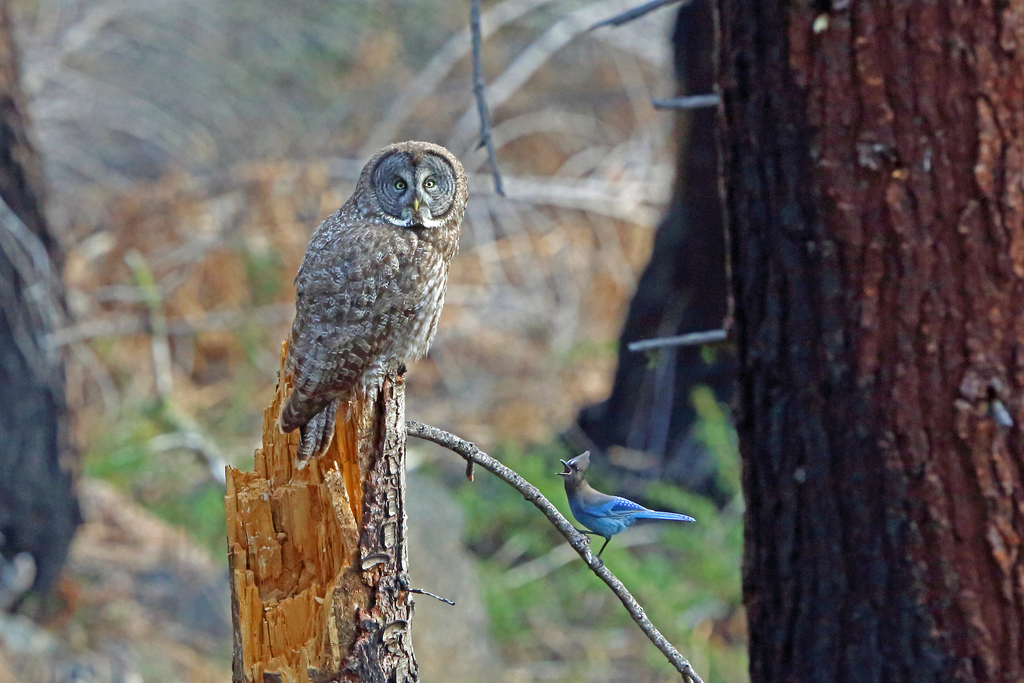
(c) Nigel Voaden, some rights reserved (CC BY) · licence
Family: Strigidae · Class: Aves · Order: Strigiformes
Conservation status: SE · G5 S3?
Strix nebulosa (Great gray owl) is a California animal in the Strigidae family.
The great gray owl is North America's largest owl by length, measuring 61 to 84 cm (24 to 33 inches) with a wingspan reaching 142 to 152 cm (56 to 60 inches). Despite its considerable size, adults typically weigh only 580 to 1,900 grams (1.3 to 4.2 pounds) due to dense plumage that creates a deceptively bulky appearance. The species displays predominantly gray-brown coloration with intricate barring and streaking patterns. Most distinctive are the prominent facial discs, which can reach 46 cm (18 inches) in diameter, and the bright yellow eyes surrounded by concentric circles of gray and white. Small white patches between the eyes and bill create a distinctive "bow tie" pattern. No significant sexual dimorphism exists in plumage, though females average larger than males. In California, the great gray owl represents the southernmost population of the species in North America. The California population is geographically isolated, occurring primarily in the Sierra Nevada mountains from Yosemite National Park north to Plumas County, with elevation ranges typically between 1,200 and 2,400 meters (4,000 to 8,000 feet). Small populations may also exist in the Cascade Range near the Oregon border. The broader North American range extends through boreal forests of Canada, Alaska, and the northern Rocky Mountains. California great gray owls inhabit mature coniferous and mixed coniferous-deciduous forests, particularly those containing large trees for nesting and adjacent meadows for hunting. Key habitat components include old-growth or mature second-growth forests with trees exceeding 50 cm (20 inches) diameter at breast height, and openings such as wet meadows, clear-cuts, or natural clearings within 1 km of forest edge. The species requires snags or trees with suitable cavities for nesting, often utilizing abandoned hawk, crow, or squirrel nests. Great gray owls are primarily crepuscular and nocturnal hunters, specializing in small mammals, particularly pocket gophers and voles, which comprise 80 to 90 percent of their diet. Their exceptional hearing allows them to detect prey beneath snow up to 30 cm deep. Breeding occurs from March to July, with females laying 2 to 5 eggs in stick nests located 4 to 18 meters above ground. Incubation lasts 28 to 36 days, and young fledge after 3 to 4 weeks but remain dependent on parents for several months. The California Department of Fish and Wildlife lists the great gray owl as state endangered, reflecting the small, isolated nature of the California population. Population estimates suggest fewer than 300 individuals remain in California, with habitat loss, fragmentation, and altered fire regimes identified as primary threats. Climate change poses additional risks through potential upslope habitat shifts and altered prey availability. West Nile virus has emerged as a significant mortality factor since 2003. Conservation efforts focus on habitat protection, nest site management, and population monitoring through ongoing research programs in Yosemite and surrounding areas.
Classification
Class: Aves · Order: Strigiformes · Family: Strigidae
Conservation status
SE · G5 S3?
Frequently asked questions
How is Strix nebulosa classified?
Strix nebulosa belongs to class Aves, order Strigiformes, family Strigidae.
What family does Strix nebulosa belong to?
Strix nebulosa is in the Strigidae family.
Is Strix nebulosa protected or of conservation concern?
Strix nebulosa carries the following status: SE · G5 S3?.
What is Strix nebulosa?
The great gray owl is North America's largest owl by length, measuring 61 to 84 cm (24 to 33 inches) with a wingspan reaching 142 to 152 cm (56 to 60 inches).
Is Strix nebulosa found in California?
Yes. Strix nebulosa is recorded in California in The California Species Project's catalogue.
Related species
Other California species in the same genus, family, or bioregion.
Data from The California Species Project — 14,000+ California species with verified data from CNPS, CDFW, USFWS, and more.