Strix occidentalis caurina
Northern spotted owl
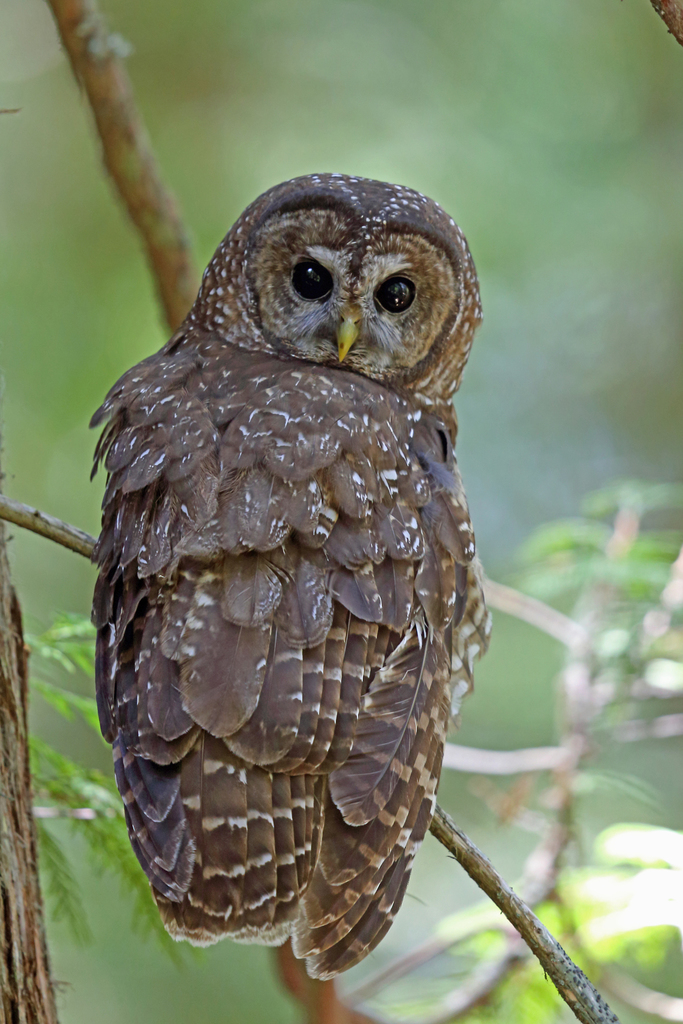
(c) Nigel Voaden, some rights reserved (CC BY) · licence
Family: Strigidae · Class: Aves · Order: Strigiformes
Conservation status: ST · Threatened
Strix occidentalis caurina (Northern spotted owl) is a California animal in the Strigidae family.
The Northern spotted owl is a medium-sized forest owl and the largest of three spotted owl subspecies. Adults measure 41-48 cm (16-19 inches) in length with a wingspan of 107-114 cm (42-45 inches). Females are typically larger than males, weighing 550-760 grams compared to males at 520-620 grams. The species displays distinctive brown and white barred plumage with large dark eyes and lacks ear tufts. White spotting on the head and underparts creates the characteristic "spotted" appearance that distinguishes it from the closely related barred owl. The Northern spotted owl occurs in the western United States and southwestern British Columbia, Canada. Its range extends from southwestern British Columbia through the Cascade Mountains and coastal ranges of Washington and Oregon into northern California (USFWS 2011). The species is continuously distributed throughout these forested regions, with populations concentrated in areas of suitable old-growth habitat. In California, Northern spotted owls are found primarily in the northern coastal ranges and Cascade Mountains. Northern spotted owls inhabit structurally complex, mature and old-growth forests characterized by multi-layered canopies, large trees, and abundant snags and downed logs. These forests typically contain Douglas-fir, western hemlock, and other coniferous species that provide the structural diversity necessary for nesting, roosting, and foraging. The species requires forests with 60-80 percent canopy closure and significant amounts of woody debris on the forest floor. Elevation ranges vary by region but generally occur from sea level to 1,200 meters (4,000 feet). Northern spotted owls are primarily nocturnal predators that feed mainly on flying squirrels, woodrats, and other small mammals. They are non-migratory and maintain year-round territories that can range from 1,000 to 5,000 acres depending on habitat quality. Breeding occurs from March through September, with females typically laying 1-3 eggs in tree cavities or on platforms formed by broken tree tops. The species exhibits site fidelity, often returning to the same nesting areas year after year. Northern spotted owls can live over 20 years in the wild. The Northern spotted owl was listed as threatened under the Endangered Species Act in June 1990 due to habitat loss from logging of old-growth forests. Population monitoring since listing has documented continued declines, with the species experiencing annual population decreases of approximately 2.9 percent range-wide (USFWS 2011). Current population estimates suggest fewer than 20,000 pairs remain throughout the subspecies' range. Primary threats include continued habitat loss from timber harvest and wildfire, as well as competition from the invasive barred owl, which has expanded into spotted owl habitat and is currently considered the stressor with the largest negative impact on Northern spotted owls. The U.S. Fish and Wildlife Service has developed a Barred Owl Management Strategy to address this invasive species threat through targeted removal programs to support Northern spotted owl recovery.
Classification
Class: Aves · Order: Strigiformes · Family: Strigidae
Conservation status
ST · Threatened
Frequently asked questions
How is Strix occidentalis caurina classified?
Strix occidentalis caurina belongs to class Aves, order Strigiformes, family Strigidae.
What family does Strix occidentalis caurina belong to?
Strix occidentalis caurina is in the Strigidae family.
Is Strix occidentalis caurina protected or of conservation concern?
Strix occidentalis caurina carries the following status: ST · Threatened.
What is Strix occidentalis caurina?
The Northern spotted owl is a medium-sized forest owl and the largest of three spotted owl subspecies.
Is Strix occidentalis caurina found in California?
Yes. Strix occidentalis caurina is recorded in California in The California Species Project's catalogue.
Related species
Other California species in the same genus, family, or bioregion.
Data from The California Species Project — 14,000+ California species with verified data from CNPS, CDFW, USFWS, and more.