Strix occidentalis lucida
Mexican spotted owl
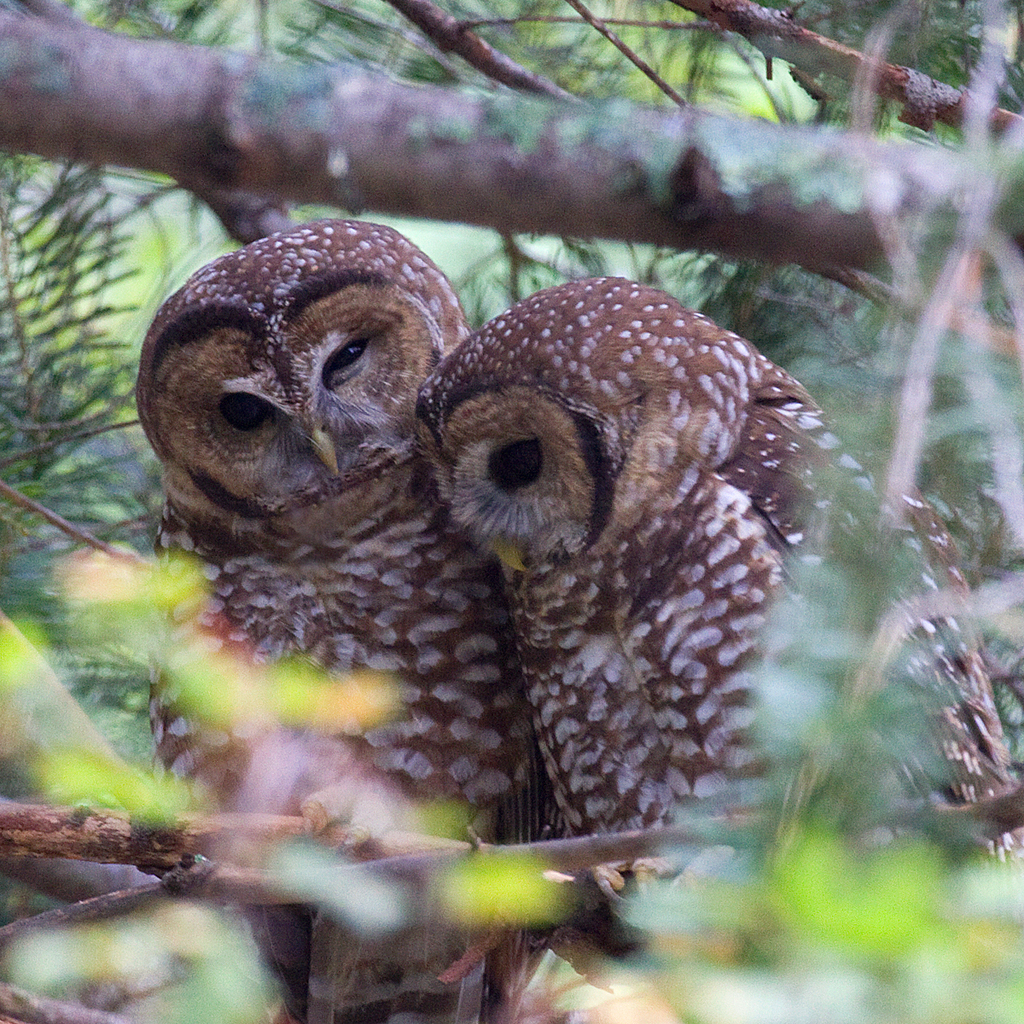
(c) Dan Vickers, some rights reserved (CC BY) · licence
Family: Strigidae · Class: Aves · Order: Strigiformes
Conservation status: Threatened
Strix occidentalis lucida (Mexican spotted owl) is a California animal in the Strigidae family.
The Mexican spotted owl is a medium-sized owl measuring 41 to 48 cm (16 to 19 inches) in length with a wingspan of 107 to 114 cm (42 to 45 inches). It ranks among North America's five largest owl species. The species lacks external ear tufts and displays a rounded head with large, round facial disks featuring indistinct concentric circles around dark brown eyes. The plumage is brown with a distinctive mottled appearance, and females are slightly larger than males, weighing 19-27 ounces compared to males at 17-24 ounces. The Mexican spotted owl occurs throughout the southwestern United States, including Arizona, New Mexico, Utah, and Colorado, extending into Mexico. This subspecies does not occur in California, where the California spotted owl (Strix occidentalis occidentalis) is found instead. The Mexican spotted owl is geographically separated from both the northern spotted owl (Strix occidentalis caurina) and California spotted owl, with distinct mitochondrial DNA sequences confirming the validity of the subspecies designation (Barrowclough et al. 1999). The species may appear in California regulatory databases due to potential impacts from federal projects or activities that could affect populations in adjacent southwestern states. This subspecies inhabits structurally complex forested areas similar to other spotted owl subspecies but also occupies steep, rocky canyonlands and riparian habitats along waterways. The species requires dense herbaceous riparian vegetation along streams, seeps, and ditches. Mexican spotted owls nest and roost in forested areas with multilayered canopies, utilizing both densely forested areas for nesting and more open spaces for hunting activities. Mexican spotted owls are territorial raptors with specific reproductive and foraging behaviors. Like other spotted owl subspecies, they require large territories and are primarily nocturnal hunters. The species feeds on small mammals, with radio-telemetry studies documenting their presence and movement patterns in nest core areas and wintering areas (USFWS 2012). Their territorial nature and habitat requirements make them sensitive to landscape-level changes and habitat fragmentation. The U.S. Fish and Wildlife Service listed the Mexican spotted owl as threatened under the Endangered Species Act in 1993, with critical habitat designated in 2004 and revised in 2016. The primary reason for listing was historical alteration of the owl's habitat due to timber management practices, with ongoing threats from continued habitat modification. Large-scale, high-severity wildfires represent the most significant current threat, displacing owls from established territories and forcing them to establish new territories in lower-quality habitat. After severe fires, owls can find perching sites but lack suitable nesting locations, often resulting in territory abandonment. Recovery efforts focus on habitat conservation and management, with active adaptive forest management identified as essential for achieving recovery goals. Critical habitat designation ensures protection of areas essential for the species' conservation across its range.
Classification
Class: Aves · Order: Strigiformes · Family: Strigidae
Conservation status
Threatened
Frequently asked questions
How is Strix occidentalis lucida classified?
Strix occidentalis lucida belongs to class Aves, order Strigiformes, family Strigidae.
What family does Strix occidentalis lucida belong to?
Strix occidentalis lucida is in the Strigidae family.
Is Strix occidentalis lucida protected or of conservation concern?
Strix occidentalis lucida carries the following status: Threatened.
What is Strix occidentalis lucida?
The Mexican spotted owl is a medium-sized owl measuring 41 to 48 cm (16 to 19 inches) in length with a wingspan of 107 to 114 cm (42 to 45 inches).
Is Strix occidentalis lucida found in California?
Yes. Strix occidentalis lucida is recorded in California in The California Species Project's catalogue.
Related species
Other California species in the same genus, family, or bioregion.
Data from The California Species Project — 14,000+ California species with verified data from CNPS, CDFW, USFWS, and more.