Strix occidentalis occidentalis pop. 2
California spotted owl - Sierra Nevada DPS
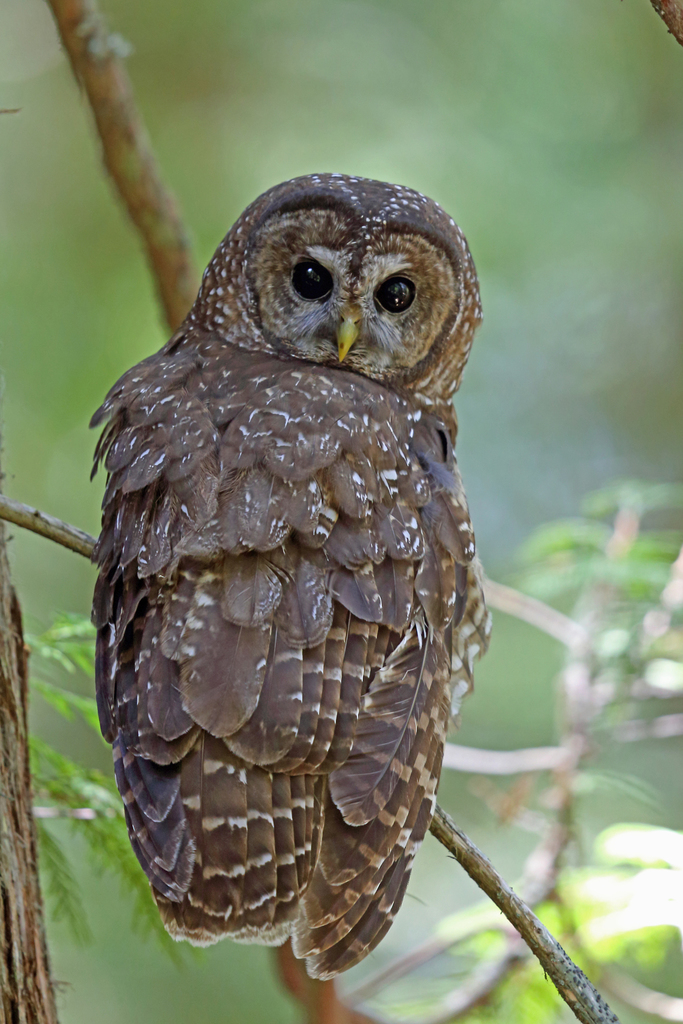
(c) Nigel Voaden, some rights reserved (CC BY) · licence
Family: Strigidae · Class: Aves · Order: Strigiformes
Conservation status: Proposed Threatened
Strix occidentalis occidentalis pop. 2 (California spotted owl - Sierra Nevada DPS) is a California animal in the Strigidae family.
The California spotted owl Sierra Nevada distinct population segment (DPS) is a medium-sized forest owl endemic to the Sierra Nevada mountain range of California and Nevada. Adults measure 41-48 cm (16-19 inches) in length with a wingspan of 102-114 cm (40-45 inches). The species exhibits brown and white barred plumage with distinctive facial discs lacking ear tufts. Dark eyes distinguish spotted owls from other owl species in their range. Females are typically larger than males, weighing 520-760 grams compared to males at 470-630 grams. The Sierra Nevada DPS occurs throughout the Sierra Nevada mountain range from the Cascade Range in northern California south to Kern County. This population is geographically distinct from the Coastal-Southern California DPS, with no gene flow between the two populations (USFWS 2023). The Sierra Nevada population primarily inhabits lands managed by the U.S. Forest Service and National Park Service, occurring at elevations typically between 300-2,700 meters (1,000-9,000 feet). California spotted owls select structurally diverse forests with larger trees and moderate to dense canopy closure for nesting, with more variable habitat acceptable for foraging. They prefer old-growth and mature mixed-conifer forests dominated by Douglas fir, ponderosa pine, sugar pine, white fir, and incense cedar. Nesting sites are typically located in large trees with broken tops, cavities, or platforms created by mistletoe infections or other deformities. The species requires multilayered forest canopies that provide thermal regulation and protection from predators. Spotted owls are primarily nocturnal and non-migratory. Their diet consists mainly of flying squirrels, woodrats (Neotoma spp.), and other small mammals, supplemented by birds, reptiles, and insects. Breeding occurs from March through August, with peak activity in April and May. Females typically lay 1-3 eggs, with 2 being most common. Incubation lasts approximately 30 days, and young fledge after 34-36 days but remain dependent on parents for 3-5 months. Spotted owls exhibit high site fidelity, often using the same territory for multiple years. The U.S. Fish and Wildlife Service proposed the Sierra Nevada DPS for listing as threatened under the Endangered Species Act in February 2023 (USFWS 2023). Primary threats include high-severity wildfires that remove large trees and create extensive areas of unsuitable habitat, climate change effects on forest composition, and competition from invasive barred owls. Barred owls have recently invaded the Sierra Nevada range and are expected to expand throughout the California spotted owl's habitat without management intervention. Since 2020, 10-15 territorial barred owls have been removed annually from the Sierra Nevada, representing the minimum estimate of the current invasive population (USFWS 2024). Historical logging practices reduced old-growth forest habitat, though federal forest management changes have slowed habitat loss on public lands. The species exhibits low genetic variation relative to other spotted owl subspecies, potentially limiting adaptive capacity to environmental changes.
Classification
Class: Aves · Order: Strigiformes · Family: Strigidae
Conservation status
Proposed Threatened
Frequently asked questions
How is Strix occidentalis occidentalis pop. 2 classified?
Strix occidentalis occidentalis pop. 2 belongs to class Aves, order Strigiformes, family Strigidae.
What family does Strix occidentalis occidentalis pop. 2 belong to?
Strix occidentalis occidentalis pop. 2 is in the Strigidae family.
Is Strix occidentalis occidentalis pop. 2 protected or of conservation concern?
Strix occidentalis occidentalis pop. 2 carries the following status: Proposed Threatened.
What is Strix occidentalis occidentalis pop. 2?
The California spotted owl Sierra Nevada distinct population segment (DPS) is a medium-sized forest owl endemic to the Sierra Nevada mountain range of California and Nevada.
Is Strix occidentalis occidentalis pop. 2 found in California?
Yes. Strix occidentalis occidentalis pop. 2 is recorded in California in The California Species Project's catalogue.
Related species
Other California species in the same genus, family, or bioregion.
Data from The California Species Project — 14,000+ California species with verified data from CNPS, CDFW, USFWS, and more.