Strix occidentalis ssp. occidentalis
California Spotted Owl
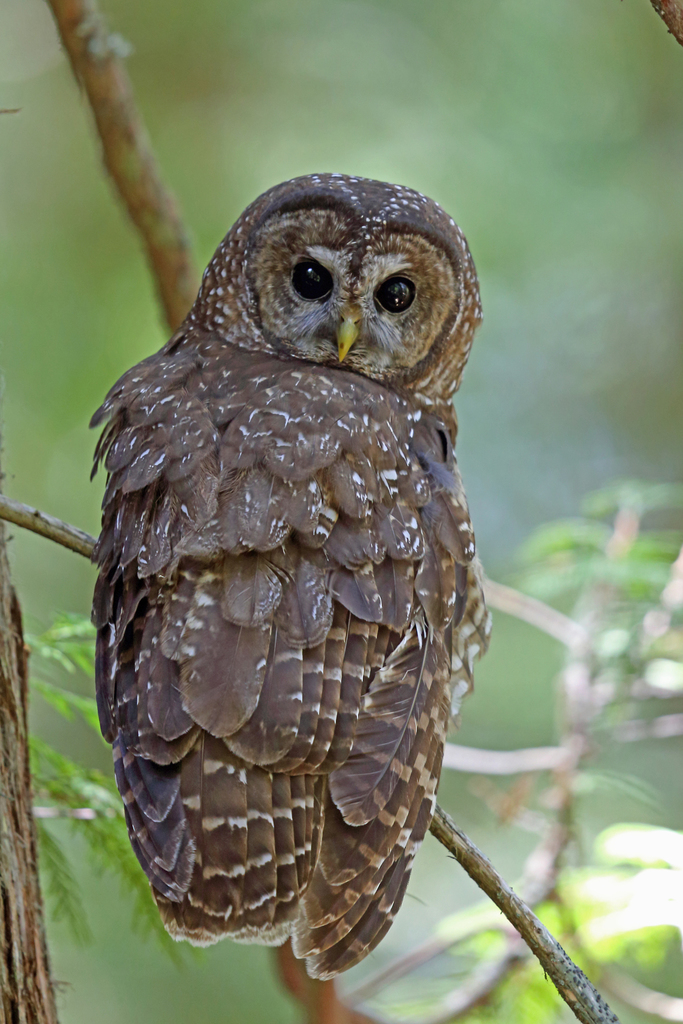
(c) Nigel Voaden, some rights reserved (CC BY) · licence
Family: Strigidae · Class: Aves · Order: Strigiformes
Conservation status: G3G4T2T3 S3
Strix occidentalis ssp. occidentalis (California Spotted Owl) is a California animal in the Strigidae family.
The California Spotted Owl is a medium-sized forest owl endemic to the Pacific Coast region. Adults measure 16 to 19 inches (41 to 48 cm) in length with a wingspan of 42 to 45 inches (107 to 114 cm). Females are typically larger than males, weighing 520 to 760 grams compared to males at 460 to 630 grams. The species displays brown and white barred plumage throughout, with distinctive white spots on the head, back, and wings that give the subspecies its common name. The facial disc is grayish-brown with darker concentric circles, and the eyes are dark brown to black. Unlike the closely related Barred Owl, the California Spotted Owl lacks streaking on the underparts, instead showing brown and white barring. Historically, the California Spotted Owl ranged throughout old-growth and mature forests from southwestern British Columbia to Baja California. The California subspecies occurs in the Sierra Nevada, Coast Ranges, and mountains of Southern California. Current distribution extends from Shasta County south through the Sierra Nevada to Kern County, and in Coast Range forests from Monterey County to San Luis Obispo County. Isolated populations persist in the San Bernardino, San Jacinto, Cuyamaca, and Palomar mountains of Southern California. The species inhabits mature and old-growth coniferous and mixed forests, typically at elevations between 1,000 and 7,000 feet (305 to 2,134 meters). In the Sierra Nevada, primary habitat consists of mixed-conifer forests dominated by ponderosa pine, sugar pine, incense cedar, white fir, and Douglas-fir. Coast Range populations utilize Douglas-fir, redwood, and mixed hardwood forests. Critical habitat features include large trees for nesting, multi-layered canopy structure providing 60 to 80 percent canopy closure, and fallen logs and snags for prey habitat. California Spotted Owls are nocturnal predators that hunt primarily from perches, using their acute hearing to locate prey in darkness. Diet consists predominantly of small mammals, with flying squirrels, woodrats, and mice comprising 80 to 90 percent of prey items. The species is non-migratory and maintains year-round territories averaging 1,000 to 2,400 acres. Breeding occurs from February through August, with peak nesting in March through May. Females lay 1 to 3 white eggs in tree cavities, broken-topped trees, or abandoned raptor nests. Incubation lasts 28 to 32 days, and fledglings remain dependent on parents for 3 to 4 months. Although not federally listed, the California Spotted Owl has experienced significant population decline. According to the U.S. Forest Service, populations declined by approximately 2.9 percent annually from 1993 to 2018 across the Sierra Nevada. Primary threats include habitat loss from logging and development, high-intensity wildfire, competition with invasive Barred Owls, and climate change effects on forest ecosystems. The U.S. Fish and Wildlife Service determined in 2020 that federal listing was warranted but precluded by higher priority actions. Forest management strategies now emphasize maintaining large tree retention and heterogeneous forest structure to support breeding and foraging habitat.
Classification
Class: Aves · Order: Strigiformes · Family: Strigidae
Conservation status
G3G4T2T3 S3
Frequently asked questions
How is Strix occidentalis ssp. occidentalis classified?
Strix occidentalis ssp. occidentalis belongs to class Aves, order Strigiformes, family Strigidae.
What family does Strix occidentalis ssp. occidentalis belong to?
Strix occidentalis ssp. occidentalis is in the Strigidae family.
Is Strix occidentalis ssp. occidentalis protected or of conservation concern?
Strix occidentalis ssp. occidentalis carries the following status: G3G4T2T3 S3.
What is Strix occidentalis ssp. occidentalis?
The California Spotted Owl is a medium-sized forest owl endemic to the Pacific Coast region.
Is Strix occidentalis ssp. occidentalis found in California?
Yes. Strix occidentalis ssp. occidentalis is recorded in California in The California Species Project's catalogue.
Related species
Other California species in the same genus, family, or bioregion.
Data from The California Species Project — 14,000+ California species with verified data from CNPS, CDFW, USFWS, and more.