Strongylocentrotus purpuratus
Pacific Purple Sea Urchin
(c) Garth Harwood, some rights reserved (CC BY) · licence
Family: Strongylocentrotidae · Class: Echinoidea · Order: Echinoida
Strongylocentrotus purpuratus (Pacific Purple Sea Urchin) is a California animal in the Strongylocentrotidae family.
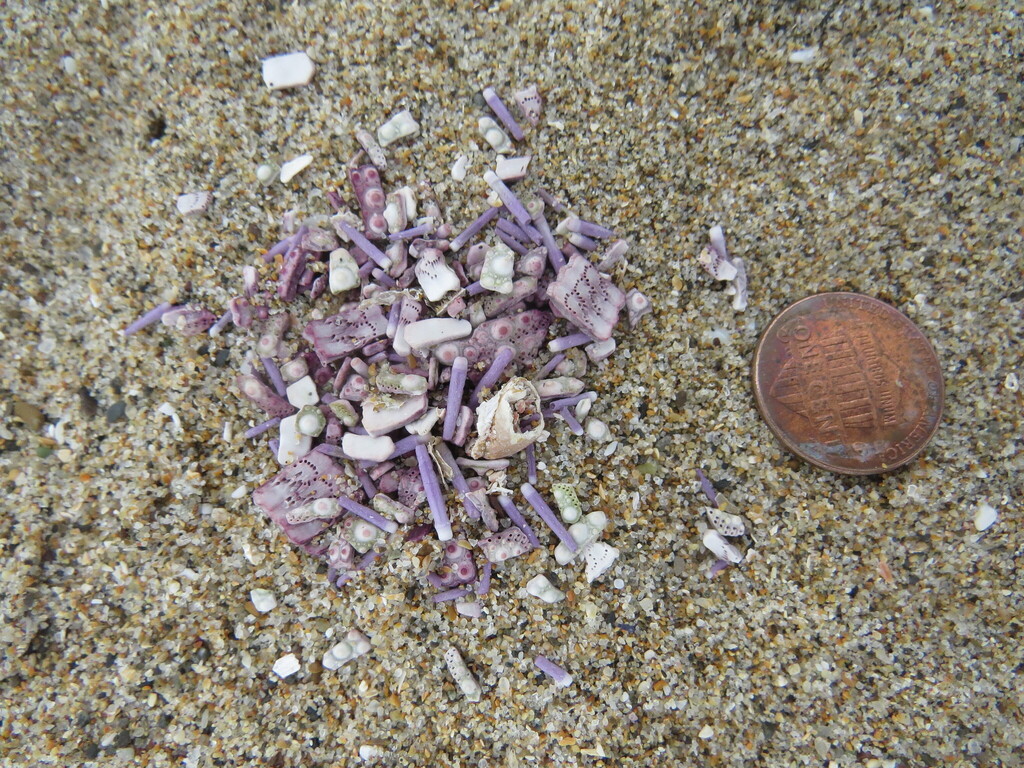
The Pacific purple sea urchin is a marine echinoderm characterized by its spherical test (shell) covered in sharp, moveable spines. Adults typically measure 5 to 10 centimeters (2 to 4 inches) in diameter, with spines extending an additional 2 to 4 centimeters. The test ranges from deep purple to reddish-purple, occasionally appearing nearly black, while the spines display similar coloration with darker tips. Five rows of tube feet extend through pore pairs in the test, enabling locomotion and feeding. The mouth, located on the underside, contains a complex jaw structure called Aristotle's lantern with five sharp teeth. Pacific purple sea urchins occur along the Pacific coast from Alaska to Baja California, Mexico. In California, they are abundant from the intertidal zone to depths of approximately 500 meters (1,640 feet). The species is particularly common in rocky intertidal areas and kelp forests throughout the state's coastline, including the Channel Islands and central coast regions such as Monterey Bay, Van Damme, and Crystal Cove. This species inhabits rocky substrates in intertidal zones, subtidal reefs, and kelp forest ecosystems. Purple sea urchins prefer areas with hard surfaces for attachment and grazing, often creating depressions or burrows in soft rock through persistent scraping. They tolerate a wide range of environmental conditions, from exposed wave-swept shores to protected coves, and can survive in both high and low salinity conditions. Pacific purple sea urchins are herbivorous grazers that feed primarily on kelp, coralline algae, and other marine vegetation. They use their specialized teeth to scrape algae from rock surfaces and consume drift kelp that settles on the seafloor. Reproduction occurs through broadcast spawning, typically during spring and summer months, when males and females simultaneously release gametes into the water column. Fertilized eggs develop into free-swimming larvae that eventually settle and metamorphose into juvenile urchins. The species can live 20 to 30 years under favorable conditions. Purple sea urchins play a critical ecological role in California's marine ecosystems but have recently become a conservation concern due to dramatic population explosions. Following the decline of their primary predator, the sunflower sea star (Pycnopodia helianthoides), due to sea star wasting disease from 2013-2016, purple urchin populations increased substantially along the North American coast (USFWS 2022). Combined with thermal and nutrient stress from the 2014-2016 North Pacific marine heat wave, this predator release led to extensive kelp forest destruction, creating "urchin barrens" - areas of bare rock dominated by starving urchins that have consumed available kelp vegetation. These barrens now characterize formerly diverse kelp forest ecosystems from Northern California to Oregon, significantly impacting marine biodiversity and fisheries. Current management efforts focus on understanding population dynamics and exploring methods to restore predator-prey balance in affected kelp forest ecosystems.
Classification
Class: Echinoidea · Order: Echinoida · Family: Strongylocentrotidae
Frequently asked questions
How is Strongylocentrotus purpuratus classified?
Strongylocentrotus purpuratus belongs to class Echinoidea, order Echinoida, family Strongylocentrotidae.
What family does Strongylocentrotus purpuratus belong to?
Strongylocentrotus purpuratus is in the Strongylocentrotidae family.
What is Strongylocentrotus purpuratus?
The Pacific purple sea urchin is a marine echinoderm characterized by its spherical test (shell) covered in sharp, moveable spines.
Is Strongylocentrotus purpuratus found in California?
Yes. Strongylocentrotus purpuratus is recorded in California in The California Species Project's catalogue.
More California species
This species has no close relatives in our California data — here are other species to explore.
Data from The California Species Project — 14,000+ California species with verified data from CNPS, CDFW, USFWS, and more.