Sturnella neglecta
Western Meadowlark
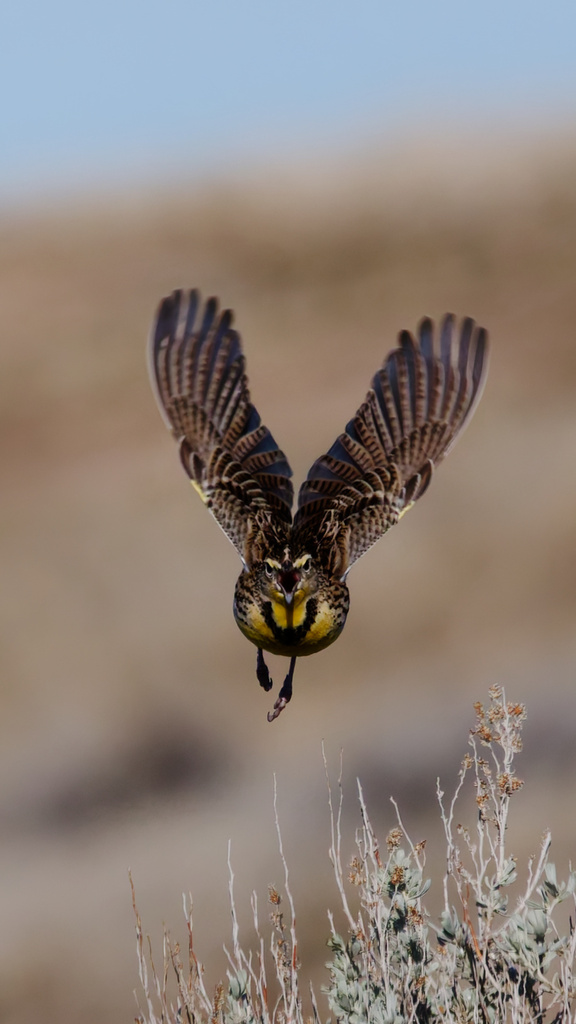
(c) Daughter Dad, some rights reserved (CC BY) · licence
Family: Icteridae · Class: Aves · Order: Passeriformes
Sturnella neglecta (Western Meadowlark) is a California animal in the Icteridae family.
The Western Meadowlark is a medium-sized passerine bird measuring 16 to 26 cm (6.3 to 10.2 inches) in length with a wingspan of 35 to 40 cm (13.8 to 15.7 inches). Adults weigh between 89 to 115 grams (3.1 to 4.1 ounces). The species exhibits distinctive plumage with bright yellow underparts marked by a prominent black "V" across the breast. The upperparts are brown and streaked with darker brown and buff coloration. Males and females appear similar, though males are slightly larger and display more vibrant coloration during breeding season. The bill is long, straight, and pointed, adapted for ground foraging. In flight, the species displays white outer tail feathers and alternating flapping and gliding flight patterns. Western Meadowlarks occur throughout much of western North America, with their range extending from southern British Columbia and Alberta south to central Mexico. In California, the species is found statewide from sea level to approximately 2,400 meters (7,900 feet) elevation. They inhabit most counties except for heavily forested mountain regions and urban areas. The species occurs year-round in suitable habitat throughout most of California, with some seasonal movement from higher elevations during winter months. The species primarily inhabits grasslands, prairies, agricultural fields, and open areas with scattered shrubs or fence posts for perching. Western Meadowlarks require areas with medium-height grass cover for nesting and foraging, avoiding both closely cropped and extremely tall or dense vegetation. They utilize cultivated lands including alfalfa fields, pastures, and fallow agricultural areas. The species also occupies meadows, valley floors, and rolling hills with mixed grassland and scattered trees. Western Meadowlarks are ground-foraging birds that feed primarily on insects during the breeding season, including beetles, grasshoppers, caterpillars, and ants. Seeds and grains become more important in their diet during fall and winter months. Males establish territories through elaborate song displays, often singing from prominent perches such as fence posts, utility lines, or tall shrubs. The species is polygamous, with males potentially mating with multiple females. Nesting occurs from April through July, with females constructing dome-shaped nests on the ground in grass clumps. Clutch size ranges from 3 to 7 eggs, typically 5, with an incubation period of 13 to 15 days. Young fledge after 10 to 12 days but remain dependent on parents for several weeks. The Western Meadowlark is not federally or state listed as threatened or endangered. However, the species has experienced population declines across much of its range due to habitat loss and fragmentation. According to the North American Breeding Bird Survey, Western Meadowlark populations declined by approximately 1.6% annually from 1966 to 2019. Primary threats include conversion of grasslands to agriculture, urban development, and intensive farming practices that eliminate nesting habitat. Climate change may affect the species through altered precipitation patterns that impact grassland ecosystems.
Classification
Class: Aves · Order: Passeriformes · Family: Icteridae
Frequently asked questions
How is Sturnella neglecta classified?
Sturnella neglecta belongs to class Aves, order Passeriformes, family Icteridae.
What family does Sturnella neglecta belong to?
Sturnella neglecta is in the Icteridae family.
What is Sturnella neglecta?
The Western Meadowlark is a medium-sized passerine bird measuring 16 to 26 cm (6.3 to 10.2 inches) in length with a wingspan of 35 to 40 cm (13.8 to 15.7 inches).
Is Sturnella neglecta found in California?
Yes. Sturnella neglecta is recorded in California in The California Species Project's catalogue.
Related species
Other California species in the same genus, family, or bioregion.
Data from The California Species Project — 14,000+ California species with verified data from CNPS, CDFW, USFWS, and more.