Sturnus vulgaris
European Starling
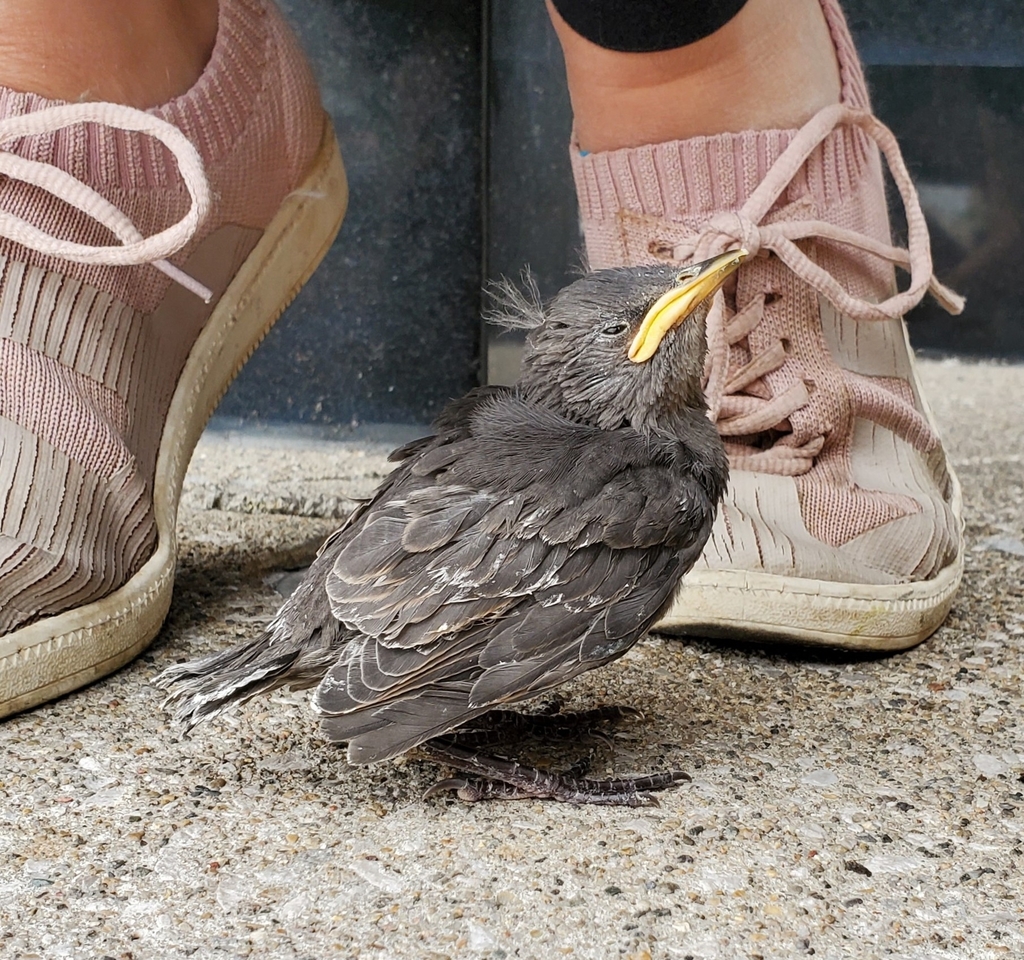
(c) Whitney Mattila, some rights reserved (CC BY) · licence
Family: Sturnidae · Class: Aves · Order: Passeriformes
Sturnus vulgaris (European Starling) is a California animal in the Sturnidae family.
The European Starling is a medium-sized passerine bird measuring 19 to 22 cm (7.5 to 8.7 inches) in length with a wingspan of 31 to 40 cm (12 to 16 inches). Adults weigh between 60 to 100 grams (2.1 to 3.5 ounces). During breeding season, adults display iridescent black plumage with a metallic green and purple sheen, a bright yellow bill, and yellow legs. In winter, the plumage becomes heavily spotted with white and buff markings, and the bill darkens to black. Juveniles are uniformly brown-gray with a dark bill. The species exhibits a characteristic triangular wing shape in flight and a slightly forked tail. Originally native to Europe and western Asia, European Starlings were intentionally introduced to North America in the 1890s. In California, the species now occurs throughout the state from sea level to elevations exceeding 2,000 meters (6,600 feet). They are present in all 58 counties, with highest densities in urban and agricultural areas. The species has expanded its range dramatically since introduction, with California populations established by the 1940s and reaching current distribution levels by the 1960s. European Starlings inhabit diverse environments including urban areas, suburban neighborhoods, agricultural lands, grasslands, and open woodlands. They show strong preferences for areas with short grass for foraging and nearby structures or trees for roosting and nesting. The species readily adapts to human-modified landscapes, commonly nesting in building cavities, traffic lights, and nest boxes. They avoid dense forests and extreme desert environments but utilize riparian corridors and park settings within otherwise unsuitable habitat. European Starlings are highly social, forming large flocks outside the breeding season that can number in the thousands. They are omnivorous, feeding primarily on insects, earthworms, snails, and fruits. Their diet shifts seasonally, with invertebrates comprising the majority during breeding season and fruits and seeds becoming more important in fall and winter. The species breeds from March through July in California, with peak activity in April and May. Females lay 3 to 6 pale blue eggs in cavity nests, with incubation lasting 11 to 13 days. Both parents feed nestlings, which fledge after 18 to 21 days. Pairs commonly produce two broods per season. As an introduced species, European Starlings are not afforded protection under federal or state endangered species legislation. They are classified as an invasive species due to their competitive interactions with native cavity-nesting birds. Studies indicate starlings can displace native species including Western Bluebirds, Tree Swallows, and several woodpecker species through nest site competition. The species causes agricultural damage estimated in millions of dollars annually through crop consumption and contamination. Population control efforts focus on habitat modification and exclusion techniques rather than direct reduction, as the species' high reproductive rate and adaptability make population-level control challenging.
Classification
Class: Aves · Order: Passeriformes · Family: Sturnidae
Frequently asked questions
How is Sturnus vulgaris classified?
Sturnus vulgaris belongs to class Aves, order Passeriformes, family Sturnidae.
What family does Sturnus vulgaris belong to?
Sturnus vulgaris is in the Sturnidae family.
What is Sturnus vulgaris?
The European Starling is a medium-sized passerine bird measuring 19 to 22 cm (7.5 to 8.7 inches) in length with a wingspan of 31 to 40 cm (12 to 16 inches).
Is Sturnus vulgaris found in California?
Yes. Sturnus vulgaris is recorded in California in The California Species Project's catalogue.
Related species
Other California species in the same genus, family, or bioregion.
Data from The California Species Project — 14,000+ California species with verified data from CNPS, CDFW, USFWS, and more.