Styela montereyensis
Long-stalked Sea Squirt
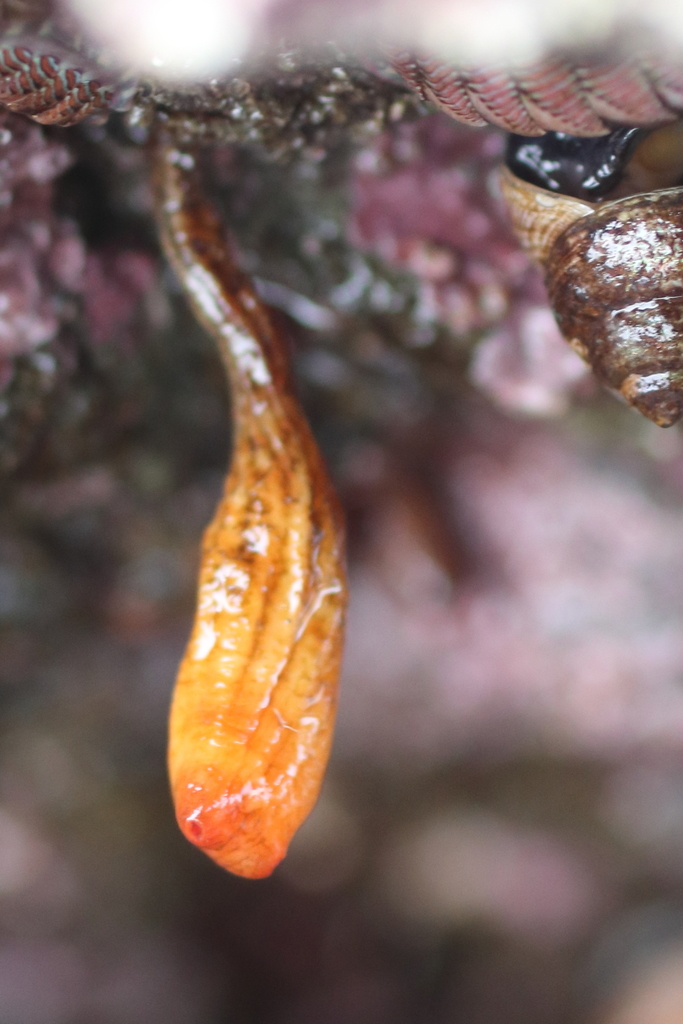
(c) Erin McKittrick, some rights reserved (CC BY) · licence
Family: Styelidae · Class: Ascidiacea · Order: Stolidobranchia
Styela montereyensis (Long-stalked Sea Squirt) is a California animal in the Styelidae family.
The Long-stalked Sea Squirt (Styela montereyensis) is a solitary tunicate belonging to the family Styelidae within the order Stolidobranchia. As a member of the subphylum Urochordata within the phylum Chordata, this species represents one of the closest invertebrate relatives to vertebrates. The species exhibits the characteristic sea squirt body plan with two siphons—an oral (incurrent) siphon for water intake and an atrial (excurrent) siphon for water expulsion—connected by a cylindrical or sac-like body that may be attached to hard substrates by a stalk, as suggested by its common name. Styela montereyensis is endemic to the eastern Pacific Ocean, with its range centered along the California coast. The species name "montereyensis" indicates a strong association with the Monterey Bay region, though specific distributional data for this species remains limited in the scientific literature. Like other members of the genus Styela, this species likely inhabits subtidal rocky reefs and hard substrates in marine environments. The species typically occurs in subtidal marine habitats, attaching to rocky surfaces, pier pilings, and other hard substrates. Sea squirts in the genus Styela generally prefer areas with moderate to strong water currents that facilitate filter feeding. The Long-stalked Sea Squirt likely inhabits depths ranging from shallow subtidal zones to deeper offshore rocky reefs, though specific depth preferences for S. montereyensis have not been well documented. As a filter-feeding tunicate, Styela montereyensis feeds by drawing water through its oral siphon, capturing phytoplankton, bacteria, and organic particles through its pharyngeal basket, and expelling filtered water through its atrial siphon. Like other solitary ascidians, the species is hermaphroditic, possessing both male and female reproductive organs. Reproduction typically involves the release of sperm into the water column, with fertilization occurring either externally or within the atrial cavity of other individuals. The resulting larvae are planktonic tadpole-like organisms that eventually settle and metamorphose into the sessile adult form. Styela montereyensis does not appear on federal or state endangered species lists, and its conservation status has not been formally assessed by major conservation organizations. However, like many marine species endemic to California's coastal waters, it may face threats from habitat alteration, pollution, and climate change effects including ocean warming and acidification. The broader context of marine invasions in California waters, where related sea squirt species have been documented as both native and non-native components of biofouling communities, suggests the importance of continued monitoring of tunicate populations and their ecological roles. Detailed ecological studies of this species are lacking, and much of the available information is extrapolated from research on closely related Styela species. Additional field studies and taxonomic work are needed to better understand the distribution, ecology, and conservation needs of the Long-stalked Sea Squirt in California's marine ecosystems.
Classification
Class: Ascidiacea · Order: Stolidobranchia · Family: Styelidae
Frequently asked questions
How is Styela montereyensis classified?
Styela montereyensis belongs to class Ascidiacea, order Stolidobranchia, family Styelidae.
What family does Styela montereyensis belong to?
Styela montereyensis is in the Styelidae family.
What is Styela montereyensis?
The Long-stalked Sea Squirt (Styela montereyensis) is a solitary tunicate belonging to the family Styelidae within the order Stolidobranchia.
Is Styela montereyensis found in California?
Yes. Styela montereyensis is recorded in California in The California Species Project's catalogue.
More California species
This species has no close relatives in our California data — here are other species to explore.
Data from The California Species Project — 14,000+ California species with verified data from CNPS, CDFW, USFWS, and more.