Stylaster californicus
California Hydrocoral
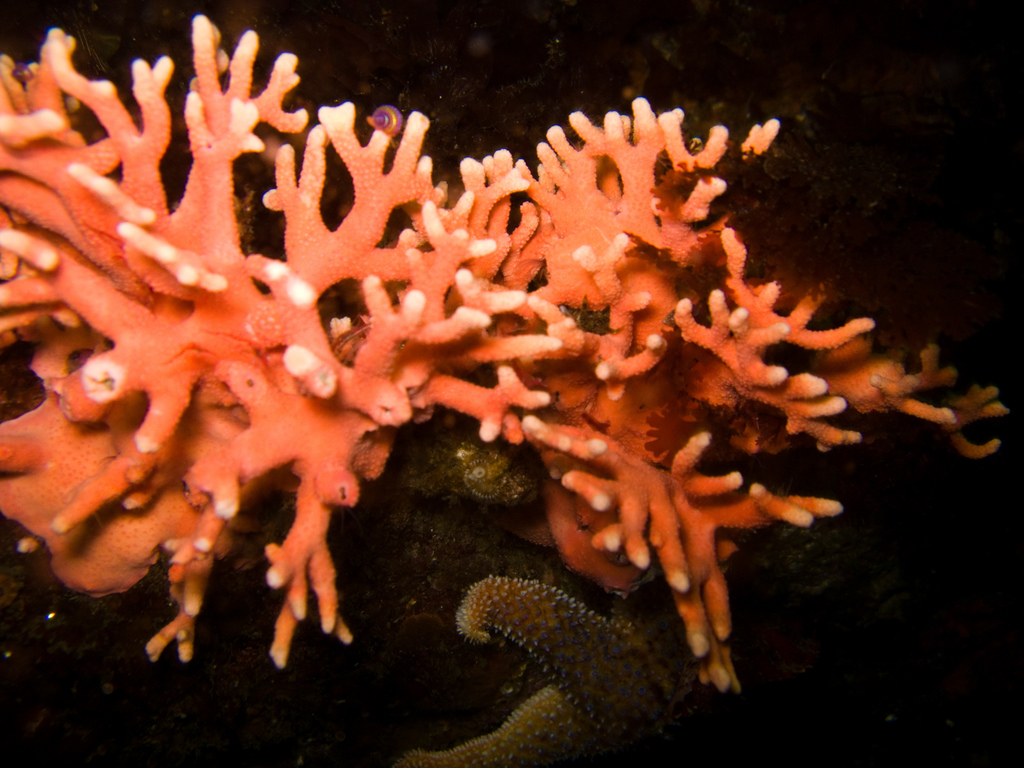
(c) Ken-ichi Ueda, some rights reserved (CC BY) · licence
Family: Stylasteridae · Class: Hydrozoa · Order: Anthoathecatae
Stylaster californicus (California Hydrocoral) is a California animal in the Stylasteridae family.
The California hydrocoral is a colonial marine cnidarian that forms branching, tree-like structures resembling true corals. Unlike true corals, which are anthozoans, California hydrocoral belongs to the class Hydrozoa and constructs its skeleton from calcium carbonate secreted by specialized polyps. Colonies typically display purple to reddish coloration and can grow to substantial sizes, creating three-dimensional reef-like formations on hard substrates. Stylaster californicus is endemic to the eastern Pacific Ocean, with its range extending along the California coast and into Baja California waters. The species occurs primarily in the Southern California Bight region, where it has been documented at locations including the Channel Islands, Farnsworth Bank, and various submarine canyons. According to the California Department of Fish and Wildlife, colonies have been observed near Mattole Canyon State Marine Reserve and at Farnsworth Offshore State Marine Conservation Area, as well as around Gull Island. This hydrocoral inhabits deeper marine waters, typically found at depths ranging from 80 feet to over 1,600 feet. The species demonstrates a strong preference for high current, low turbidity environments where nutrient-rich waters support its filter-feeding lifestyle. California hydrocoral establishes colonies on rocky substrates, particularly in areas subject to seasonal upwelling that brings cold, nutrient-dense water to the surface. The cold, rough waters of submarine canyons and offshore banks provide ideal conditions for colony development. As a colonial cnidarian, California hydrocoral exhibits a complex life cycle involving both polyp and medusa stages typical of hydrozoans. The colonies consist of numerous small polyps that capture plankton and other small organisms from the water column. Each polyp contributes to the overall calcium carbonate skeleton that gives the colony its rigid structure. The species reproduces both asexually through budding to expand existing colonies and sexually through the release of gametes into the water column. California hydrocoral faces significant conservation challenges due to its limited distribution and specific habitat requirements. According to NOAA Sanctuaries, the species confronts threats from human activities including pollution, climate change, and ocean acidification (NOAA Sanctuaries). Ocean acidification poses a particular concern as it can impair the organism's ability to build and maintain its calcium carbonate skeleton. The species' restriction to only a few California locations makes individual colonies especially valuable for population persistence. Climate change may alter ocean temperatures and current patterns that are essential for the species' survival, while pollution can degrade water quality in the clear, low-turbidity conditions the species requires. The protection of marine protected areas where California hydrocoral occurs, such as state marine reserves and conservation areas, provides crucial habitat safeguards for this endemic species.
Classification
Class: Hydrozoa · Order: Anthoathecatae · Family: Stylasteridae
Frequently asked questions
How is Stylaster californicus classified?
Stylaster californicus belongs to class Hydrozoa, order Anthoathecatae, family Stylasteridae.
What family does Stylaster californicus belong to?
Stylaster californicus is in the Stylasteridae family.
What is Stylaster californicus?
The California hydrocoral is a colonial marine cnidarian that forms branching, tree-like structures resembling true corals.
Is Stylaster californicus found in California?
Yes. Stylaster californicus is recorded in California in The California Species Project's catalogue.
More California species
This species has no close relatives in our California data — here are other species to explore.
Data from The California Species Project — 14,000+ California species with verified data from CNPS, CDFW, USFWS, and more.