Suberites lambei
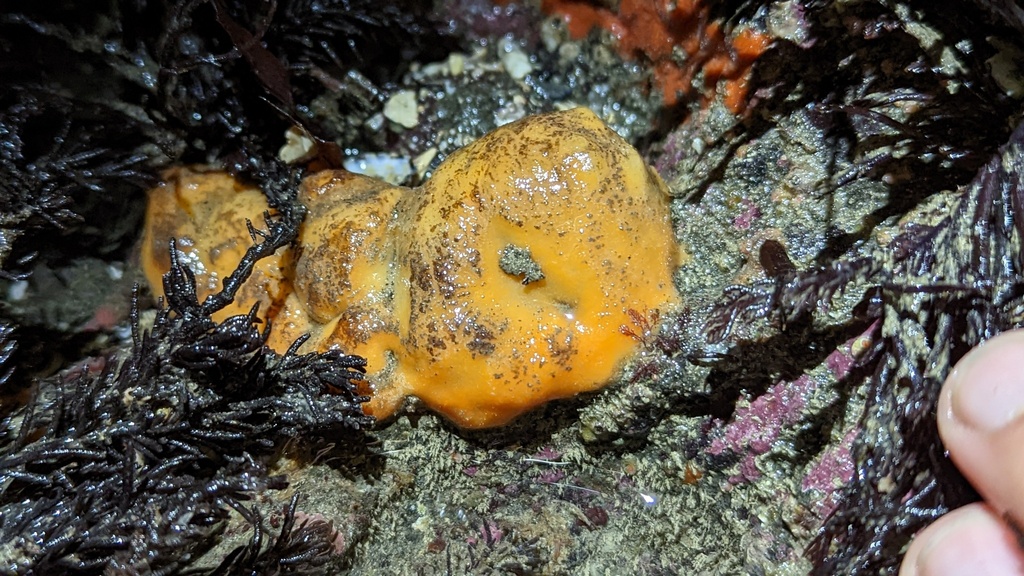
(c) Trevor Van Loon, some rights reserved (CC BY) · licence
Family: Suberitidae · Class: Demospongiae · Order: Hadromerida
Suberites lambei is a California animal in the Suberitidae family.
Suberites lambei is a marine demosponge belonging to the family Suberitidae within the order Hadromerida. This species represents one of many marine invertebrates found along the North American Pacific coast, though detailed scientific documentation remains extremely limited in the available literature. As a member of the Demospongiae, the largest class of sponges, S. lambei possesses a skeleton composed of siliceous spicules and organic fibers called spongin. Like other Suberites species, it likely exhibits the characteristic encrusting or massive growth form typical of this genus, with a firm, dense texture and relatively smooth surface. The coloration and specific morphological features of this species have not been well documented in accessible scientific literature. The geographic range of Suberites lambei includes marine waters along the Pacific coast of North America. Based on the genus distribution and limited available records, this species likely occurs in subtidal rocky habitats along the California coast, though specific distribution data and depth ranges have not been comprehensively documented. Other Suberites species typically inhabit hard substrates in temperate marine environments. Like other demosponges, S. lambei inhabits marine environments where it attaches to hard substrates such as rock faces, boulders, or artificial structures. Sponges in this family typically occur in subtidal zones where water circulation provides adequate flow for filter feeding. The specific habitat preferences, including depth range, substrate requirements, and associated community types for this species, require further scientific investigation. As a suspension feeder, Suberites lambei likely employs the typical sponge feeding strategy of drawing water through its porous body via specialized cells called choanocytes. These cells create water currents that transport microscopic food particles, including bacteria, phytoplankton, and organic detritus, through the sponge's aquiferous system. Reproduction likely involves both sexual and asexual methods, with sexual reproduction producing free-swimming larvae that settle on suitable substrates to develop into adult sponges. Specific details regarding reproductive timing, larval development, and growth rates for this species have not been documented. The conservation status of Suberites lambei has not been formally assessed by state or federal agencies. This species does not appear on current endangered species lists or conservation priority rankings. However, like many marine invertebrates, populations may face threats from coastal development, water quality degradation, ocean acidification, and climate change impacts on marine ecosystems. The lack of comprehensive biological and ecological data for this species represents a significant knowledge gap that limits effective conservation planning. Scientific documentation for this species remains extremely limited despite thorough research of available databases and literature. The information presented here synthesizes what little is known about the genus and family characteristics. Detailed studies of S. lambei's distribution, ecology, reproduction, and conservation needs are lacking. We welcome contributions of verified scientific data, photographs, or field observations to enhance this species account.
Classification
Class: Demospongiae · Order: Hadromerida · Family: Suberitidae
Frequently asked questions
How is Suberites lambei classified?
Suberites lambei belongs to class Demospongiae, order Hadromerida, family Suberitidae.
What family does Suberites lambei belong to?
Suberites lambei is in the Suberitidae family.
What is Suberites lambei?
Suberites lambei is a marine demosponge belonging to the family Suberitidae within the order Hadromerida.
Is Suberites lambei found in California?
Yes. Suberites lambei is recorded in California in The California Species Project's catalogue.
More California species
This species has no close relatives in our California data — here are other species to explore.
Data from The California Species Project — 14,000+ California species with verified data from CNPS, CDFW, USFWS, and more.