Sula brewsteri
Cocos Booby
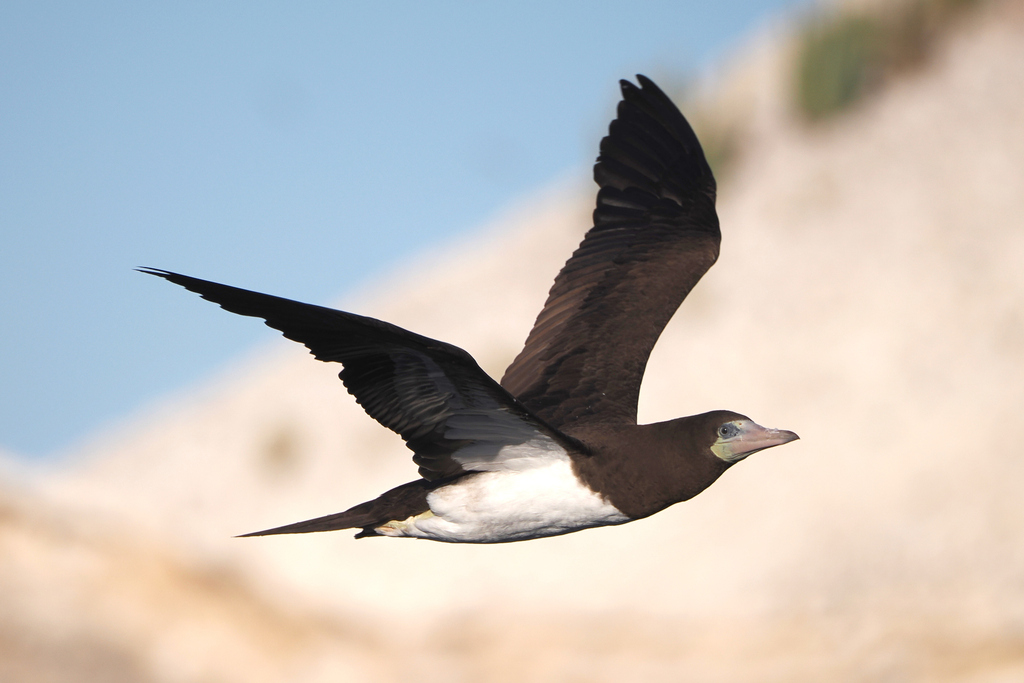
no rights reserved · CC0
Family: Sulidae · Class: Aves · Order: Suliformes
Sula brewsteri (Cocos Booby) is a California animal in the Sulidae family.
The Cocos Booby is a large, heavy-bodied seabird endemic to the eastern Pacific Ocean. Adults display distinctive plumage with dark brown upperparts and a white belly, similar to the closely related Brown Booby but with notable differences in size and proportions. The species possesses a daggerlike bill and robust build typical of sulids. Intermediate plumages show white bellies with distinct dark brown speckles or blotches, representing transitional stages between juvenile and adult appearances. The Cocos Booby breeds from the Gulf of California and northwestern Mexico south along the Pacific coast, including southern California's Channel Islands (Birds of the World). This distribution represents a relatively restricted range within the eastern Pacific region. The species' breeding range extends through Central America to islands in the central and southern Pacific Ocean, though specific population data for California waters remains limited. During the breeding season, Cocos Boobies require sandy atolls or rocky islands with flat areas that provide safety from predators and human disturbance (Birds of the World). These nesting sites must offer suitable substrate for ground nesting and proximity to productive marine foraging areas. The species shows strong site fidelity to established breeding colonies, though some dispersal occurs between seasons. Cocos Boobies feed primarily on small fish that occur near the water surface, foraging in both shallow coastal waters and relatively deep oceanic areas (Birds of the World). Like other boobies, they employ plunge-diving techniques to capture prey, diving from considerable heights to pursue fish below the surface. Their feeding ecology links them closely to productive marine environments where small pelagic fish concentrate. The species exhibits typical sulid social behaviors, forming breeding colonies on suitable islands. Pair bonds can be long-term, though divorce occurs when individuals detect opportunities to increase reproductive success with new partners (Birds of the World). This adaptive mating strategy reflects the species' investment in maximizing breeding output within the constraints of their specialized island breeding habitat. Taxonomic studies have examined geographic variation and species limits within the 'Masked' Boobies of the eastern Pacific, indicating ongoing scientific interest in the evolutionary relationships within this group (Wilson Bulletin 110:155-170). The Cocos Booby was historically considered a subspecies of the Brown Booby (Sula leucogaster brewsteri) but is now recognized as a distinct species based on morphological and ecological differences. Conservation status information for the Cocos Booby appears limited in current databases, suggesting the need for updated population assessments. The species' restricted breeding range and dependence on specific island habitats make it potentially vulnerable to environmental changes, human disturbance, and climate-related impacts on marine food webs. Protection of breeding colonies and maintenance of healthy marine ecosystems remain important for the species' long-term conservation.
Classification
Class: Aves · Order: Suliformes · Family: Sulidae
Frequently asked questions
How is Sula brewsteri classified?
Sula brewsteri belongs to class Aves, order Suliformes, family Sulidae.
What family does Sula brewsteri belong to?
Sula brewsteri is in the Sulidae family.
What is Sula brewsteri?
The Cocos Booby is a large, heavy-bodied seabird endemic to the eastern Pacific Ocean.
Is Sula brewsteri found in California?
Yes. Sula brewsteri is recorded in California in The California Species Project's catalogue.
Related species
Other California species in the same genus, family, or bioregion.
Data from The California Species Project — 14,000+ California species with verified data from CNPS, CDFW, USFWS, and more.