Sula dactylatra
Masked Booby
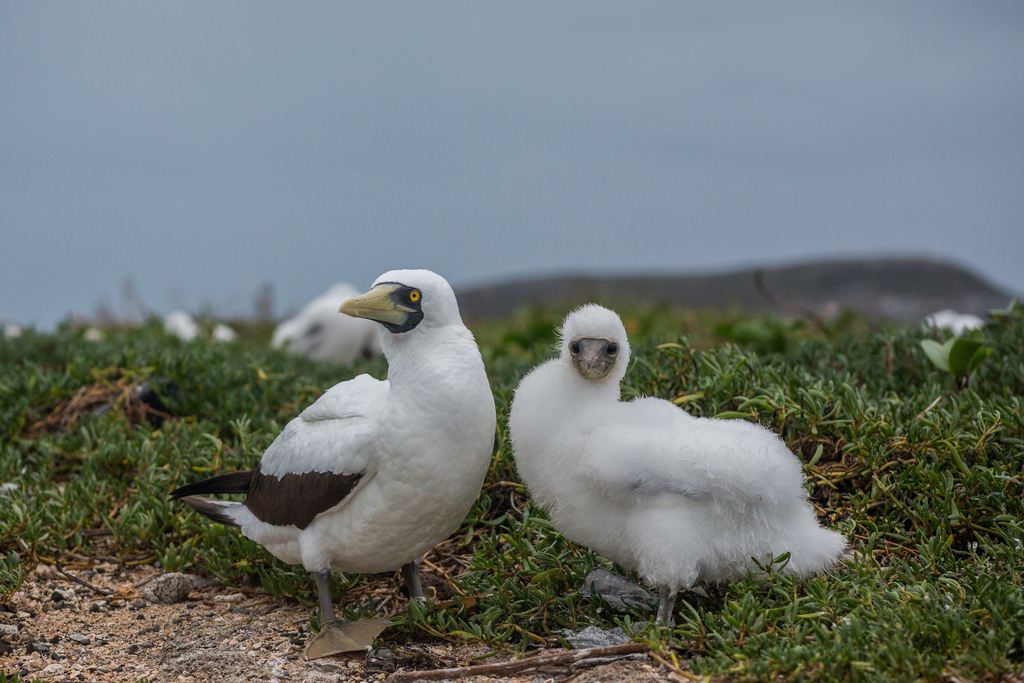
(c) João D'Andretta, some rights reserved (CC BY) · licence
Family: Sulidae · Class: Aves · Order: Suliformes
Sula dactylatra (Masked Booby) is a California animal in the Sulidae family.
The Masked Booby is a large seabird measuring 81 to 92 cm (32 to 36 inches) in length with a wingspan reaching 152 cm (60 inches). Adults weigh between 1.3 to 2.3 kg (2.9 to 5.1 pounds). The species exhibits distinctive plumage with bright white body and wing coverts contrasting sharply with black flight feathers, tail, and wing tips. The face displays characteristic black skin around the eyes, creating the 'masked' appearance that gives the species its common name. The bill is yellow to orange-yellow, and legs are yellow to greenish-yellow. Juveniles show mottled brown and white plumage that gradually transitions to adult coloration over approximately four years. The Masked Booby has a pantropical distribution, occurring in warm oceanic waters worldwide. In California waters, the species is primarily found offshore in the Southern California Bight, with observations extending north to central California during warm water events. The nearest breeding colonies to California are located on the Revillagigedo Islands off Mexico, approximately 400 km southwest of Baja California. Non-breeding individuals regularly occur in California waters year-round, with increased numbers during late summer and fall months. This pelagic species inhabits open ocean waters, typically remaining far from shore except when breeding. Masked Boobies prefer tropical and subtropical marine environments with water temperatures above 25°C (77°F). They are commonly observed over deep waters beyond the continental shelf, often associated with upwelling areas and seamounts where prey concentrates. During breeding, they nest on remote oceanic islands with low vegetation or bare ground. Masked Boobies are highly specialized plunge-divers, feeding primarily on flying fish, sardines, anchovies, and squid. They dive from heights of 10 to 30 meters (33 to 98 feet), entering the water at speeds up to 96 km/h (60 mph). Their streamlined body and forward-facing eyes provide excellent underwater vision for pursuing prey. Breeding occurs in colonies on isolated islands, with pairs constructing shallow scrapes lined with debris. Females typically lay one to two eggs, with incubation lasting 43 to 45 days. The species exhibits obligate siblicide, where the first-hatched chick typically eliminates its sibling. Fledging occurs after 109 to 151 days. The Masked Booby is not federally listed in the United States and maintains stable global populations. The International Union for Conservation of Nature classifies the species as Least Concern. However, regional populations face threats from plastic pollution, overfishing of prey species, and climate change impacts on marine ecosystems. Oil spills pose particular risks to California populations due to heavy shipping traffic in their foraging areas. Introduced predators and habitat modification on breeding islands represent the primary conservation concerns for the species globally.
Classification
Class: Aves · Order: Suliformes · Family: Sulidae
Frequently asked questions
How is Sula dactylatra classified?
Sula dactylatra belongs to class Aves, order Suliformes, family Sulidae.
What family does Sula dactylatra belong to?
Sula dactylatra is in the Sulidae family.
What is Sula dactylatra?
The Masked Booby is a large seabird measuring 81 to 92 cm (32 to 36 inches) in length with a wingspan reaching 152 cm (60 inches).
Is Sula dactylatra found in California?
Yes. Sula dactylatra is recorded in California in The California Species Project's catalogue.
Related species
Other California species in the same genus, family, or bioregion.
Data from The California Species Project — 14,000+ California species with verified data from CNPS, CDFW, USFWS, and more.