Sylvilagus audubonii
Audubon’s Cottontail
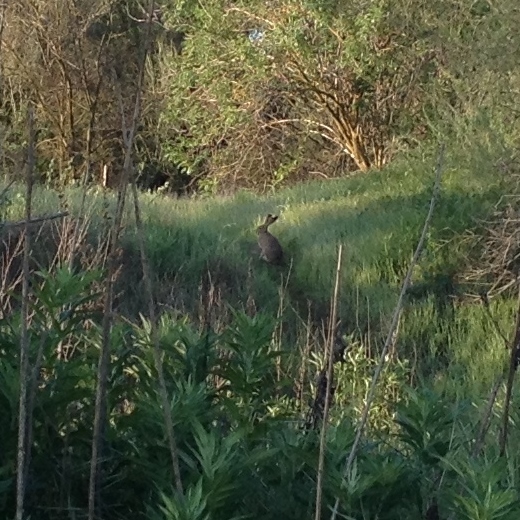
(c) Justin Johnsen, some rights reserved (CC BY) · licence
Family: Leporidae · Class: Mammalia · Order: Lagomorpha
Sylvilagus audubonii (Audubon’s Cottontail) is a California animal in the Leporidae family.
Audubon's cottontail, also known as the desert cottontail, is a medium-sized rabbit species native to western North America. Adults measure 375 to 435 mm (14.8 to 17.1 inches) in total length, with body length ranging from 300 to 350 mm (11.8 to 13.8 inches). The tail measures 50 to 65 mm (2.0 to 2.6 inches) and displays the characteristic white underside that gives cottontails their common name. Adults typically weigh between 680 to 1,360 grams (1.5 to 3.0 pounds). The dorsal pelage is grayish-brown with darker guard hairs, while the ventral surface is white to pale gray. The ears are proportionally large, measuring 65 to 75 mm (2.6 to 3.0 inches) in length, and lack the distinctive black tips found in some related species. In California, Audubon's cottontail occurs primarily in the southeastern desert regions, including portions of the Sonoran and Mojave deserts. The species ranges from sea level to approximately 1,830 meters (6,000 feet) in elevation. The California distribution includes Imperial, Riverside, San Bernardino, Inyo, and Mono counties, with populations extending eastward into Arizona, Nevada, and Mexico. The species inhabits arid and semi-arid environments characterized by sparse vegetation and rocky terrain. Preferred habitats include desert scrublands dominated by creosote bush, burrobush, and various cacti species. Audubon's cottontail also occupies riparian areas along desert washes, agricultural edges, and suburban developments where water and cover are available. The species demonstrates strong association with areas containing adequate shelter, including rock piles, dense shrubs, and abandoned burrows. Audubon's cottontail is primarily crepuscular, with peak activity occurring during dawn and dusk hours. The diet consists mainly of grasses, forbs, cacti, and shrubs, with seasonal variation based on plant availability. During summer months, succulent plants provide necessary moisture in water-scarce environments. Breeding occurs throughout much of the year in favorable conditions, with females producing multiple litters annually. Gestation lasts approximately 28 to 30 days, with litter sizes ranging from two to five young. Females construct shallow nests lined with fur and vegetation in concealed locations. Young are born altricial and remain in the nest for approximately two weeks. The species serves as an important prey base for various predators, including coyotes, foxes, hawks, and owls. Audubon's cottontail exhibits several adaptations to desert life, including efficient kidney function for water conservation and behavioral thermoregulation through seeking shade during extreme heat. Currently, Audubon's cottontail maintains stable populations throughout most of its range and is not federally or state-listed as threatened or endangered. The species has demonstrated adaptability to human-modified landscapes, including agricultural areas and urban-wildland interfaces. Primary threats include habitat fragmentation from development, vehicle strikes, and predation by domestic cats and dogs in suburban areas. Climate change may affect water availability and vegetation communities within the species' range, but current population trends appear stable across California's desert regions.
Classification
Class: Mammalia · Order: Lagomorpha · Family: Leporidae
Frequently asked questions
How is Sylvilagus audubonii classified?
Sylvilagus audubonii belongs to class Mammalia, order Lagomorpha, family Leporidae.
What family does Sylvilagus audubonii belong to?
Sylvilagus audubonii is in the Leporidae family.
What is Sylvilagus audubonii?
Audubon's cottontail, also known as the desert cottontail, is a medium-sized rabbit species native to western North America.
Is Sylvilagus audubonii found in California?
Yes. Sylvilagus audubonii is recorded in California in The California Species Project's catalogue.
Related species
Other California species in the same genus, family, or bioregion.
Data from The California Species Project — 14,000+ California species with verified data from CNPS, CDFW, USFWS, and more.