Sylvilagus bachmani
Brush Rabbit
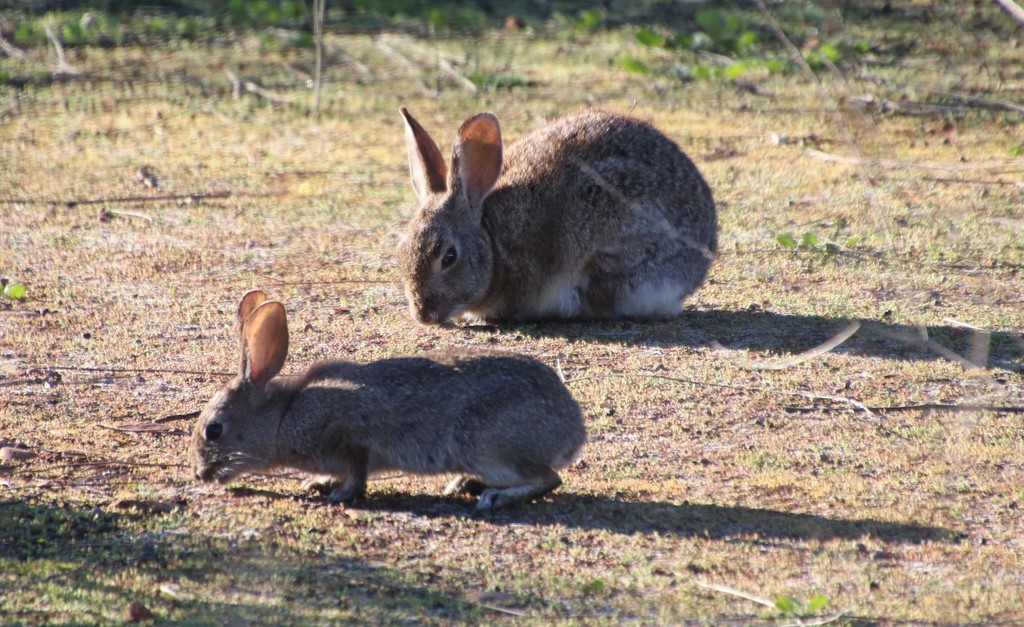
(c) Millie Basden, some rights reserved (CC BY) · licence
Family: Leporidae · Class: Mammalia · Order: Lagomorpha
Sylvilagus bachmani (Brush Rabbit) is a California animal in the Leporidae family.
The brush rabbit is a small cottontail rabbit native to the western United States. Adults typically measure 303 to 369 mm (11.9 to 14.5 inches) in total length, with hind feet ranging from 65 to 80 mm (2.6 to 3.1 inches). Body weight ranges from 511 to 917 grams (1.1 to 2.0 pounds). The dorsal pelage is grayish-brown to dark brown with black-tipped guard hairs, while the ventral surface is grayish-white to buff. The tail is small and inconspicuous, measuring 20 to 40 mm (0.8 to 1.6 inches), and is uniformly dark brown to blackish above and below, distinguishing it from other cottontail species that typically have white undersides on their tails. The ears are relatively short and rounded compared to other rabbits in the genus. Brush rabbits occur along the Pacific Coast from the Columbia River in Oregon south through California to Baja California, Mexico. In California, the species ranges from sea level to approximately 1,500 meters (4,900 feet) elevation in the Coast Ranges, Sierra Nevada foothills, and Transverse and Peninsular Ranges. Populations are found from Humboldt County south to the Mexican border, with the species absent from the Central Valley floor and high Sierra Nevada. The species inhabits dense brushy areas, including chaparral, coastal scrub, riparian woodland edges, and early successional forests. Brush rabbits require thick understory vegetation for cover, typically within 5 meters (16 feet) of protective shrubs. They utilize a network of runways through dense vegetation and construct forms under shrubs for resting. The species shows strong preference for areas with shrub cover exceeding 75 percent and rarely ventures into open areas. Brush rabbits are primarily crepuscular, most active during dawn and dusk hours. Their diet consists mainly of forbs, grasses, and browse from shrubs and trees, including ceanothus, manzanita, oak, and various herbaceous plants. Breeding typically occurs from December through June, with peak activity from February to April. Females produce 2 to 4 litters annually, with litter sizes ranging from 2 to 5 young. Gestation period is approximately 30 days. Nests are constructed in shallow depressions lined with fur and vegetation. Young are altricial and remain in the nest for about 14 days. Currently, brush rabbits have no federal or state listing status and are considered stable throughout most of their range. However, some populations face pressure from habitat loss due to urban development, agriculture, and fire suppression that reduces early successional habitats. The species is particularly vulnerable to habitat fragmentation, as individuals rarely cross open areas exceeding 30 meters (98 feet). Climate change may affect future distribution by altering vegetation communities and increasing fire frequency in some regions.
Classification
Class: Mammalia · Order: Lagomorpha · Family: Leporidae
Frequently asked questions
How is Sylvilagus bachmani classified?
Sylvilagus bachmani belongs to class Mammalia, order Lagomorpha, family Leporidae.
What family does Sylvilagus bachmani belong to?
Sylvilagus bachmani is in the Leporidae family.
What is Sylvilagus bachmani?
The brush rabbit is a small cottontail rabbit native to the western United States.
Is Sylvilagus bachmani found in California?
Yes. Sylvilagus bachmani is recorded in California in The California Species Project's catalogue.
Related species
Other California species in the same genus, family, or bioregion.
Data from The California Species Project — 14,000+ California species with verified data from CNPS, CDFW, USFWS, and more.