Sylvilagus nuttallii
Nuttall’s Cottontail
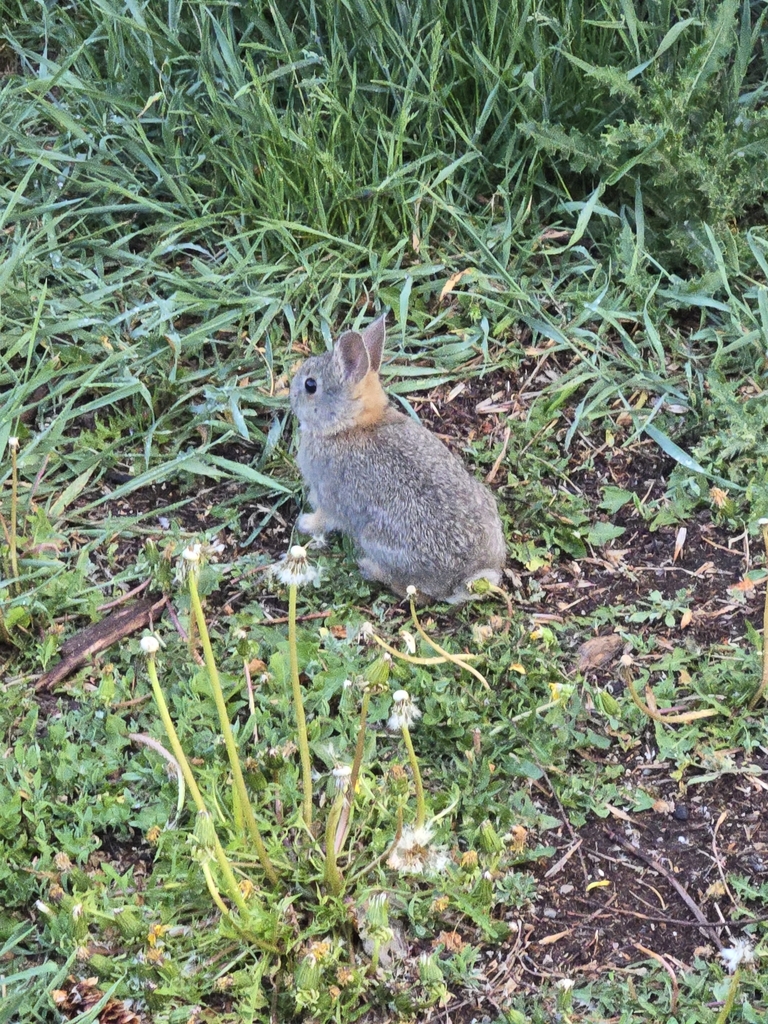
no rights reserved · CC0
Family: Leporidae · Class: Mammalia · Order: Lagomorpha
Sylvilagus nuttallii (Nuttall’s Cottontail) is a California animal in the Leporidae family.
Nuttall's cottontail is a medium-sized rabbit species native to western North America, including portions of California. Adults measure 375 to 400 mm (14.8 to 15.7 inches) in total length, with a tail length of 30 to 52 mm (1.2 to 2.0 inches). Body weight ranges from 815 to 1,400 grams (1.8 to 3.1 pounds). The dorsal pelage is grayish-brown with black-tipped guard hairs, while the ventral surface is white to pale gray. The ears are relatively large, measuring 62 to 75 mm (2.4 to 3.0 inches) in length, with blackish tips. The tail displays the characteristic cottontail pattern: brown above and white below. During winter months, the pelage becomes grayer and denser. In California, Nuttall's cottontail occurs primarily in the northeastern counties, including portions of Modoc, Lassen, and Siskiyou counties. The species' range extends northward through Oregon and Washington, eastward to Montana, Wyoming, and Colorado, and southward into Nevada and Utah. Within California, populations are associated with sagebrush ecosystems and montane areas of the Great Basin region. The species inhabits sagebrush steppe, pinyon-juniper woodlands, and mountain shrublands at elevations ranging from 1,200 to 2,800 meters (3,900 to 9,200 feet). Nuttall's cottontail shows strong preference for areas with dense shrub cover, particularly big sagebrush (Artemisia tridentata), bitterbrush (Purshia tridentata), and rabbitbrush (Ericameria species). Rocky outcrops, fallen logs, and dense vegetation provide essential escape cover. The species requires areas with adequate snow depth during winter, as it creates tunnel systems beneath the snow for protection and foraging. Nuttall's cottontail is primarily crepuscular, exhibiting peak activity during dawn and dusk hours. The diet consists mainly of grasses, forbs, and shrubs, with seasonal variation in plant preferences. During summer, green vegetation including grasses and herbaceous plants comprise the majority of the diet. Winter feeding focuses on woody browse, bark, and dried vegetation. Breeding occurs from March through August, with females producing two to three litters annually. Gestation lasts 28 to 30 days, with litter sizes ranging from three to eight young. Nests are shallow depressions lined with fur and vegetation, typically located beneath shrubs or in dense grass. Nuttall's cottontail is not federally listed and appears stable throughout most of its range as of December 2025. However, habitat fragmentation and degradation of sagebrush ecosystems pose ongoing threats. Wildfire, invasive plant species, and urban development have reduced available habitat in some areas. Climate change may affect the species through alterations to precipitation patterns and vegetation communities. In California, the species occurs within a relatively small portion of its overall range, making local populations potentially vulnerable to habitat changes. The species serves as an important prey base for various predators, including coyotes, bobcats, great horned owls, and red-tailed hawks.
Classification
Class: Mammalia · Order: Lagomorpha · Family: Leporidae
Frequently asked questions
How is Sylvilagus nuttallii classified?
Sylvilagus nuttallii belongs to class Mammalia, order Lagomorpha, family Leporidae.
What family does Sylvilagus nuttallii belong to?
Sylvilagus nuttallii is in the Leporidae family.
What is Sylvilagus nuttallii?
Nuttall's cottontail is a medium-sized rabbit species native to western North America, including portions of California.
Is Sylvilagus nuttallii found in California?
Yes. Sylvilagus nuttallii is recorded in California in The California Species Project's catalogue.
Related species
Other California species in the same genus, family, or bioregion.
Data from The California Species Project — 14,000+ California species with verified data from CNPS, CDFW, USFWS, and more.