Symmetrischema striatella
Streaked Twirler
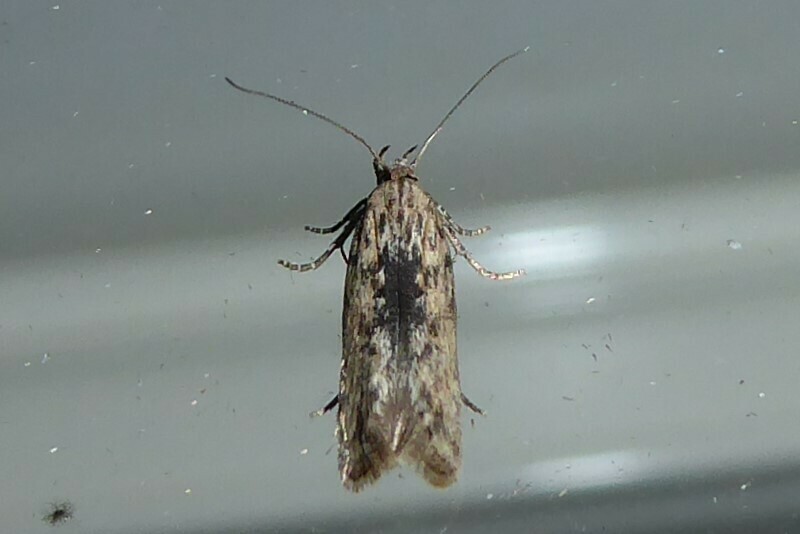
(c) Aalbert Rebergen, some rights reserved (CC BY) · licence
Family: Gelechiidae · Class: Insecta · Order: Lepidoptera
Symmetrischema striatella (Streaked Twirler) is a California animal in the Gelechiidae family.
The Streaked Twirler is a small moth in the family Gelechiidae, subfamily Gelechiinae. As a member of the twirler moth family, this species exhibits the characteristic narrow forewings and reduced hindwings typical of gelechiids. Specific morphological details including wingspan measurements and detailed coloration patterns have not been well documented in the scientific literature. Symmetrischema striatella occurs across a broad range in North America, with documented records from California east to Arkansas, Oklahoma, New York, and Louisiana (BugGuide). The species appears to have a transcontinental distribution, though specific locality records within California and detailed range boundaries remain poorly documented. Historical records indicate the species was first described by Murtfeldt in 1900, originally as Eucatoptus striatella. Specific habitat requirements for the Streaked Twirler have not been comprehensively studied. Like many gelechiid moths, the species likely occupies diverse terrestrial habitats where suitable host plants occur. Many members of this family are associated with herbaceous plants and shrubs, though the particular vegetation types and elevation ranges preferred by S. striatella remain undocumented. The life history and ecological requirements of Symmetrischema striatella are largely unknown. Host plant associations, larval feeding behavior, adult flight periods, and reproductive biology have not been described in available literature. The species carries Hodges number 2039 in the standard North American moth classification system. As with many small moths in the Gelechiidae, adults are likely nocturnal and attracted to artificial lights. The conservation status of the Streaked Twirler has not been formally assessed at the federal or California state level. However, the species appears on Species of Greatest Conservation Need (SGCN) lists for multiple states including Arkansas and New York, suggesting regional conservation concern (BugGuide). These designations typically indicate species that are rare, experiencing population declines, or lack sufficient data to determine their conservation status. The inclusion on multiple state SGCN lists may reflect the species' apparent rarity or the general lack of survey data for small moths. Like many microlepidoptera, Symmetrischema striatella likely faces threats from habitat loss, urbanization, and agricultural intensification, though specific threat assessments have not been conducted. The broad geographic range suggests the species may be more resilient than those with restricted distributions, but population trends and current abundance remain unknown. Scientific documentation for this species remains extremely limited. The information presented here is based on available sources including BugGuide taxonomic records and state wildlife action plans. Detailed ecological studies, host plant documentation, and systematic surveys are needed to better understand the biology and conservation needs of this species. We welcome contributions of verified scientific data, photographs, or field observations to enhance this species account.
Classification
Class: Insecta · Order: Lepidoptera · Family: Gelechiidae
Frequently asked questions
How is Symmetrischema striatella classified?
Symmetrischema striatella belongs to class Insecta, order Lepidoptera, family Gelechiidae.
What family does Symmetrischema striatella belong to?
Symmetrischema striatella is in the Gelechiidae family.
What is Symmetrischema striatella?
The Streaked Twirler is a small moth in the family Gelechiidae, subfamily Gelechiinae.
Is Symmetrischema striatella found in California?
Yes. Symmetrischema striatella is recorded in California in The California Species Project's catalogue.
Related species
Other California species in the same genus, family, or bioregion.
Data from The California Species Project — 14,000+ California species with verified data from CNPS, CDFW, USFWS, and more.