Sympetrum corruptum
Variegated Meadowhawk
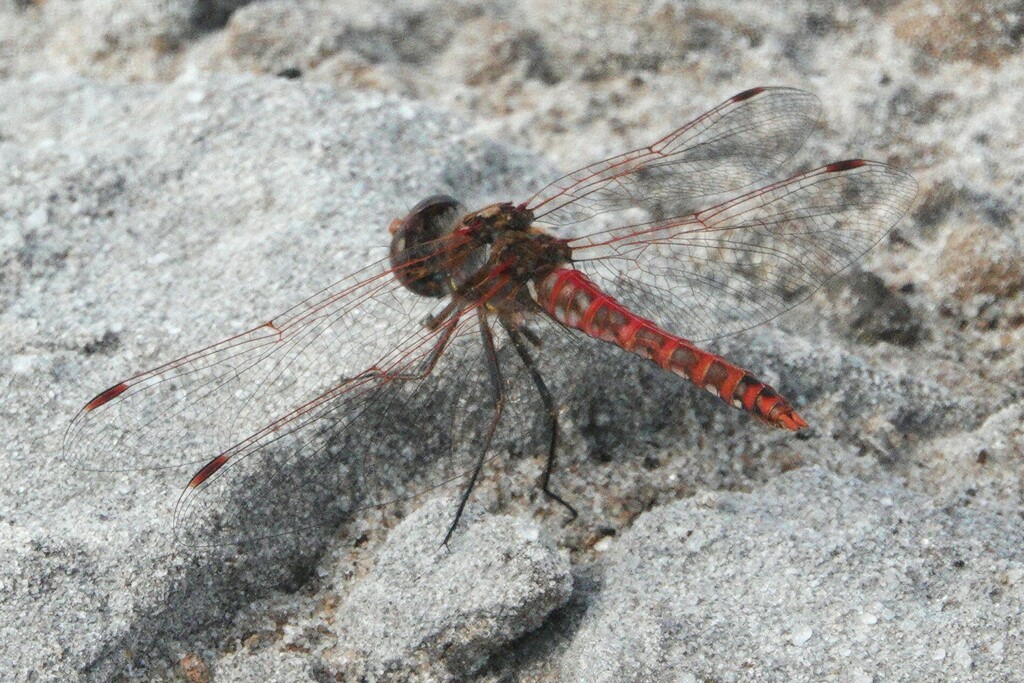
(c) Claire Herzog, some rights reserved (CC BY) · licence
Family: Libellulidae · Class: Insecta · Order: Odonata
Sympetrum corruptum (Variegated Meadowhawk) is a California animal in the Libellulidae family.
The Variegated Meadowhawk is a medium-sized dragonfly belonging to the family Libellulidae. Males measure approximately 32-36 mm (1.3-1.4 inches) in body length with wingspans reaching 65-75 mm (2.6-3.0 inches). Males display distinctive reddish coloration on the abdomen and thorax, while females exhibit more muted brown and yellow tones with less pronounced red markings. The species is characterized by clear wings with amber or yellowish patches at the base, and prominent yellow or amber wing veins. The face is typically reddish in males and pale yellow in females, with large compound eyes that meet at the top of the head. Sympetrum corruptum has one of the most extensive ranges of any North American dragonfly, occurring from southern Canada through most of the United States and into Mexico. According to NatureServe, the species is found across western North America from British Columbia and Alberta south to California and New Mexico, and eastward across the Great Plains and into parts of the eastern United States. In California, the species occurs throughout much of the state, from coastal areas to inland valleys and mountainous regions, typically at elevations from sea level to approximately 2,400 meters (7,900 feet). This highly adaptable species inhabits a wide variety of aquatic environments, including ponds, lakes, slow-moving streams, irrigation ditches, stock tanks, and temporary pools. Adults are commonly found in open areas such as fields, meadows, agricultural lands, and urban parks. The species demonstrates broad tolerance for different water qualities and can exploit both permanent and ephemeral water bodies. Nymphs develop in shallow, often weedy waters where they feed on small aquatic invertebrates. Variegated Meadowhawks are notable for their migratory behavior, particularly along the Pacific Coast. According to the Migratory Dragonfly Partnership, large numbers migrate southward through coastal Washington and Oregon during fall months, with peak activity typically occurring in August and September. Adults are opportunistic predators, capturing flying insects including mosquitoes, midges, flies, and small moths. Males establish territories around suitable breeding sites, perching on vegetation or bare ground while defending their areas from rivals. Mating occurs during flight, followed by egg-laying where females deposit eggs in shallow water or moist soil near water edges. The species can produce multiple generations per year in warmer climates, with development from egg to adult taking approximately 6-8 weeks under favorable conditions. Conservation status for Sympetrum corruptum is currently secure, with NatureServe assigning a global rank of G5, indicating the species is secure and widespread. The species faces no immediate conservation threats and appears to be benefiting from human-created habitats such as irrigation systems and constructed ponds. Climate change may potentially affect migration patterns and breeding timing, but the species' adaptability and broad habitat tolerance suggest resilience to environmental changes. The Variegated Meadowhawk serves as one of five focal species for citizen science monitoring through the Migratory Dragonfly Partnership, which tracks dragonfly migration patterns across North America.
Classification
Class: Insecta · Order: Odonata · Family: Libellulidae
Frequently asked questions
How is Sympetrum corruptum classified?
Sympetrum corruptum belongs to class Insecta, order Odonata, family Libellulidae.
What family does Sympetrum corruptum belong to?
Sympetrum corruptum is in the Libellulidae family.
What is Sympetrum corruptum?
The Variegated Meadowhawk is a medium-sized dragonfly belonging to the family Libellulidae.
Is Sympetrum corruptum found in California?
Yes. Sympetrum corruptum is recorded in California in The California Species Project's catalogue.
Related species
Other California species in the same genus, family, or bioregion.
Data from The California Species Project — 14,000+ California species with verified data from CNPS, CDFW, USFWS, and more.