Sympetrum madidum
Red-veined Meadowhawk
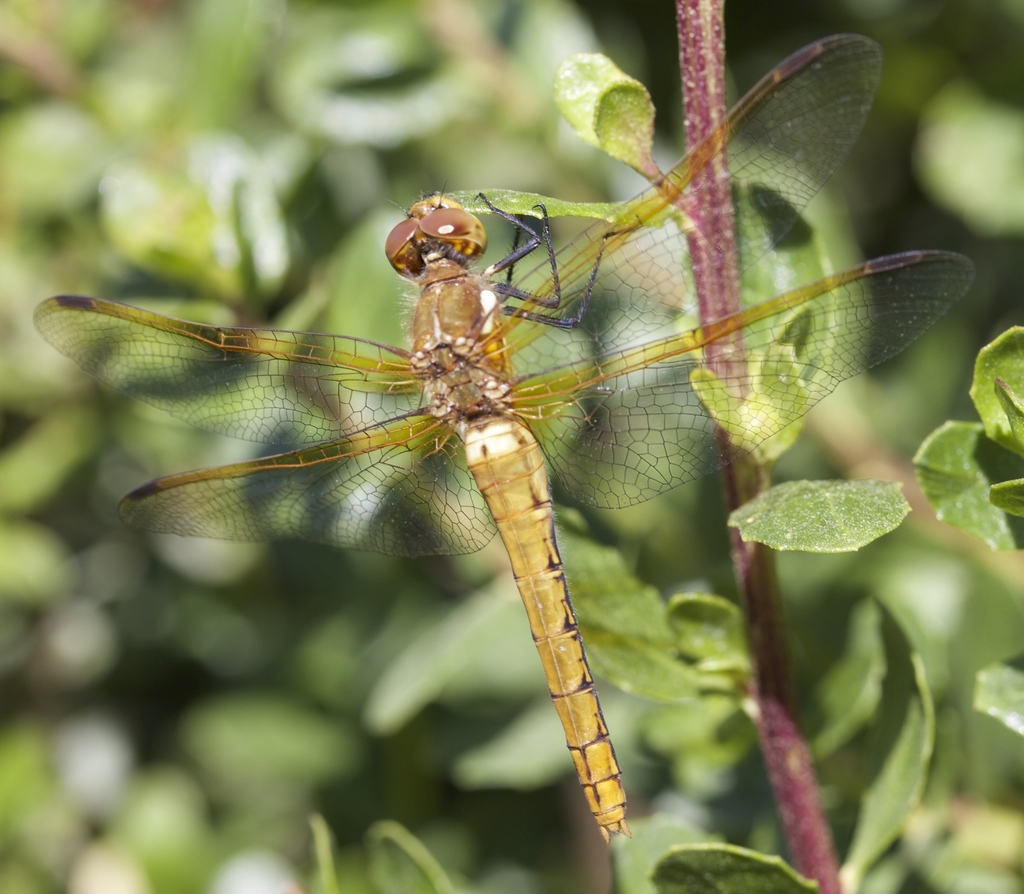
(c) John Hibbard, some rights reserved (CC BY) · licence
Family: Libellulidae · Class: Insecta · Order: Odonata
Sympetrum madidum (Red-veined Meadowhawk) is a California animal in the Libellulidae family.
The Red-veined Meadowhawk is a medium-sized dragonfly in the family Libellulidae, subfamily of skimmers. Adults measure approximately 25-30 mm (1.0-1.2 inches) in body length with a wingspan of 60-70 mm (2.4-2.8 inches). Males display bright red coloration on the abdomen and thorax, with distinctive red veining in the wing membranes that gives the species its common name. The thorax features pale stripes, and males exhibit jagged black markings on the sides of the abdomen. Females are generally brown to reddish-brown with a dark longitudinal stripe along the sides of the abdomen and similar pale thoracic striping (Xerces Society 2013). The Red-veined Meadowhawk occurs across western North America, with documented populations from British Columbia south through California and east to Montana. In California, the species has been recorded from multiple counties including San Luis Obispo County along the central coast (BugGuide 2005). The species also occurs in Montana, where it inhabits sedge meadows at elevations around 1,500 meters (4,900 feet) in areas such as Cable Creek in Deer Lodge County (BugGuide 2010). This species inhabits a variety of wetland environments including ponds, marshes, slow-moving streams, and sedge meadows. Red-veined Meadowhawks prefer areas with emergent vegetation and are commonly found in montane and foothill regions. They utilize standing or slow-flowing water bodies for reproduction and larval development. Adults are often observed perching on vegetation near water sources, particularly sedges and other emergent plants. Red-veined Meadowhawks are aerial predators that capture prey in flight using their spiny legs arranged in a basket-like configuration. They feed primarily on small flying insects including flies, mosquitoes, midges, and other soft-bodied insects. Like other meadowhawks, they employ both hawking and gleaning feeding strategies, either catching prey during continuous flight or from perched positions. The species exhibits typical dragonfly reproductive behavior, with males establishing territories near breeding sites and females depositing eggs in aquatic vegetation or substrates. Flight period varies by elevation and latitude but generally extends from late spring through early fall, with peak activity during summer months. The Red-veined Meadowhawk does not appear on federal or state endangered species lists as of December 2025. However, like many wetland-dependent species, it may face localized threats from habitat loss due to wetland drainage, water diversions, and climate change impacts on mountain snowpack and seasonal water availability. The species' dependence on specific aquatic habitats makes it potentially vulnerable to alterations in hydrological patterns. Population trends and conservation status require further study, as comprehensive surveys of meadowhawk populations across their western range remain limited. Habitat conservation efforts focused on maintaining wetland ecosystems and natural water regimes benefit this species and other aquatic insects.
Classification
Class: Insecta · Order: Odonata · Family: Libellulidae
Frequently asked questions
How is Sympetrum madidum classified?
Sympetrum madidum belongs to class Insecta, order Odonata, family Libellulidae.
What family does Sympetrum madidum belong to?
Sympetrum madidum is in the Libellulidae family.
What is Sympetrum madidum?
The Red-veined Meadowhawk is a medium-sized dragonfly in the family Libellulidae, subfamily of skimmers.
Is Sympetrum madidum found in California?
Yes. Sympetrum madidum is recorded in California in The California Species Project's catalogue.
Related species
Other California species in the same genus, family, or bioregion.
Data from The California Species Project — 14,000+ California species with verified data from CNPS, CDFW, USFWS, and more.